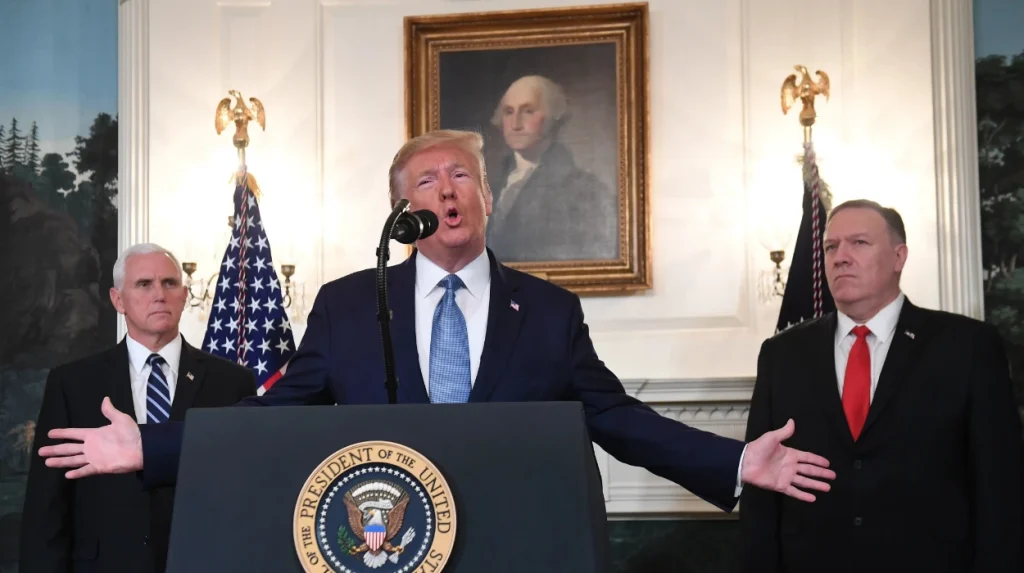
The Trump second administration is starting 2025 that has a speedy, unilateral foreign policy and a transactional worldview. The White House has anchored its policy on the end of the endless wars, which have been reiterated severally on the lips of the president in speeches, as it has been backed by the orders to reduce US participation in major world conflicts as quickly as possible. This change is a departure of models of engagement over the decades built by sluggish coalition-building and multilateral diplomacy.
According to senior officials, the policy is a realism-oriented policy based on American interests. It is based on solidified positions on negotiation, leverage of military power, and redefining of the U.S. global priorities. According to analysts in the wake of the administration, the foreign policymaking process has been centralized to just a small group of advisors who have been known more to be loyal rather than to have background credentials in foreign policy, something that makes it easier to make decisions and less scrutinizing to their colleagues.
The political calculations are also manifested in the focus on speed. The administration wants public markers of progress in conflict resolution before the next election, and diplomatic successes represent the demonstration of a smarter and more aggressive American stance. However, this strategy puts the United States at a set of trade-offs between geopolitics, particularly in situations where long-term partners are uncomfortable with sudden changes in policy.
Rapid Conflict Resolution: Aspirations And Obstacles
The most outrageous statement made by the administration is that it plans to end the war in Ukraine and Russia by speeding up the negotiation process. President Trump has mentioned on several occasions that peace can be achieved within 24 hours, and this has aroused doubt among the European allies who fear the repercussions of that haste. Washington diplomatic signs indicate that it was willing to sign a ceasefire agreement sacrificing some of its territory to Russia, but urging Ukraine to take equivalent conditions that would stabilize the situation in the nearest future.
This strategy is a representation of how the administration perceives realism, where the conservation of American resources is put before regional security in the long-term perspective. Nonetheless, the representatives of Warsaw, Berlin, and Brussels are warning that such compromises may only empower Moscow, undermine NATO unification, and establish precedents of coercive territorial revisionism. The geopolitics of risk is that the stabilization of one conflict will come at the cost of the flashpoints in the future, and Russia may once again have influence in the eastern part of Europe because the western unity will be tearing.
Middle East Maneuvering And Military Calculations
The U.S. approach in the Middle East incorporates a two-track policy with the use of force and negotiation. The airstrikes of Iranian nuclear infrastructure in June of 2025 showed that the administration is ready to use military force without prolonged diplomatic preparation. About the same time, U.S. representatives were able to negotiate a ceasefire and a hostage-release deal between Israel and other regional countries.
These fast actions demonstrate how the administration felt that bold actions could open up diplomatic opportunities. But the policy has some contentious suggestions, including the resettlement of displaced Palestinian people and the restructuring of Gaza as an international special economic zone. Humanitarian agencies and the governments of the region caution that such notions may lead to the destabilization of relations with Jordan, Egypt, and Qatar, where the general opinion is already tender to forced population migrations.
Western Hemisphere Security And Expanding Priorities
The shift by the administration toward the Western Hemisphere can be seen in the draft 2025 National Defense Strategy as the drug cartels and cross-border crime are ranked on the same level with traditional geopolitical threats. Several U.S. naval operations in the Caribbean and eastern Pacific indicate the reincarnation of what some scholars have termed as a retrogression to gunboat diplomacy, to exercise American power to break the smuggling rings.
The fact Washington has chosen to declare many drug cartels as terrorist organisations is a stretch of defining national security. On the one hand, the policy is supported by domestic governments; on the other hand, the several Latin American governments state that the naming will increase violence and drawbacks in bilateral security cooperation. These strains underscore the difficulty of implementing counterterrorism models on criminal cells that are integrated into weak political frameworks.
Underlying Themes Of Realism, Hard Power, And Strategic Isolation
The process of foreign policy making has been reduced to a limited group of advisors who are acting beyond the established institutional framework. This brings in focus of purpose but less multiplicity of opinions, which has always informed key decisions in diplomacy. Analysts note that career diplomats are less influential in the formulation of negotiations, which restricts the institutional memory to handle sophisticated conflicts.
This centralization strengthens a policy culture in which short-term results are superior to long-term consistency. It helps to make deals quicker and can ignore regional dynamics that have historically guided U.S. engagement policies. The effect is further enhanced by the lessened cooperation with the multilateral institutions and the administration has limited its involvement in various multilateral programs such as development programs that used to be employed to strengthen American influence.
Soft Power Retreat And Global Leadership Shifts
Reductions in organizations such as USAID and Voice of America are indicators of a shift in approach towards soft power instruments. China and Russia have rapidly grown their presence in places where U.S. withdrawal is most apparent, providing financial support of infrastructures, security organization, and influence campaigns with information.
Surveys of the public opinion published at the beginning of 2025 indicate that the world is losing its trust in the leadership of Washington, especially in Africa, Southeast Asia, and some areas of Latin America. The development-oriented foreign policy of China is perceived by many of the respondents as an alternative stabilizing factor, and this trend is a long-term challenge to the U.S. geopolitical competition.
Strategic Risks Embedded In Rapid Gambits
The effort to stop the conflicts within a short time has serious structural risks. Peace agreements made under duress might not have mechanisms that keep the parties at peace, particularly in areas where power is unequal. Ukraine, Gaza, and some Latin American states represent the cases of the setting where a temporary peace may blur unsettled territorial or political scores.
Transactional contracts also bring in the question of permanence. Spouses might doubt that these commitments will be upheld under a new administration and this will diminish motives to compromise or collaborate. The tense response of European and Asian partners to some U.S. words at the beginning of 2025 reflects the increasing concern with the predictability of strategy.
The designations made and military activities practiced unilaterally also complicate the diplomatic scenery. Actions like the declaration of drug cartels as terrorist groups threaten to divide the security relationships, whereas any form of selective interaction with other opposing forces would produce unintended geopolitical alliances. Such dynamics highlight that implementing a sudden conflict resolution process poses a dilemma of compromising the stability at a larger scale.
Balancing Opportunity And Uncertainty
The 2025 foreign policy of Trump echoes an unmistakable strategic rationality: less American involvement in the protracted conflicts and negotiating as a strong party, as well as to restore national interests with the least compromise. A number of results such as the Gaza ceasefire and the hostage negotiations show the possible advantages of unconventional diplomacy that needs to be performed with haste.
Yet the durability of these achievements depends on frameworks not yet fully defined. The administration must reconcile the appeal of rapid de-escalation with the structural complexity of modern conflict environments, where political identities, territorial claims, and regional power struggles cannot be reshaped through speed alone. Whether the pursuit of ending endless wars evolves into a sustainable doctrine or accelerates geopolitical volatility remains a defining question shaping the strategic landscape of 2025 and the years ahead.