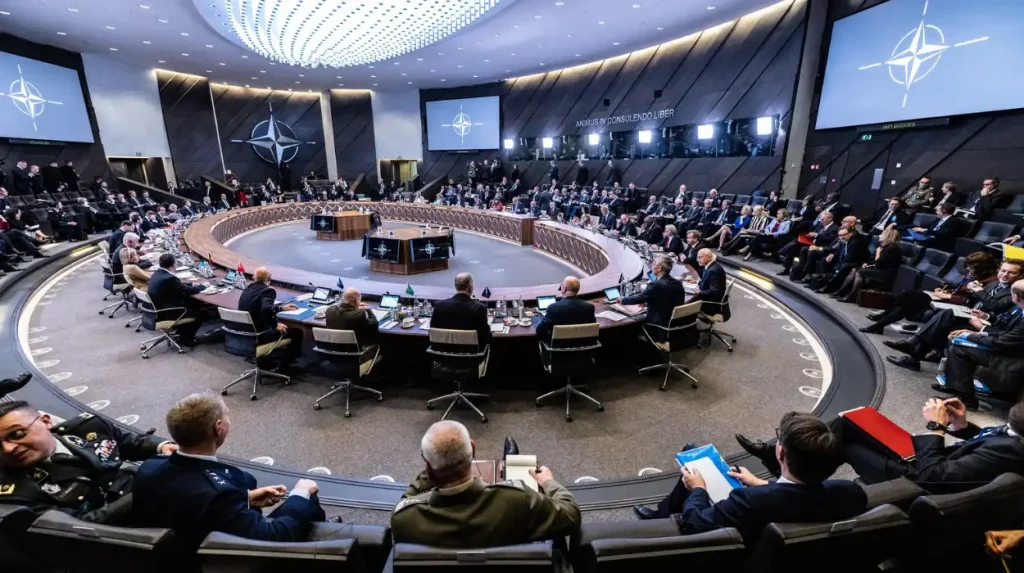
The change in the priorities of US defense spending in the second term of President Trump has changed the internal balance of NATO and questioned the old beliefs about equal input. The relative imbalance between the American and European defense spending has been part of the alliance since the cold war period.
By 2023, the United States had contributed approximately 69 percent of the total defense expenditure in NATO, which continued to prompt Washington to continually request increased burden-sharing. This is the pressure that was more pronounced in 2025, as new US defense allocations were made towards Indo-Pacific engagements and modernisation initiatives. The change produced new momentum in the urgency of the European states to match the political and capability demands that were established in the 2025 Hague Summit, where the leaders resolved to substantially redefine the pace of defense expenditure thresholds.
Rising Targets And Political Pressure
The shift towards a 5 percent GDP expenditure target in 2035 was the largest increase in the burden-sharing presumptions in NATO since the emergence of the alliance. The US authorities orchestrated the rise as a necessary correction to the situation, citing that the current 2 percent standard failed to reflect the current levels of threats. The demand was further reinforced with the statement by President Trump that Article 5 protections can be conditional on the contributions to be made fairly, further making European capital cities dependent on political outcomes.
Transformation Of Strategic Priorities
The new objectives are in line with the increased US efforts to counter the modernization of the Chinese military. The European allies have the responsibility of defending the region at the moment as Washington intensifies its Indo-Pacific position. It is the balance of this balance that highlights the inter-relationship between US and European security commitments, showing the influence that American spending priorities have on NATO cohesion.
Implications For Collective Deterrence
The increased targets indicate greater deterrence to frontline states that are adjacent to Russia. Nonetheless, the magnitude of the commitment poses a concern of whether every member state is able to maintain the financial demands and this may cause fractures in case the burden is not fairly shared.
Economic Constraints And Defense Financing Challenges
The fiscal burden of achieving the 5 percent goal is high, especially to those states which already have a fiscal strain. Some of its members such as Italy and France went into 2025 with large debt-to-GDP values and poor fiscal maneuverability. The short-term room of defense expenditure was obtained by the suspension of the constitutional debt of Germany but the uncertainty about the affordability remained in the long run.
Divergent National Capacities
The increased differences between economically sound and financially stressed members makes alliance cohesion a hard task. Eastern European countries, despite their positive attitude to raising commitments under the influence of the closeness to Russia, do not possess the industrial base that would allow developing the military quickly. Poorer states, on the other hand, have competing priorities within their country, and therefore steady annual growth is a hot-potato politically.
Inflation And Defense Procurement
Inflation in the defense sector, which is always higher than the general inflation, reduces the purchasing power. The processes of procurement in Europe are slow which brings the issue that substantial spending does not necessarily result in corresponding enhancement of capacity. These pressures increase dependence on the US defense supply chains, increasing the strategic dependence at a time when NATO seeks to have a more balanced burden-sharing.
Alliance Capability Gaps And Strategic Reorientation
The capability gaps are one of the primary sources of the burden-sharing discussion in NATO. The defense position of the alliance is more and more reliant on hi-tech technologies, such as high-speed missiles, unmanned systems, and cyber capabilities. US investment is booming strongly in these areas, but many European states have lagged years behind in terms of procurement, integration, and training.
Modernization Pressures In A New Threat Environment
The presence of Russia in Ukraine as of 2025 has supported the necessity of high-readiness forces and long-lasting ammunition stocks. Some of the leaders such as the president of Finland Alexander Stubb pointed out that new spending targets should represent realistic, deployable military forces and not showcase budgetary targets.
The focus of the United States on the Indo-Pacific issues also has an impact on the orientation of NATO. With Washington hoping to overcome the military build-up of China, Europe is left with more to do with the deterrence tasks in the region that were formerly overly dependent on the American presence. This reform can reinforce NATO on the European front and yet it places more pressure on individual governments to seal capacity gaps in a short period of time.
Operational Readiness And Training Demands
The rates of rapid expenditure demand the corresponding enhancement of military training and preparation. In early 2025, NATO evaluations revealed that there were enormous gaps in the member states in terms of logistics infrastructure, command structures, and staffing capacity. These are important operational factors that have been essential to burden-sharing yet they are skewed even to states that have reached the 2 percent target.
Political Tensions And Alliance Solidarity
The political turnover of the US Defense Spending is not just a balance sheet issue. The transactional nature of Trump to commitments in alliances has remained uncertain particularly among the European members who fear the conditions that accompany Article 5. The attitude of the US that there will be an evaluation of its commitments on the basis of national rates of expenditure is another tier of political tension in the alliance.
Impact On Transatlantic Trust
Belief is another key tenet of NATO unity. Governments in Europe have been worried that sudden change in the US policies may complicate its long term planning. The updated US National Defense Strategy of 2025 focused on flexibility in both partnerships and regional autonomy, which justifies the belief that Washington anticipates that European nations will become more self-reliant.
Strategic Autonomy Debates In Europe
This climate has again brought about debate at Brussels on European strategic autonomy. Although the majority of the members attest to the primacy of NATO, the European Union has been pace setters in defense projects, especially that of procurement coordination and swift response. A tradeoff of these endeavors with NATO needs will be the architecture of security within the continent in the next decade.
The Future Of NATO Burden-Sharing Under Uncertain Trajectories
NATO faces opportunities as well as threats in the changing environment influenced by the US Defense Spending Shifts. The increase in standards of spending can be used to enhance collective defense, but its sustainability suggests the strength of political unity, industry, and the legitimacy of application.
A different fiscal reality of the member states creates doubts as to whether a standard 5 percent target can be met without putting pressure on the cohesion of the alliance. However, the increased attention to the development of capabilities and deterrence is indicative of a more general awareness that the security environment of NATO has shifted radically since 2014.
It is in the future that the alliance will be tested by the way forward to continue to be in solidarity and in the process be able to accommodate the various national interests as well as economic limitations. The result of these changes can be the identity of NATO itself more than any other transformation as 2035 approaches and one can take a closer look at how alliances shift as balance of power in the world and internal demands on the nation transform long-established expectations.