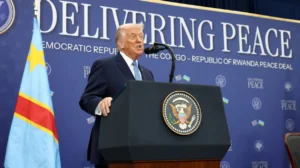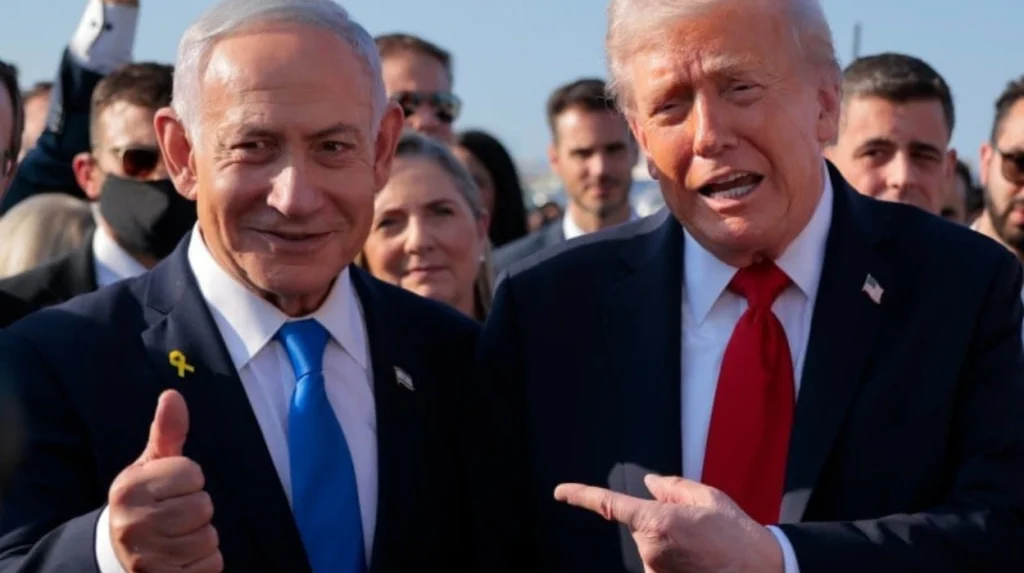
A historic ceasefire in Gaza was declared in September 2025 after months of strenuous negotiations by the U.S. The proposal was generally known as Trump 20-point Gaza peace plan and aimed at ending months of tensions by a comprehensive plan covering ceasefire, exchange of prisoners, demilitarization of Gaza and an international stabilization process. The plan was unveiled by the Israeli Prime Minister Benjamin Netanyahu and the U.S. President Donald Trump together in Jerusalem and termed it a new era of peace.
The United States under the arrangement sent a small number of troops to Israel to help in monitoring the ceasefire, a remarkable degree of personal intervention in the post-conflict management of the region. The plan also put forward transitional governance of Gaza by a group of Palestinian technocrats under international supervision with the eventual move to self-governance. However, since its establishment, analysts have referred to the accord as structurally unsound because of the vested political asymmetries and distrust that characterize the Israel-Palestine conflict.
The implementation of the plan encountered numerous obstacles on several levels: partial cooperation of Hamas in disarmament, reluctance of Israel to make complete territorial concessions, and the doubt of the rest of the region of the U.S. led peace efforts after the years of apparent prejudice.
The Special Relationship: Strategic Shield And Political Leverage
Strategic relations between Israel and the United States have characterized Middle Eastern geopolitics for more than seventy years. The relationship has grown to be an invaluable pillar of Israeli security machinery based on joint democratic principles, cooperation in intelligence and military support. Washington offers Israel about 3.8 billion annually in military aid, and regular diplomatic safeguard in world forums like the United Nations.
This entrenched alliance acts as a political protective mechanism that enables Israel to exercise aggressive security policies with impunity to global criticism. The congruence, as well, limits the role of Washington as a mediator in the Israeli-Palestinian war.
Netanyahu’s Political Calculus And American Cover
It is well-summed up by the ideological dogmatism that is still characteristic of Israeli politics: the statement by Prime Minister Netanyahu in 2025, that there would be no Palestinian state under his leadership. Although this position has been criticized on the international level, it has been mostly shielded by the alliance between the U.S. and Israel. American political support gives the administration of Netanyahu the confidence to adopt a hardliner stand on matters touching on territories as well as sovereignty especially on the Gaza and the West Bank.
According to the 2025 assessment provided by Foreign Policy, the situation with this conflict can be changed only by a dramatic change in the relationships between the U.S. and Israel. It was argued in the analysis that the strategic and ideological character of the partnership is useful in mitigating the external pressure to make the policy change so that Israel can have wide freedom of operation.
Humanitarian And Governance Challenges In Gaza
The humanitarian cost of the Gaza war continues to be disastrous. Following the ceasefire, there were reports of exacerbated food, medicine and electricity shortages in October of 2025 reported by the United Nations Relief and Works Agency (UNRWA). There are still thousands of displaced citizens who are still residing in temporary shelters and the reconstruction efforts are still slow as a result of political wrangles and logistical blockades.
The Transitional Governance Dilemma
The transitional government suggested in the peace plan, headed by the Palestinian technocrats, and controlled by an international stabilization force was meant to guarantee neutrality and peace. This process has however been eroded by Hamas not wanting to disarm totally. The organization still has localized control of strategic locations and has not been cooperative with some international scrutiny systems. This partial obedience has made the governance in Gaza disjointed and vulnerable to new instability.
The Ongoing Humanitarian Crisis
The health services are also on the brink of being overstretched and the hospitals work below capacity and are also greatly dependent on foreign assistance. The 2025 post-conflict report issued by the World Health Organization estimated that one out of three Gazans is exposed to acute food insecurity. Humanitarian corridors are also debatable and aid convoys are often held up by border restrictions that are an aspect of Israeli security measures. Such a delicate nature of the balance between the aid provision and the political control demonstrates the complications of the peace enforcement in the destroyed land.
Stakeholder Perspectives And Regional Geopolitics
There has been concerned optimism as well as strategic skepticism on the part of the regional players. Qatari Prime Minister Mohammed bin Abdulrahman Al Thani commented that the ceasefire is just a start and that justice and sovereignty should follow. His words mirror the general worry of the Arab world that the temporary peace without political solution is likely to institutionalize occupation and inequality.
When Trump was defending his peace plan, he insisted that Gaza will turn into a terror-free zone that will be watched by the international community. The strategy of his administration has focused on deradicalization and economic reconstruction but has been criticized to ignore Palestinian aspiration of statehood.
Domestic Divides Within Israel And Palestine
Within Israel, there is still strong polarization within the opinion of the people. The ceasefire is perceived by many citizens as a required gap but one that cannot last long unless Hamas is fully demilitarized. According to polls carried out by Haaretz in October 2025, 58 percent of the Israelis think that within a year, there is a high likelihood of a renewed conflict.
The distrust by Palestinians of international supervision is still there. Faith in the diplomatic processes is still low with daily life being still characterised as a scarcity and trauma. The transitional governance system, which many individuals believe was foisted by the west, has not helped much to regain political legitimacy as well as confidence.
The 2025 peace plan geopolitically has strengthened the U.S. and Israel hegemony in the diplomatic arena of the region. Other Arab countries such as Egypt and Jordan have taken up friendly but wary positions with border security and humanitarian access being their priorities. In the meantime, European countries are pushing for a two state solution, and insist that long term grievances of territorial integrity, refugees and sovereignty grievances must be addressed to prevent the constant cycles of violence.
The Fragility Of Gaza Peace And The Path Forward
The Gaza ceasefire of 2025 reveals the possibilities and constraints of U.S. diplomacy. Although the accord put a temporary end to hostilities, it can only last as long as there are structural transformations to the Israel-U.S. strategic paradigm. The special relationship has continued to be the pivot around which a significant portion of the political inertia in the conflict revolves.
Analysts caution that peace will continue to be only episodic unless this alliance is recalibrated in line with short-term military and political aims. The U.S. policy of ensuring the security of Israel has long been consistent, but in many cases, has been at the cost of adopting an approach that would mitigate the causes of Palestinian disenfranchisement. This inequity continues to build mistrust and lack of confidence by the international community on the peace process.
Peace in Gaza is not about ceasefire technology, but also the redefinition of strategic imperatives, which perpetuate the status quo. To find a lasting solution to the problem, it is important to understand that the notion of true stability cannot co-exist with incessant asymmetry.
The 2025 peace plan geopolitically has strengthened the U.S. and Israel hegemony in the diplomatic arena of the region. Other Arab countries such as Egypt and Jordan have taken up friendly but wary positions with border security and humanitarian access being their priorities. In the meantime, European countries are pushing for a two state solution, and insist that long term grievances of territorial integrity, refugees and sovereignty grievances must be addressed to prevent the constant cycles of violence.