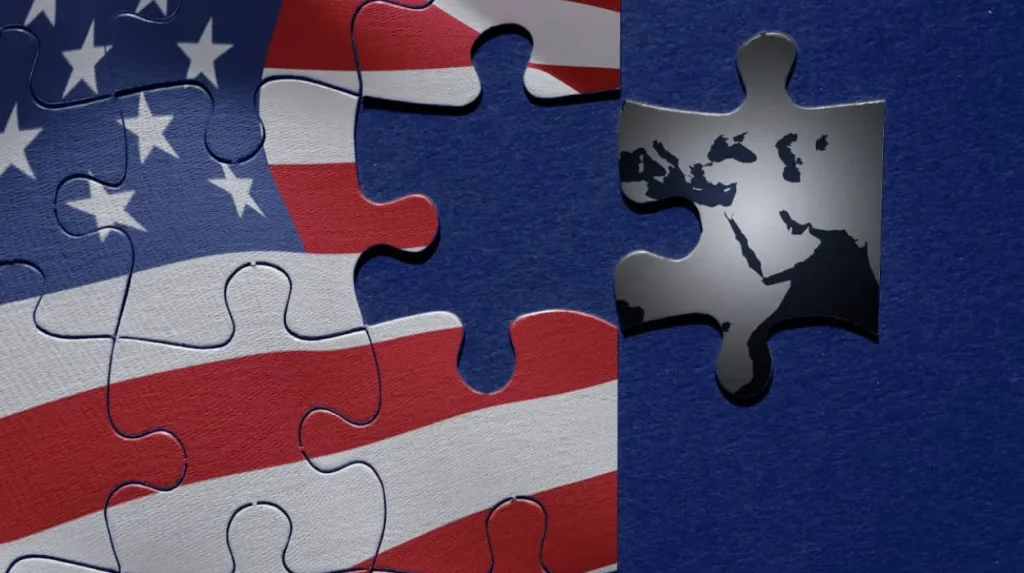
In 2025, U.S. foreign policy balances global leadership and sovereignty. Trump’s “America First 2.0” reframes engagement to pressure rivals like Russia and China while stressing national interests. Yet despite his rhetoric, long-standing alliances and institutional frameworks continue to shape Washington’s choices and sustain America’s foreign policy direction.
The irony is the double nature of the alliances: they are simultaneously instruments of influence and sources of constraint. US commitments to Israel, NATO, and Gulf states, to mention a few, usually limit the administration to pivot unilaterally. For example, the annual $3.8 billion in military aid to Israel persists in the face of mounting international criticism of Israeli operations in Gaza, which numerous US legislators and international organizations have characterized as potential violations of humanitarian law. America’s stance on this conflict is still tightly tied to alliance allegiance and not simply an independent evaluation.
These entanglements question whether US foreign policy can really be independent when alliance commitments create political, diplomatic, and military demands that exceed short-term national interests.
Balancing autonomy and alliance maintenance
A key theme in the Trump administration’s foreign policy is burden-sharing pressuring allies to assume greater responsibility for their defense and regional security. This principle has reemerged in NATO relations, where the US demands that European states meet their 2% GDP military spending targets. The goal is to ease Washington’s financial and military burden while preserving its strategic influence.
Yet partners tend to have their own agendas, and contradictions are the result. US backing for Gulf allies like Saudi Arabia and the UAE persists in the Middle East in spite of regional policies from time to time deviating from American interests, such as unilateral actions in Yemen or Libya. These trends can lead the US into entanglements that complicate larger regional diplomacy.
US policy towards Israel provides another parallel case. Though the friendship is still core to American Middle East policy, increasing outrage in the Democratic Party about Israeli settlements and civilian deaths in Gaza has caused internal tension. Even within the current administration, backing of Israeli military campaigns goes largely uncontested because of the alliance’s weight of history and strategic imperatives despite growing domestic opposition.
Legislative divides and ethical friction
Congress follows suit. Progressive members of Congress have grown louder in calling for renewed scrutiny of military aid packages and bringing US foreign policy into line with human rights values. Measures to condition aid to Israel or reconsider military assistance to repressive governments have won some backing, though none have thus far overcome bipartisan opposition.
Simultaneously, classic bipartisan backing for alliance systems is firm. Most lawmakers continue to view NATO, the Indo-Pacific Quad, and Gulf alliances as pillars of international order. This consensus makes it difficult to implement reforms that value policy autonomy, especially when such reforms imperil traditional strategic partnerships.
Domestic political pressures and policy shifts
US foreign policy continues to be extremely responsive to domestic political forces. During the current term, the Trump administration has shifted funding for foreign assistance to support immigration enforcement and homeland security, reinforcing campaign agendas. Transfers of budgetary priorities impact diplomacy and development work, diminishing the US capacity to shape foreign environments without the military.
Furthermore, interest groups also have significant influence on Congress. Defense contractors, fossil fuel interests, and pro-Israel lobbies frequently dominate the legislative agenda, generating structural inertia that discourages sudden changes in policy. This power limits flexibility even when public polls indicate an interest in increased independence or a change in strategy.
The consequence is usually a reactive, not proactive, foreign policy. Even as public opinion around the world changes, the US is still bound to alliance stances and domestic constituencies that circumscribe the administration’s freedom of action.
Public opinion and foreign entanglements
Surveys in 2025 indicate rising skepticism in America regarding extended foreign commitments, especially in conflict areas. Public approval for US military engagement overseas has been decreasing, particularly among younger voters, who prioritize diplomacy, climate cooperation, and multilateralism.
However, these inclinations seldom get translated into policy change because of the US political system’s setup. Electoral cycles, lobbying, and embedded narratives about leadership and security all keep commitments in alliances in place. The disconnect between public preference and foreign policy practice shows the intricacy of untangling national autonomy from alliance expectations.
Geopolitical competition and multilateral engagement
In its global positioning, the US continues to be engaged in strategic competition with China and Russia. The Biden administration had been trying to do multilateral coalition-building to address Beijing and Moscow in the past, whereas Trump 2.0 has focused on bilateral leverage and military posturing.
Still, the structural dilemma persists, since the US has to address rising powers, while also pursuing a type of global hegemony. To do so, Washington has to rely on allies, which can be a difficult balancing act, particularly in the Indo-Pacific region, where approaches such as AUKUS and the Quad will be integral in restricting China’s regional growth. This deeper reliance on allies generates the contradiction that the US must face: the more the US depends on allies (for a strategic presence), the less ability the US can maintain complete autonomy from its allies, in determining foreign policy on its own.
The Ukrainian conflict also reveals the limits of independence. While the US keeps on providing Kyiv with aid and arms, European interests and NATO obligations determine the scope and character of American engagement. Any action to diminish assistance would provoke instant diplomatic repercussions and undermine transatlantic confidence.
Institutional dependence and global order
The post World War II international order, shaped to a great extent by the US, now operates as both a tool and a limitation. Organizations such as NATO, the IMF, and the World Bank ground the US in rule-governed systems calling for consensus, compromise, and continuity. Although these institutions project greater US power, they also weaken untrammeled freedom of action.
This background has prompted demands from nationalist intellectuals and certain policymakers to cut back dependence on institutions. But the difficulty is how to do it without compromising leadership and filling vacuums that contenders can exploit.
Political analysts like Rnaud Bertrand have argued that contemporary US foreign policy needs to walk a fine balance between defending strategic partnerships and reasserting room for national discretion.
In 2025, US foreign policy is finding itself confronted with issues of autonomy, defined in the context of interdependence, commitments, and strategic imperatives that are best understood not as a binary switch, but rather on a continuum. Washington must balance the complexity of interdependence without losing the values and interests that define its position in the international order. As rising powers exert political power while global crises multiply, continuing to act independently but responsibly remains the challenge for the next chapter of American global leadership.