In 2025 in the Middle East, the policy of President Donald Trump has already acquired a high stakes character with broad economic alliances, surgical military intervention, and chronic diplomatic myopia. The continuity in desire with contradictions in practice has come with his re-election to the white house. As the administration with landmark investment and defense agreements framed U.S relationship with the Gulf countries, the administration exudes power and is strategically minded. But the unstable combination of outstanding tensions, most criticized being those between Iran and Israel as well as the Israeli-Palestinian conflict show a tenuous basis behind such strong headlines.
Deepening Ties Through Economic and Military Leverage
Historic Agreements Across the Gulf
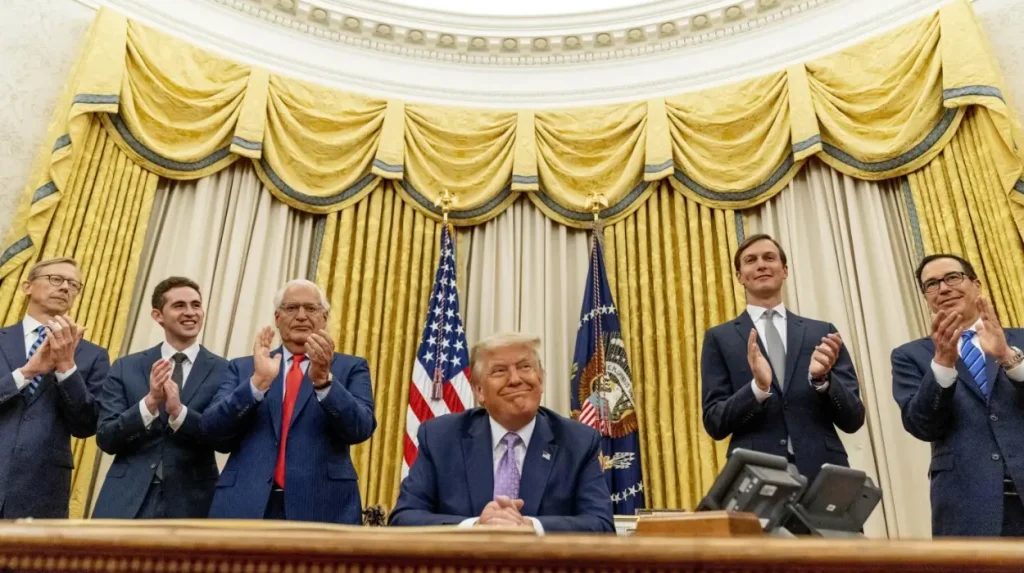
In May 2025 Trump made an historic tour of Saudi Arabia, Qatar and the UAE to finalize economic and defense agreements, worth around 2 trillion dollars. Saudi Arabia made a commitment of $142 billion worth of defense purchases partly followed by a $600 billion commitment of U.S. focused infrastructure and energy products. Qatar consented to buy 96 billion dollars worth of Boeing airplanes and the UAE made a gargantuan 1,4 trillion dollars investment plan centered in the United States real estate market, AI technologies, and clean energy.
These deals are not just ceremonial; they can be described as a foundation of Trump consolidation of the U.S strategic alliances in the Gulf; interdependence in economic terms. The White House was emphasizing that the agreements would create more than a million jobs for Americans, and referred to the plan as: “Jobs for Peace” in its internal paperwork.
The administration of Trump also opened the gateway of technology-corridor of the U.S. to Gulf countries where it includes the most-debatable decision to grant UAE the permission to import half a million Nvidia AI chips per year. The choice by the United States, to circumvent and therefore offset the expanding power of China, is intended to erect a novel hub of AI development, and U.S-loyal digital infrastructure in the Gulf.
Balancing Benefits with Ethical Scrutiny
Despite their scale, the deals have sparked concern in Washington. Reports that Qatar gifted Trump a $400 million luxury jet raised alarms among ethics watchdogs, prompting bipartisan calls for investigation. Senator Elizabeth Warren noted in a Senate hearing that such personal gains “blur the line between diplomacy and profiteering.”
The administration’s economic overtures risk being interpreted as transactional rather than strategic, raising questions about long-term diplomatic coherence. Tying security cooperation to investment packages may yield short-term gains, but critics argue it leaves U.S. foreign policy vulnerable to allegations of impropriety and elite favoritism.
Persistent Flashpoints: Iran and the Israel-Palestine Conflict
Renewed Confrontation with Iran
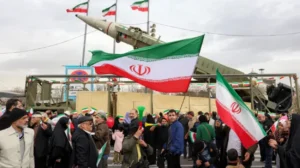
The biggest proof of the strength of the administration came on June 21, 2025, when the U.S. bombed the nuclear apparatus of Iran, hitting the Fordow enrichment plant. This was a move following the intelligence which indicated that Iran had rekindled uranium enrichment at weapons grade as well as sidelining the IAEA in any monitoring efforts.
In response, Iran launched missiles towards the U.S. bases in Qatar injuring 17 American military members and destroying military property. The Supreme National Security Council of Tehran announced the termination of indirect nuclear negotiations with the EU and dismissed the strikes as “an act of war.”
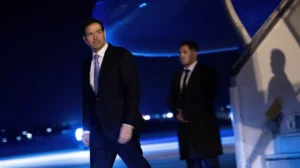
Secretary of State Mike Pompeo justified the operation as the means to “prevent an imminent nuclear breakout,” which was the logic of the first term of Trump. However, European allies faulted this move as uncoordinated as it risked breaking up the other existing avenues of diplomacy.
A Stalled Israeli-Palestinian Process
Although Trump has been attempting to further the Abraham Accords, including Oman and Tunisia in the sphere of normalization relations with Israel, the conflict between the Israelis and the Palestinians has been stagnating. The pro-Israel visions held by the administration have also distanced the Palestinian leadership that does not want to go into negotiations with what it considers to be a biased mediator.
Large parts of the tenuous Israeli-Iranian backed ceasefire in the south of Lebanon (within Gaza) since April 2025 have not withstood. The situation is that no moves have been affected in the direction of a two-state solution. According to the analysts at Carnegie Endowment, any further reckless mishandling of the Palestinian issue will likely cause an outrageous war in the region again as the West Bank settlement growth is being pursued.
A Multipolar Middle East and Shifting Alliances
The Rise of Gulf Regional Leadership
Trump’s approach reflects growing recognition that Gulf states now assert more agency in shaping regional affairs. Qatar has played a key role in mediation talks between Hamas and Israel, while Saudi Arabia continues to lead a coalition to stabilize Yemen. The UAE has increased its presence in Red Sea security through investment in Sudanese port infrastructure, part of its broader bid for geopolitical influence.
Trump has responded by encouraging a model of “regional burden-sharing,” reducing the expectation of direct U.S. military intervention in favor of economic alignment and tech partnerships. Pentagon sources confirm that plans to reduce the U.S. military footprint in Iraq by 3,000 troops are underway, in part to support realignment toward the Indo-Pacific theater.
Strategic Realignment Within U.S. Policy
The 2025 global context shapes U.S. Middle East policy in new ways. With tensions in the Taiwan Strait and continued Russian aggression in Ukraine, the Biden-Trump transition underscored the challenge of balancing global military commitments. National Security Advisor Kash Patel has noted that
“a smaller U.S. footprint in the Middle East doesn’t mean disengagement—it means smarter engagement through allies and assets.”
Domestically, Trump faces a politically divided electorate. A June 2025 NPR/PBS/Marist poll showed 52% of Americans disapprove of his foreign policy. Key swing-state voters express concern over escalating military actions abroad amid inflation and health care anxieties at home.
Peace Rhetoric Versus On-the-Ground Fragility
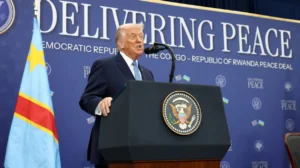
Trump’s post-strike declaration on Truth Social:
“CONGRATULATIONS WORLD, IT’S TIME FOR PEACE!”
was met with skepticism. History has shown that ceasefires following major strikes rarely hold without diplomatic groundwork. Although there is a preferred story of deterrence by the administration, the region is experiencing very delicate balances.
The instability is seen in Israel’s April 2025 attempt to strike down Hezbollah weapons stores in Syria coupled with Iran’s revived proxy practices in Iraq and Yemen. The White House has reiterated that its inflexible policies act as a deterrent but the regional actors are still maintaining gray areas that they test the U.S. and Israeli red lines without direct conflict.
The Strategic Gamble of 2025
The comeback of Trump has restored American interest in the Middle East but under his conditions. The 2025 strategy has a hybrid orientation: it involves the option of building coalitions based on economic advantages, and a high-risk attitude towards the enemies such as Iran. It is ambitious and ventures on shaky grounds.
The leadership has to deal with the consequences of its military involvement, viability of its alliances in the Gulf region, and a world that is becoming highly competitive and divided. The team of Trump might discover that even the most momentous contracts fail to cover the sharp cracks in a place where there is no break in the ring, and any guarantee of permanence is accompanied by the possibility of a complication.
The determination of the history of the Trump policy on Middle East in 2025 will have to be made on whether this strategy becomes lasting regional change or is a temporary adjustment in a precarious equilibrium.