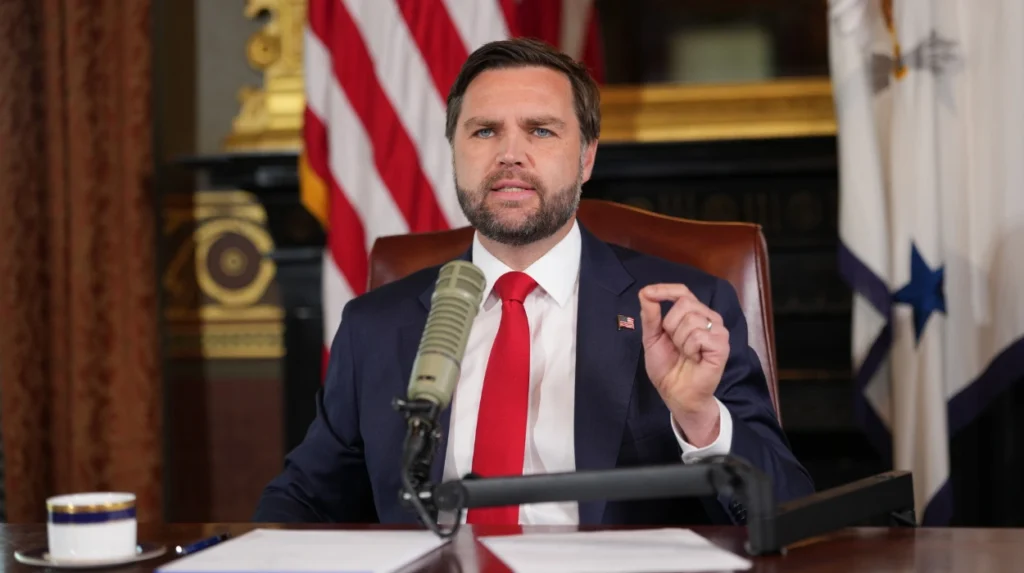
J.D. Vance has increasingly become the central political interpreter of Donald Trump’s foreign policy, particularly as outcomes grow more complex and less predictable. His political identity was built on a blend of skepticism toward foreign interventions and confidence in decisive leadership, yet current developments are testing whether those positions can coexist in practice.
The challenge is not simply about defending policy choices but about maintaining coherence between past promises and present realities. As military actions expand and diplomatic outcomes remain uncertain, Vance is positioned at the intersection of ideology and execution, where contradictions become highly visible and politically consequential.
A harder week reshapes Vance’s political positioning
Recent developments have amplified scrutiny around Vance’s role, as two separate foreign policy tracks have converged into a single narrative of pressure without resolution. Events involving Iran and political shifts in Europe have collectively altered the perception of the administration’s strategic direction.
Iran negotiations collapse under pressure
The breakdown of negotiations between the United States and Iran after extended diplomatic efforts has reinforced the perception that coercive pressure has not delivered the intended results. Talks that were expected to produce incremental progress instead highlighted the persistence of deep structural disagreements.
Vance has been tasked with explaining why intensified military and economic pressure has not translated into meaningful concessions. This responsibility places him in a position where he must reconcile expectations of quick success with the reality of prolonged engagement. The gap between those two realities is shaping how both supporters and critics assess the administration’s approach.
Hungary’s political shift complicates alliances
At the same time, developments in Hungary have introduced an additional layer of complexity. The electoral setback faced by Viktor Orbán has weakened one of the administration’s most symbolically important international relationships.
For Vance, who has been closely associated with promoting ideological alignment with leaders like Orbán, this shift carries broader implications. It suggests that political currents in Europe may not align as consistently with the administration’s worldview as previously assumed, complicating efforts to project a unified international front.
The optics of inconsistency intensify scrutiny
The convergence of these developments has sharpened attention on Vance’s messaging, particularly where it appears to diverge from earlier positions. His role as both advocate and interpreter of policy makes these inconsistencies more visible and more politically significant.
Balancing supporter expectations and policy realities
Vance has long positioned himself as a critic of prolonged foreign interventions, emphasizing the costs and unintended consequences of past conflicts. That stance resonated strongly with a political base seeking a more restrained approach to global engagement.
However, his current defense of military actions against Iran creates a visible tension with that earlier position. While he frames these actions as limited and strategic, the expanding scope of engagement makes it harder to sustain a clear distinction between restraint and escalation. This tension places pressure on his credibility as both a policymaker and communicator.
Narrative control becomes harder to sustain
Maintaining a consistent narrative becomes increasingly difficult as events evolve beyond initial expectations. Claims of controlled and targeted engagement are challenged by the broader regional impact of military actions, including retaliatory measures and ongoing instability.
Vance’s role requires him to present these developments as part of a coherent strategy, yet the absence of clear milestones or outcomes complicates that effort. As a result, the narrative shifts from one of decisive action to one of ongoing management, altering how the policy is perceived.
The Iran contradiction defines the strategic dilemma
The situation involving Iran highlights the central contradiction in the administration’s foreign policy: the attempt to combine assertive action with a commitment to avoiding prolonged conflict. This balance is difficult to maintain as the dynamics of escalation unfold.
From restraint rhetoric to active engagement
Vance’s political messaging has consistently emphasized avoiding unnecessary military entanglements. This perspective was reinforced during the 2024 campaign and remained a key element of his public identity.
The current approach toward Iran, which includes direct strikes and sustained pressure, represents a shift from that framework. While these actions are presented as necessary and limited, they nonetheless mark a transition toward a more interventionist posture. This shift raises questions about how restraint is defined and applied in practice.
Framing military action as limited intervention
To address this contradiction, Vance has emphasized the limited scope and specific objectives of military actions. He has argued that these operations are designed to achieve targeted outcomes without leading to long-term commitments.
This framing seeks to preserve the core promise of avoiding extended conflicts while justifying immediate actions. However, as the situation evolves and responses spread across regions, maintaining this distinction becomes increasingly complex. The line between limited intervention and sustained engagement begins to blur, challenging the effectiveness of this narrative.
Europe and the Orbán setback reshape transatlantic signals
Developments in Europe have added another dimension to the administration’s foreign policy challenges, particularly in terms of alliance-building and ideological alignment. These shifts affect not only policy outcomes but also the broader narrative of international cooperation.
A symbolic loss with broader implications
Orbán’s electoral difficulties carry symbolic significance that extends beyond Hungary. For the administration, they represent a setback in efforts to demonstrate the viability of a broader ideological alignment across national boundaries.
For Vance, this development is particularly significant because of his association with promoting such alignment. The shift suggests that political trends in allied nations may not consistently reinforce the administration’s strategic vision, introducing uncertainty into long-term planning.
Reassessing the international coalition narrative
The broader implication is a need to reassess claims of a cohesive international coalition. Without consistent alignment among partners, the administration’s strategy risks appearing fragmented rather than unified.
Vance’s role in articulating a sense of cohesion becomes more challenging as evidence of divergence accumulates. This dynamic affects not only policy execution but also public perception, as narratives of strength rely heavily on the appearance of coordinated support.
The 2025 policy foundation shapes current challenges
The difficulties faced in 2026 are closely linked to policy decisions made throughout 2025, when the administration established its approach to foreign engagement. Those decisions created expectations that are now being tested under more complex conditions.
Pressure-first strategy carries forward
Throughout 2025, the administration emphasized pressure as the primary tool for influencing adversaries. This approach prioritized rapid results and visible demonstrations of strength, while leaving limited space for gradual diplomatic processes.
As this strategy carried into 2026, its limitations became more apparent. Pressure produced responses but not resolution, creating a cycle in which additional measures were required to sustain momentum. Vance, having helped articulate this framework, now faces the challenge of explaining its outcomes.
The burden of translating policy into politics
Vance’s role extends beyond policy advocacy to include the translation of complex developments into politically coherent narratives. This task becomes more difficult when outcomes are uncertain or incomplete.
Public perception tends to focus on tangible results rather than strategic nuance. As a result, Vance must bridge the gap between policy intent and observable outcomes, a task that grows more demanding as the situation evolves.
External perspective reflects growing skepticism
An external perspective from Furkan Gozukara captures the broader skepticism surrounding the administration’s approach. This person has spoken on the topic and summarized the situation accordingly:
The commentary reflects a wider analytical trend that views current policy as encountering structural limits. Rather than producing decisive outcomes, the strategy appears to be generating prolonged engagement and increasing complexity. This perspective aligns with concerns that pressure alone may not be sufficient to achieve strategic objectives.
The burden of being the administration’s interpreter grows
As foreign policy challenges persist, Vance’s role as the administration’s primary interpreter becomes more pronounced. He is tasked with maintaining coherence in a strategy that is continually evolving under pressure.
This position amplifies both his influence and his exposure. Success reinforces his credibility as a political communicator, while setbacks tie his public image more closely to the limitations of the policy itself. The balance between these outcomes will shape how his role is understood in the broader political landscape.
The evolving situation raises a deeper question about the sustainability of a foreign policy approach that relies heavily on pressure while seeking to avoid long-term commitments. Whether Vance can continue to reconcile these competing priorities, or whether the contradictions will define his political trajectory, remains closely linked to how these dynamics unfold in the months ahead.