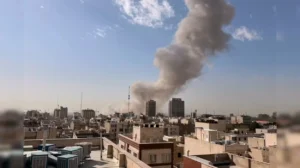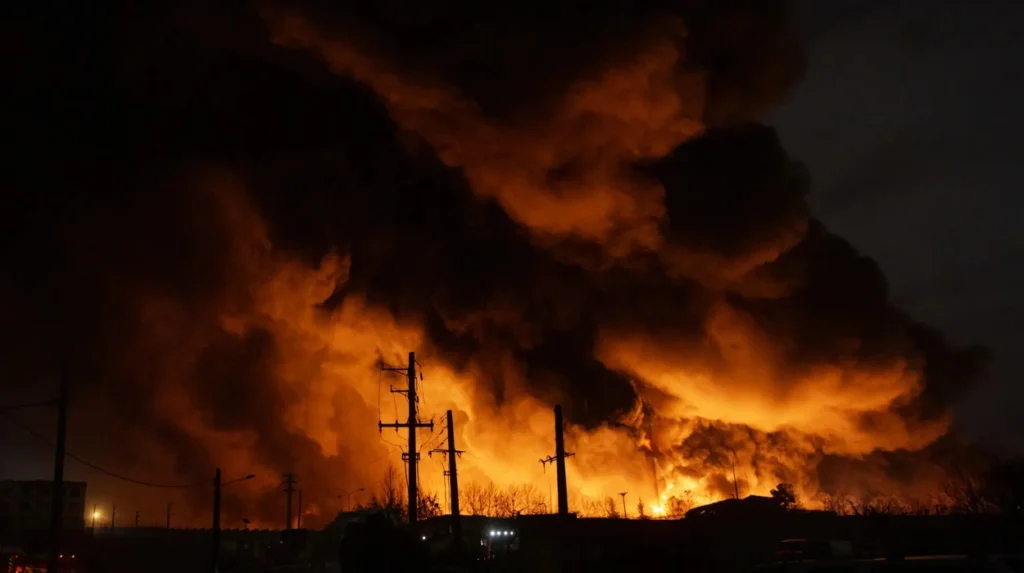
How Iranian oil limits U.S. levers has become clearer as the conflict with Tehran unfolds against a volatile global energy backdrop. Iranian crude exports remain embedded in international supply chains, meaning any shift in sanctions, military operations, or shipping routes quickly influences oil benchmarks and consumer fuel costs. By early 2026, global crude prices were again approaching levels historically associated with inflationary pressure and political sensitivity in the United States.
Strategists studying the situation point out that Washington faces a contradiction: applying maximum pressure on Iran’s economy often risks tightening global supply. That tightening can translate into higher gasoline prices domestically, reshaping public perception of the war and narrowing the administration’s maneuvering space. The economic signal generated by energy markets therefore interacts directly with military calculations.
Oil markets reacting to war dynamics
Energy traders tend to price risk rapidly when military escalation occurs in oil-producing regions. Iranian oil, even when partially restricted by sanctions, still affects expectations about global supply stability. When shipping routes or export terminals appear vulnerable, futures markets often move before physical disruptions occur.
This reaction creates a feedback loop in policy discussions. U.S. officials must evaluate not only the immediate strategic benefit of pressure on Iran but also the likelihood that markets interpret such pressure as a threat to global supply continuity.
Domestic economic exposure in the United States
Higher oil prices typically filter through the American economy quickly. Gasoline prices influence transportation, logistics, and consumer sentiment, all of which shape political reactions during prolonged conflicts. Analysts often emphasize that energy costs remain among the most visible indicators voters associate with foreign policy decisions.
Because of this sensitivity, policy responses toward Iran increasingly incorporate considerations that extend beyond security objectives. Maintaining energy stability becomes part of the strategic equation.
Sanctions flexibility and signals of constraint
The administration’s adjustments to sanctions policies have revealed how Iranian oil affects decision-making in real time. Measures allowing certain Iranian shipments already in transit to reach markets were interpreted by many analysts as an attempt to stabilize prices without abandoning pressure entirely. Officials have described such steps as necessary to avoid sudden supply shocks while continuing military operations.
These policy moves reflect a recognition that sanctions alone cannot be applied in isolation from energy market realities. The balance between enforcement and flexibility indicates that Washington must calibrate its actions carefully to avoid unintended economic consequences.
Partial easing of oil restrictions
Temporary allowances for crude cargoes already at sea highlighted how policymakers weigh market signals alongside geopolitical goals. Treasury officials suggested that preventing a sudden shortage in global supply could reduce volatility affecting consumers and businesses.
At the same time, the decision demonstrated that sanctions enforcement is not purely binary. Allowing some flows to continue may preserve stability while retaining broader leverage over financial networks tied to Iranian exports.
Strategic messaging behind policy adjustments
Sanctions adjustments also carry diplomatic implications. By selectively easing restrictions rather than fully lifting them, Washington signals both restraint and ongoing pressure. Analysts note that this dual message attempts to reassure allies concerned about energy costs while maintaining a firm stance toward Iran’s regional activities.
Such messaging underscores how energy considerations shape communication strategies as much as operational decisions.
Strait of Hormuz and the geography of leverage
The Strait of Hormuz remains central to understanding how Iranian oil limits U.S. levers. The narrow maritime corridor channels a significant share of global oil shipments, linking Persian Gulf producers to international markets. Any disruption, even temporary, can ripple across supply chains and financial markets within hours.
Because Iran sits along this chokepoint, its ability to influence maritime security gives it an asymmetric advantage that extends beyond conventional military strength. U.S. planners therefore face a dual objective: maintaining open shipping lanes while avoiding escalatory steps that could trigger broader instability.
Shipping risks and market reactions
Energy analysts frequently point out that threats to tanker traffic alone can move prices significantly. Even minor incidents involving vessels or port facilities may prompt insurers and traders to reassess risk premiums associated with the region.
These reactions illustrate why military operations in proximity to major energy routes require careful coordination with economic policy. Maintaining confidence among global markets becomes part of the mission.
Naval deployments and reassurance strategy
Naval presence in the Gulf often serves both security and psychological purposes. Deployments aim to deter attacks on shipping while signaling that major trade routes remain protected. This reassurance effort plays a role in preventing panic-driven price spikes.
In effect, military planning in the region is shaped by the need to protect infrastructure critical not only to the global economy but also to domestic political stability in the United States.
Oil flows, waivers, and strategic ambiguity
Another dimension of how Iranian oil limits U.S. levers involves the direction and destination of crude exports rather than their absolute volume. Policy adjustments affecting sanctions waivers can redirect shipments toward particular buyers, influencing price dynamics without completely halting revenue streams for Tehran.
This approach reflects an attempt to manage the market while sustaining pressure. By shaping trade flows rather than eliminating them, policymakers create a form of strategic ambiguity that complicates Iran’s calculations but also demonstrates the constraints Washington faces.
Redirecting exports in a shifting market
Energy analysts have observed that Iranian crude often finds alternative markets even under heavy sanctions. Countries with refineries suited to specific grades of Iranian oil can absorb these supplies, sometimes at discounted prices.
Redirecting flows rather than stopping them outright helps stabilize supply levels globally. However, it also means Iran retains some financial benefit from exports during periods of heightened tension.
Revenue persistence despite restrictions
The persistence of oil revenue under sanctions highlights the limits of economic pressure alone. Tehran’s ability to maintain partial export capacity ensures that energy markets remain interconnected with geopolitical developments.
This dynamic complicates efforts to impose maximum pressure without triggering broader economic disruption, reinforcing the structural constraint Iranian oil places on U.S. strategy.
Limits on escalation and policy trade-offs
Military options targeting energy infrastructure illustrate how economic considerations shape operational planning. Facilities such as export terminals or storage hubs represent significant leverage points in theory, yet striking them could rapidly reduce supply and send prices sharply higher.
Because such outcomes would likely affect global markets immediately, decision-makers must weigh the strategic benefit against the risk of domestic backlash tied to fuel costs. The result is a cautious approach that emphasizes calibrated pressure rather than sweeping disruption.
At the same time, earlier sanctions campaigns in 2025 targeting networks involved in Iranian petroleum trade demonstrated Washington’s willingness to apply financial pressure. The evolving policy mix in 2026, combining enforcement with selective flexibility, suggests that the United States is navigating a narrow corridor between economic stability and strategic coercion.
The intersection of energy markets and military strategy ensures that the Iran conflict unfolds as much through price signals as through battlefield developments. Iranian oil, embedded within global supply systems and tied to a critical maritime corridor, continues to influence how far the United States can push its campaign without destabilizing the very economic environment it seeks to protect. Observers following the situation note that as long as markets remain sensitive to disruptions in the Gulf, decisions about sanctions, naval deployments, and escalation will remain closely tied to the broader question of how energy security shapes the limits of power in modern conflict.