When President Donald Trump disrupted global trade with his so-called “Liberation Day” tariffs last year, China appeared to have a rare opportunity. Washington’s closest allies were unsettled, economically exposed, and searching for alternatives. Beijing could have stepped in with reassurance, concessions, and a diplomatic charm offensive aimed at pulling those countries closer.
Instead, China chose confrontation. Beijing warned governments against cooperating with the Trump administration’s efforts to restrict Chinese trade and rolled out export controls on critical rare earth minerals that affected the entire world, not just the United States. Rather than soothing anxious partners, China deliberately heightened their sense of vulnerability.
Why did Beijing choose pressure over persuasion?
The strategy was a calculated gamble by President Xi Jinping. According to analysts, Beijing’s goal was not to offer relief to disoriented U.S. allies, but to compound their dilemma. The message was clear: defying Washington would not spare countries from economic pain if they crossed China as well.
The expectation was that, over time, governments unnerved by U.S. unpredictability would seek closer ties with China to hedge their risks. When they did, Beijing assumed, they would be more willing to accommodate Chinese political and economic interests.
That bet now appears to be paying off.
Why are Western leaders lining up in Beijing?
A steady stream of European and Canadian leaders has recently arrived in China seeking deeper engagement with the world’s second-largest economy. This outreach has occurred even as Beijing has conceded little on long-standing points of friction, including human rights, espionage, election interference and structural trade imbalances.
The shift has drawn a sharp rebuke from President Trump, who warned that it was “dangerous” for countries like Britain and Canada to look to China as a solution to their economic troubles. Yet for many Western leaders, the immediate need to stabilize trade and investment has outweighed longer-term concerns.
“China chose to accentuate rather than alleviate the pressure on the allies to force them to tilt closer to Beijing’s position,”
said Jonathan Czin of the Brookings Institution.
“Beijing’s patient policy now seems to be paying dividends.”
Is pragmatism replacing principle in Europe?
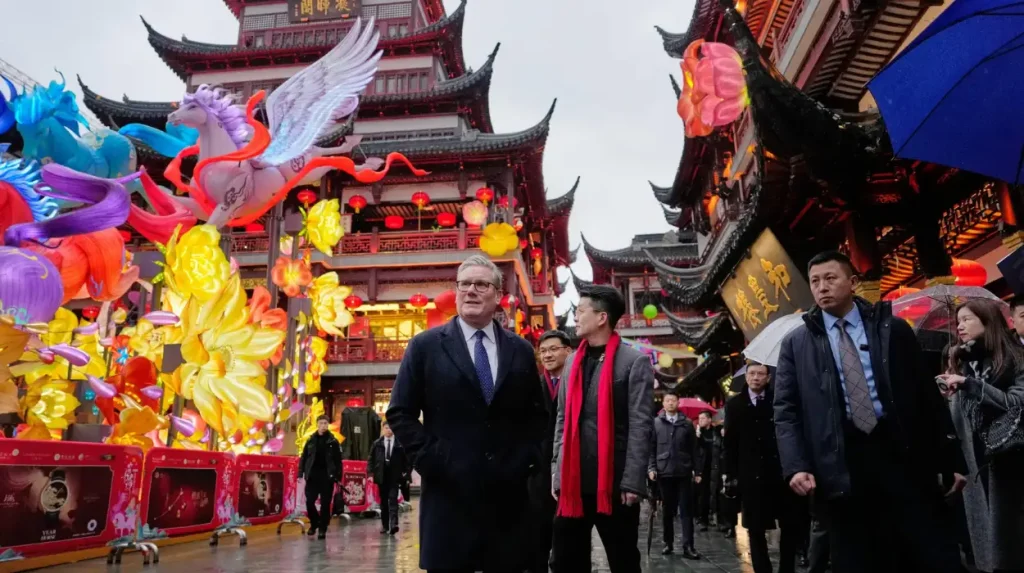
Prime Minister Keir Starmer’s visit to China this week symbolized that shift. It marked the first visit by a British leader since 2018 and a clear break from years of strained relations. Mr. Starmer emphasized business deals and economic cooperation while carefully sidestepping sensitive issues such as the imprisonment of Hong Kong democracy activist Jimmy Lai, a British citizen.
Critics argue that London has already made concessions. The British government recently approved a massive new Chinese embassy in London despite concerns that it could facilitate increased espionage. For Beijing, such decisions reinforce the sense that economic leverage is working.
Is Canada breaking ranks with Washington?
Canada has taken a similar path. Prime Minister Mark Carney traveled to Beijing this month, becoming the first Canadian leader to do so in nearly a decade. His visit followed years of tension that included the detention of Canadian nationals, accusations of election interference and public confrontations with Ottawa.
Mr. Carney announced a “new strategic partnership” with China, agreed to reduce tariffs on a limited number of Chinese electric vehicles, and signaled a willingness to diverge from the United States in pursuit of economic stability. For Beijing, the symbolism mattered as much as the substance.
“Beijing has played this extremely well — better than it could reasonably have expected a year ago,”
Mr. Czin said.
Is China gaining geopolitical deference?
Some Chinese analysts argue that Beijing’s refusal to bend under U.S. pressure has earned it respect. Wang Yiwei, a professor at Renmin University, said U.S. allies were now seeking to “diversify the risk of their dependence on the United States.”
“Naturally, they chose China,”
he said, adding that Beijing’s firmness had enhanced its stature on the world stage.
China has been quick to exploit this perception. Trump’s tariffs, threats to seize Greenland and military strikes in Venezuela, the Middle East and Africa have allowed Beijing to cast itself — however controversially — as a defender of the rules-based order and global trade, particularly in the eyes of the Global South.
Is NATO’s cohesion weakening China’s biggest rival?
Beijing has long sought to weaken transatlantic unity, viewing NATO as one of Washington’s greatest strategic assets. Trump’s rhetoric and actions have unsettled European capitals, making China’s courtship more effective.
Since French President Emmanuel Macron’s high-profile visit to China in December, Western leaders have increasingly sought direct engagement with Mr. Xi. In addition to Britain and Canada, leaders from Ireland, South Korea and Finland have visited, with Germany’s chancellor expected to follow soon. As divisions widen between the United States and its traditional partners, Beijing has gained diplomatic breathing room.
Does China now feel it no longer needs to compromise?
The growing rift has reduced the pressure on Beijing to make concessions. Analysts say China believes it can pull countries closer simply by remaining firm and predictable on its core interests, rather than offering meaningful compromises.
That dynamic could make it harder for Western governments to push back on issues such as China’s support for Russia’s war in Ukraine or its massive trade surplus, which reached a record $1.2 trillion last year.
It also risks leaving Taiwan more exposed. Days before Mr. Carney’s visit, two Canadian lawmakers quietly cut short trips to Taiwan at the government’s request — a move widely seen as an effort to avoid angering Beijing.
Is this a long-term realignment or a tactical detour?
Chinese commentators have framed the parade of Western leaders as a diplomatic triumph, helping to mask domestic challenges such as economic stagnation and military leadership purges. State media has portrayed Mr. Xi as presiding over a new chapter of global leadership in a turbulent world.
Still, some Chinese analysts remain cautious. They argue that Western outreach reflects short-term tactical hedging rather than a fundamental reorientation away from the United States. While Washington helped build the global trading system that allowed its allies to prosper, China continues to frustrate many countries through export dumping and heavy state subsidies.
For now, the West’s turn toward Beijing appears less like an embrace — and more like a reluctant adjustment to a world in which U.S. leadership feels increasingly uncertain.