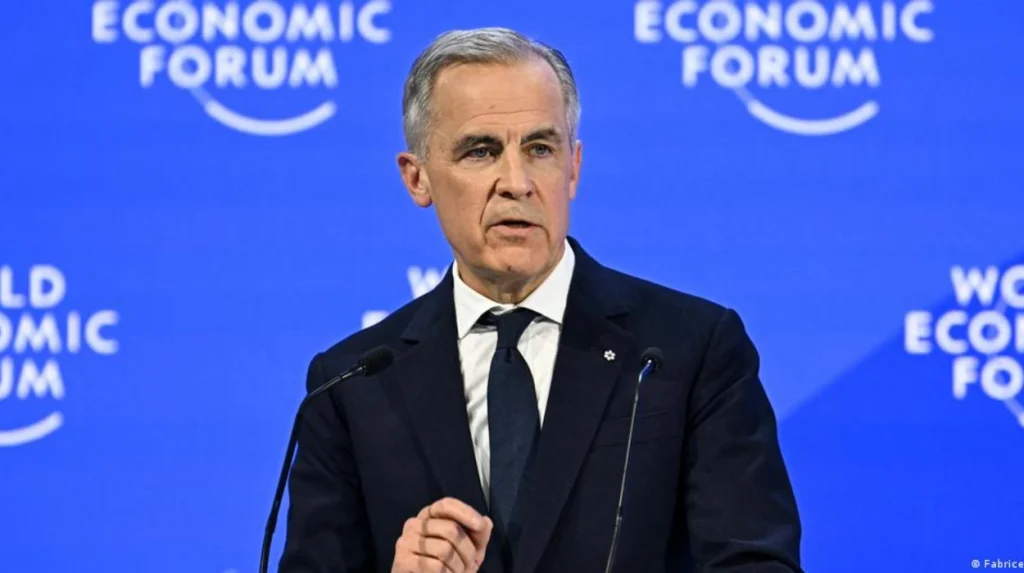
Canadian Prime Minister Mark Carney on Tuesday forcefully dismissed claims by US Treasury Secretary Scott Bessent that he had softened his criticism of President Donald Trump’s impact on the global order, insisting he stood fully by remarks made last week at the World Economic Forum in Davos.
Speaking to reporters in Ottawa, Carney directly contradicted Bessent’s assertion that the Canadian leader had “aggressively walked back” comments describing Trump’s policies as having caused an irrevocable “rupture” in the international system. Bessent made the claim during an interview on Fox News, saying he was present in the Oval Office when Carney spoke by phone with Trump.
“I Meant What I Said in Davos”
Asked whether he had rescinded any part of his Davos speech during the call, Carney was unequivocal.
“No,”
he said.
“To be absolutely clear, and I said this to the president, I meant what I said in Davos.”
At the Swiss gathering of global political and economic elites—attended annually by hundreds of CEOs, central bankers, heads of state, and investors managing trillions of dollars in assets—Carney warned that the traditional rules-based international order was under severe strain. Though he did not name Trump directly, his message was unmistakable.
Carney urged middle powers to stop accommodating Washington “just to go along to get along” and instead coordinate their economic and diplomatic leverage to counter growing US unilateralism.
Canada and the Stakes of US Trade Policy
Carney framed his remarks as a response to concrete policy shifts rather than abstract ideology. Canada, he noted, was the first major US trading partner to fully grasp the implications of Trump’s aggressive trade agenda.
The stakes are enormous. Canada and the United States conduct nearly $1 trillion in bilateral trade annually, making the relationship one of the largest and most integrated in the world. Roughly three-quarters of Canadian exports flow to the US, while Canada remains the largest foreign buyer of American goods, surpassing China and Mexico.
“It was a broader set of issues,”
Carney said.
“Canada was the first country to understand the change in US trade policy that he initiated, and we’re responding to that.”
According to Carney, Trump acknowledged Canada’s position during their Monday conversation.
A Call for Collective Action by Middle Powers
Carney’s Davos address struck a nerve among countries increasingly squeezed between US economic pressure and China’s expanding influence.
“Middle powers must act together because if we’re not at the table, we’re on the menu,” he warned—a line that drew an unusual standing ovation from the audience and widespread praise from European and Asian leaders.
The reception stood in stark contrast to Trump’s own speech at Davos, which was widely described by attendees as rambling and confrontational.
Political Fallout and Diplomatic Tensions
The consequences were swift. In the aftermath of Carney’s speech, Trump revoked Canada’s invitation to join his proposed Gaza “Board of Peace,” though Canadian officials noted Carney had not formally committed to the initiative.
Tensions were further complicated by Canada’s evolving trade relationship with China. Carney arrived in Davos after finalizing a limited agreement allowing a small number of Chinese electric vehicles to enter Canada at reduced tariff rates.
This marked a shift from Canada’s previous alignment with the Biden administration, during which Ottawa joined Washington in imposing 100 percent tariffs on Chinese EVs, citing unfair subsidies and market distortions.
Trump’s Tariff Threats and China Factor
Initially, Trump appeared to accept Carney’s China arrangement, saying,
“That’s OK, that’s what he should be doing.”
But he later reversed course, threatening on social media to impose a 100 percent tariff on Canadian exports if Ottawa pursued deeper trade engagement with Beijing.
Carney has repeatedly emphasized that Canada has no intention of negotiating a comprehensive free trade agreement with China, stressing that the EV arrangement is narrowly tailored and does not signal broader alignment.
“I explained to him our arrangement with China,”
Carney said.
“I explained what we’re doing: 12 new deals on four continents in six months—he was impressed.”
Diversifying Trade Beyond the United States
Carney’s strategy reflects a broader push to reduce Canada’s dependence on the US market, a vulnerability exposed during past tariff disputes over steel, aluminum, lumber, and autos.
On Tuesday, Canada and India released a joint statement announcing plans to expand trade in Canadian oil and natural gas—sectors that together account for roughly 20 percent of Canada’s total exports. Carney is scheduled to travel to India next month for talks with Prime Minister Narendra Modi, signaling deeper engagement with fast-growing emerging economies.
Tariffs as Negotiating Tactics?
Carney also downplayed Trump’s latest tariff threats, suggesting they should be viewed through a strategic lens rather than as imminent policy.
“The president is a strong negotiator,”
Carney said Monday.
“Some of these comments and positioning should be viewed in the broader context of that.”
The remarks come ahead of a scheduled review of the United States–Mexico–Canada Agreement (USMCA), which governs a regional economy worth more than $27 trillion. For Canada, the review represents both a risk and an opportunity: defend access to its largest market while accelerating diversification elsewhere.