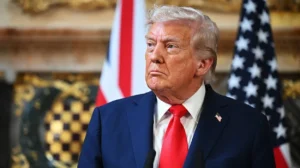
A fake image posted by US President Donald Trump on Truth Social may have been digitally manufactured, but it has become a symbol of a deeper, growing fear in Canada: the possibility that Trump’s aggressive territorial ambitions could become policy.
On Tuesday, Canadians woke to an AI-generated image showing Trump speaking to European leaders while a map displayed the US flag covering Canada, Greenland, and Venezuela. While the image itself was false, it reflected a broader trend of escalating tensions between Ottawa and Washington—and a shift in Canada’s mindset. What used to be dismissed as trolling or rhetoric is now being treated as a real security challenge.
The incident comes after a year in which Canada’s relationship with Trump has repeatedly been tested, with escalating trade threats and a renewed US focus on Arctic strategy.
Canada’s Strategic Response: Preparing for a “New Era of Economic Warfare”
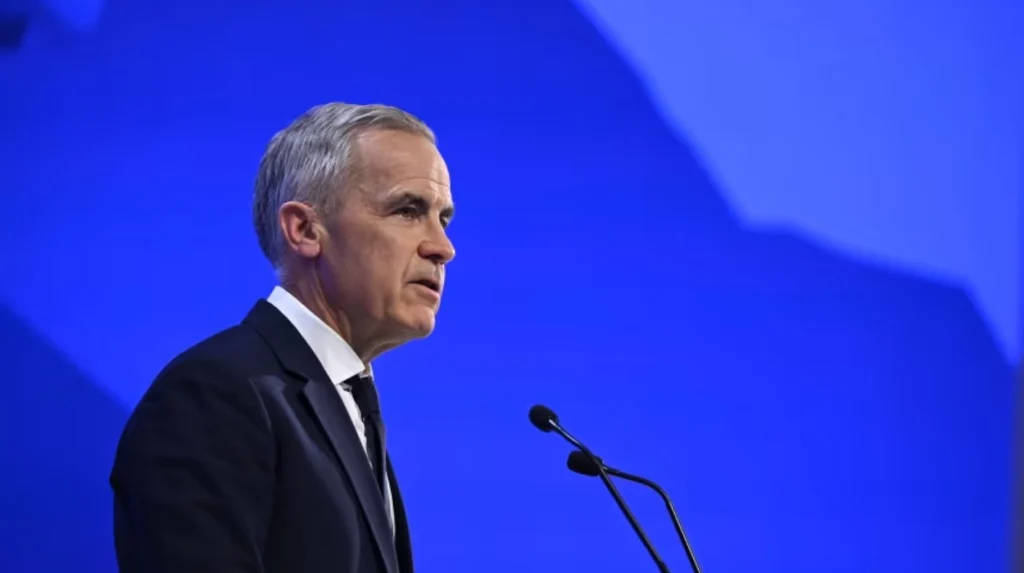
Canada’s response to the image was not only shock, but determination as well. Prime Minister Mark Carney’s message in the speech delivered to the World Economic Forum at Davos captured the new geopolitical order:
“Great powers are employing the tools of integration, tariffs, and supply chains as weapons or threats thereof, and in this new environment, Canada’s unlimited resources—our imagination, diversity, and resilience—will be the weapons of choice.”
Carney did not identify the United States by name but his meaning was unmistakable: Canada and its fellow middle powers would have to take collective action in their own defense.
“If we’re not at the table, we’re on the menu,”
he warned, pointing toward a new era of diplomatic coordination and defense readiness.
This shift in strategy comes at a time of great global economic restructuring. In fact, a recent report from the World Economic Forum found that global trade tensions are up by over 30% since 2020, amid rising use of tariffs and reshoring supply chains. Canada’s economy, heavily dependent for about 60% of its Gross Domestic Product on trade, stands out as especially vulnerable to such tensions.
A Northern Security Strategy: Investing Billions to Protect the Arctic
Canada has already spent nearly $1 billion strengthening its southern border in recent years and now is committing even more to defend its northern frontier.
Carney reiterated Canada’s support for Greenland and Denmark’s sovereignty, while warning that Russia remains the biggest security threat in the Arctic. His speech outlined new defense investments aimed at strengthening NATO’s northern and western flanks, including:
- Over-the-horizon radar systems for early Arctic detection
- Submarines and aircraft to patrol and secure northern waterways
- Troop deployments on the ground and on the ice
Canada’s investment in Arctic defense is not theoretical. One of Carney’s first actions as prime minister was committing over $4 billion to an Over-the-Horizon radar system, aimed at providing early warning of threats from the Arctic. This radar system is intended to extend detection range beyond the current coverage provided by the North Warning System, which is aging and requires major modernization.
Canada has also committed to a more permanent military presence in the Arctic, including rotating forces and increased infrastructure for operations in extreme conditions.
NORAD, Greenland, and the Limits of Cooperation
Canada’s defense strategy is complicated by geography and history. The country shares one of the world’s longest land borders with the US (over 8,800 kilometers) and one of the largest maritime borders with Greenland. For decades, Canada has relied on joint defense planning with NATO and NORAD.
This week, NORAD confirmed that aircraft from both Canada and the United States were operating in Greenland as part of long-planned defense activities. NORAD described the mission as building on
“enduring defense cooperation between the United States and Canada, as well as the Kingdom of Denmark.”
However, the key question remains: Will these cooperative measures satisfy the Trump administration’s increasingly aggressive demands?
Thisuncertainty is not unknown to the Canadian government. In aradio interview last week, US Ambassador to Canada Pete Hoekstra was asked about US involvement to ensure Canada properly secures its Arctic territory. Hoekstraconsidered the question to be “almost purelyhypothetical,” althoughCanada had already offered to coordinate efforts with the US.
Nevertheless, the question at issue implies a level of underlying vulnerability: Canadian sovereignty might be used as leverage within future US strategic assessments.
The Political Symbolism of Greenland: A Possible Canadian Military Gesture
Canada is reportedly weighing whether to send troops to Greenland as a symbolic gesture supporting Danish sovereignty and Arctic stability. Such a move would mark a significant shift in Canadian defense posture and signal that Ottawa is willing to project military power beyond its borders in support of Arctic allies.
This potential deployment would also carry broader implications for NATO and Arctic security, particularly as the region becomes a focus of great power competition.
The Third Path: Rules-Based Order vs. Force
Carney’s Davos speech framed Canada’s strategy as part of a larger choice facing middle powers. He warned that the world is not simply transitioning to a new order, but experiencing a rupture—one where legitimacy and international rules are under attack.
He urged countries to choose a “third path” rooted in legitimacy, integrity, and rules—an implicit critique of unilateralism and coercion.
In a world where trade wars, territorial claims, and geopolitical brinkmanship are increasingly normalized, Canada appears to be recalibrating its strategy from complacent reliance on US partnership to proactive defense and diplomatic coalition-building.
Whether this shift will be enough to deter a president who has repeatedly tested international norms remains an open question—but Canada’s new posture suggests it is no longer willing to treat such threats as mere political theatre.