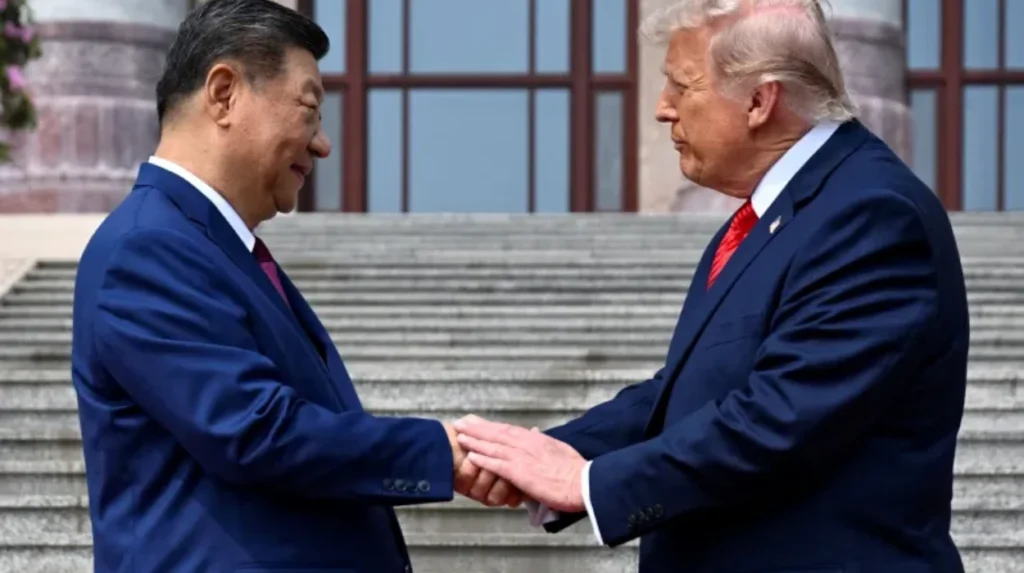
At least $17 billion worth of U.S. agricultural products will be bought each year by China, according to an announcement by the White House after a meeting held in Beijing between U.S. President Donald Trump and his Chinese counterpart, Xi Jinping. This agreement, which is set to last between 2026 and 2028, is among the most tangible results reached from recent high-level discussions between Washington and Beijing over trade issues that have plagued their relations for many years now.
From tariff war to farm‑driven détente
This is markedly different from the trade conflict witnessed during much of the past decade where China retaliated with punitive tariffs against American soybeans, corn, and other agricultural products after the United States placed punitive tariffs on Chinese industrial and hi-tech exports. This was felt particularly badly by American farmers across the Midwest and Great Plains as China, which had been purchasing more than any other nation, greatly curtailed their purchases of U.S. soybeans. The current pact is seen as an indication that the United States is deliberately choosing agriculture as a politically convenient “valve for easing tension.”
The White House released a short fact sheet stating that
“China will purchase at least $17 billion in U.S. agricultural products annually through 2028.”
It was highlighted that this amount comes on top of agreements signed in October 2025 wherein China pledged to purchase billions of dollars worth of soybeans from the United States. In simpler terms, this means that U.S. agricultural exporters can expect not only the restoration of volume figures before the trade war but even more — a minimum of an additional $17 billion every year.
What the dollar figure actually implies
In terms of numbers, a $17 billion worth of yearly agricultural trade with China is approximately equal to the combined worth of the U.S. farm commodity exports that would be shipped abroad each year, taking commodities such as soybeans, beef, and poultry. Year after year in recent times, there had been tens of billions of dollars worth of U.S. farm exports to China that ranged from several types of commodities including soybeans worth billions of dollars annually in peak trade. The additional amount of $17 billion yearly over current trade volume, on top of the previously agreed-upon soy deal by year-end 2025, indicates that Washington expects an increase in China’s desire for American farm exports over several years to come.
The US trade negotiators have not yet published a comprehensive list of products involved, but indications from public communications suggest a wide range of agricultural products that includes, among others, soybeans, beef, poultry, and additional types of grains and livestock. This would imply that the agreement aims to be favorable not just for soy producers, but also for dairy, meat, and grain producers from the Midwest and western states. In today’s unpredictable trade and environmental situation, the guarantee of a stable minimum of $17 billion annually is a unique achievement for US farmers.
How the deal is structured and enforced
Perhaps the biggest uncertainty surrounding the deal pertains to just how enforceable the $17 billion number is. According to the White House, the deal represents a minimum purchase amount per year rather than an annually fixed contract, thus allowing volumes of agricultural products to rise above or fall below this number based on market forces. To make sure China meets or surpasses the $17 billion number, however, Washington must first make sure Beijing lifts or lowers tariff levels and other trade barriers that have traditionally impeded the flow of American agro-produce into China.
While no such dollar-for-dollar statement has been made by Chinese authorities regarding the $17 billion estimate, it is noteworthy that the commerce ministry of China has indicated that China will reduce tariffs and facilitate the entry of agricultural produce into China as part of the general trade regime that is being developed after the meeting between Trump and Xi.
This indicates that while the actual figure is not important, what matters is that the trade regime that is being built provides an environment where there will automatically be more imports by Chinese companies from America. It can be noted here that problems with sanitary standards, logistics, or even politics could impede the process of increased trade.
Political and electoral messaging
The agricultural promise of $17 billion per year is an area in which President Trump can further emphasize his consistent theme of delivering to America’s farmers and adopting a tough stance towards the business activities of China. According to President Trump, China has committed itself to purchasing “billions of dollars’ worth of soybeans and other agricultural products” along with a range of other products such as aircrafts, energy, and industrial products. It is the intention of the government to use this deal as an approach in which both farmers and manufacturers benefit, thus countering any criticism that previous trade wars may have done harm to rural America.
In addition to that, the White House is trying to make use of the deal to increase confidence in U.S. exports, amid challenges being posed by protectionist policies, geopolitical rivalry, and changing supply chains. The administration believes that committing to a long-term purchase plan from what is the world’s most populated nation and largest agricultural importer could serve as motivation to invest in infrastructure, storage capacity, and logistics for agricultural products. On the other hand, there have been those who have raised the possibility of the risks faced by American farmers, given the heavy reliance on China as a single mega-market, especially in case of conflicts between Washington and Beijing over technological rivalry, Taiwan, and other similar issues.
Reactions from farmers, industry, and analysts
In the American agricultural community, the $17 billion deal has not elicited unreserved joy but a certain degree of prudence. The soybean, beef, and poultry exporting organizations have received the news favorably as a positive indication that there will be greater entry into the Chinese market; however, they have emphasized that the process should be rule-based and transparent while maintaining a diversified approach in other markets. There have been some comments from the industry insiders who have pointed out that similar announcements made in the past had not necessarily led to an increase in volumes due to domestic politics in China.
The independent observers have made similar warnings. They observe that even though more than $17 billion in extra income to the US through its agricultural exports could be considered quite a substantial boost to the agricultural sector, all of that is conditional upon factors as varied as the pattern of consumption among Chinese citizens to world grain prices, among others. A number of economic commentators have observed that a commitment to such a large figure as that might serve a political purpose well enough but be vulnerable when it comes to economic considerations if there were no proper monitoring of compliance and penalty provisions or dispute settlement processes in place.
Implications for global trade architecture
Notwithstanding U.S. farm states and Beltway politics, however, the emerging Sino-American trade agreement occurs within the larger context of fragmentation in world trade relations and increasingly strong regional blocs. In recognizing the reality that the United States and China have entered into trade agreements related to agriculture on a bilateral basis outside the ambit of the World Trade Organization, one sees how trade is increasingly moving away from multilateralism towards state-driven trade agreements. For other nations exporting agricultural goods, the idea of China entering into multi-year contracts for minimum purchase volumes from the United States is cause for concern.
At the same time, the deal may encourage other major economies to seek similar bilateral accords with China, especially where politically sensitive sectors such as agriculture or energy are involved. This could push the world trading system toward a patchwork of country‑specific deals rather than a single, unified set of open‑market rules. For developing‑country exporters, the risk is that they may lack the political leverage or market scale to negotiate comparable minimum‑purchase guarantees, potentially widening existing imbalances in global trade.
What remains undecided and uncertain
As the administration touts the $17 billion number, a number of issues remain unresolved or unclear. First, it is still uncertain as to how the minimum annual number will be determined – through either customs values, contract volume, or perhaps even some combination of both – and how any issues of shortfall will be handled if China does not make the minimum number one year. It is also unclear how quickly the tariffs and non-tariff barriers will be reduced and which industries or product lines will get preference.
Another source of uncertainty is how the deal will coexist with China’s growing emphasis on domestic agricultural self‑sufficiency and food‑security policies. Beijing has long talked about reducing dependence on foreign food imports, particularly grains and oilseeds, in order to insulate itself from geopolitical disruptions. If that self‑reliance push intensifies alongside the U.S. purchase commitment, it could lead to periodic tensions or mixed signals in how Chinese policy is actually implemented on the ground.
Looking ahead: three‑year horizon and beyond
The official timeframe for the commitment—2026 through 2028—gives Washington and Beijing a relatively short but politically meaningful window to prove whether this deal can be more than a symbolic gesture. If, over the next three years, Chinese imports of U.S. agricultural goods consistently meet or exceed the $17 billion annual floor, it could cement a new pattern of structured farm trade between the two powers, even as tech and security relations remain tense. Conversely, any major slippage or backtracking could reopen old wounds among American farmers and fuel arguments that farm‑heavy trade deals without robust enforcement are inherently unreliable.
For international markets, the transaction highlights the continuing significance of China’s position as a pivotal buyer of agricultural products. Which country decides where China will buy its next billion dollars’ worth of soy, cattle, and poultry may still alter trading patterns, shape price trends worldwide, and decide whether Iowa or Mato Grosso farmers get rich or poor. The statement issued by the White House about China buying $17 billion worth of American agricultural products yearly, therefore, is more than just a bilateral news item; it demonstrates that agricultural trade continues to be a crucial political tool wielded by major powers, despite all the high-tech talk about tariffs.