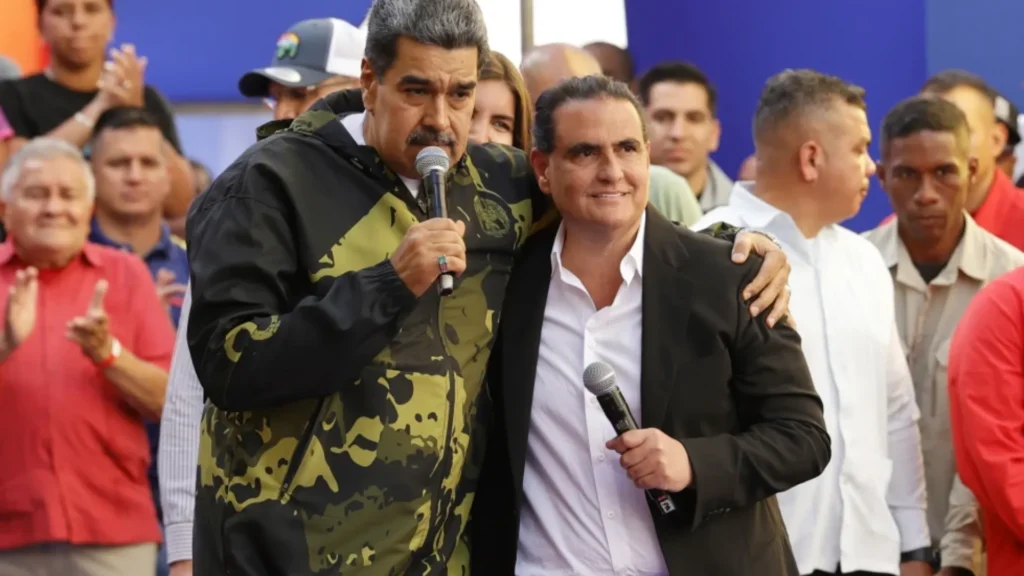
Venezuela’s alleged deportation of Alex Saab is among the most important events that have occurred so far in the long tale of corruption and sanctions around Nicolás Maduro’s regime. The businessman, who was considered by U.S. authorities as a close associate of Maduro, is once again a source of attention following the claims that he had been deported from Caracas to face charges in the United States. It would be interesting to see how this political decision will pan out and what information Saab will be willing to disclose should Washington force his hand.
Timing matters greatly because Saab has traditionally been viewed as more than just a businessman; rather, he has been seen as someone whose economic connections ensured the survival of the regime under sanctions pressures. Therefore, Saab’s deportation is not merely a matter of procedure; it is a possible breach in the web that has shielded the ruling clique in Venezuela for years and may alter the course of several American trials relating to corruption, bribery, money laundering, and illegal procurements.
Who Alex Saab Is and Why He Matters
Alex Saab, whose name was commonly referred to by many as the Colombian-born businessman and a billionaire tycoon, rose to become one of the most controversial people involved with the government of Venezuela. For several years, Alex Saab was perceived as an important player for Maduro, especially in terms of financial transactions and procurement, due to his help in carrying out the processes under sanctions.
His name came to be synonymous with the Venezuelan government’s CLAP food program, which was a government food aid program that sought to distribute boxes of food at a subsidised rate to Venezuelans. It is argued by United States authorities that this program provided cover for contracts that were fraudulent, kickbacks, and money laundering that enriched Saab and his cronies. The role of the food program has remained a crucial part of the case because it ties together all three elements.
It is important to consider that Saab himself was not just some contractor from afar either, but had reportedly been connected to Maduro’s inner circle, as well as the most confidential economic dealings of the Venezuelan state. To Maduro’s opponents, Saab is evidence of how political influence became one and the same with personal gain. As for Maduro’s allies, Saab has been painted as nothing more than a target of political persecution by America.
What Venezuela Announced
A statement attributed to the Venezuelan government concerning the deportation referred to Saab as a national from Colombia who was being deported due to ongoing criminal investigations against him in the United States. The implication of such an emphasis on his status as a foreigner is significant. The government might be maneuvering within the laws of Venezuela that prohibit the extradition of its nationals.
It should be noted that this information implies that Caracas sought to make it clear that the release was part of compliance with judicial actions, not any political compromise. Nonetheless, the larger message remains evident: Venezuela decided to deliver a man who was considered extremely valuable for the Maduro regime during a period when the United States continues its investigations of corruption within Venezuela.
It seems that the Venezuelan government did not indicate the specific criminal charges that would be brought against Saab, but made it clear that his extradition was related to the criminal process initiated in the United States. This point is critical because it transforms the status of Saab from that of a political prisoner or a hostage into a person subjected to legal proceedings within the U.S. justice system.
The U.S. Case Against Saab
For years, U.S. officials have been targeting Saab for charges associated with money laundering, bribery, and exploitation of government procurement systems. The main hypothesis is that Saab and other parties gained from inflated contracts with the Venezuelan state program, particularly the CLAP food program. It has been claimed that funds from such deals passed through complicated corporate and banking networks, making it difficult to trace their origin and destination.
The legal pressure against Saab did not start this week with the reported expulsion but began when he was extradited from Cape Verde to the United States in 2021 after years of political struggle. This case had already placed him among the high-profile individuals in the broader Venezuela sanctions and corruption narrative. In the latest development, it was reported that the U.S. was still pursuing investigations into sealed or similar cases involving Saab and other people affiliated with his and Maduro’s governments.
For Saab, by being forced back into the U.S. legal system, it opens up the possibility for him to be once again a valuable suspect or witness. It is this very potential which is important not just because of his alleged activities but because of his information. The prosecution typically relies on people who have firsthand knowledge of such things as the inner workings of financial networks and contractual agreements. Saab could be that person.
The Political Stakes for Maduro
Saab has not been just another businessman for Nicolás Maduro. Rather, he has been among those who have repeatedly made headlines when it comes to the survival architecture that keeps the Venezuelan government afloat amid economic collapse, sanctions, and pressure from abroad. Should Saab be prepared and able to talk, his testimony will certainly bring additional light into the lives of those close to the president and provide further ammunition for ongoing U.S. investigations.
That is the political significance of the recent move. Any involvement of Saab can only bolster Washington’s attempts to investigate charges of corruption, evasion of sanctions, and financial dealings involving intermediaries.
The political risk for Caracas is not just legal exposure. It is also symbolic. Handing over a longtime ally may be interpreted as a sign that the government is reshaping its internal hierarchy, managing external pressure, or distancing itself from a figure who may have become more liability than asset. In authoritarian systems, such moves are rarely purely legal. They often reflect calculations about survival, loyalty, and leverage.
Why the CLAP Program Keeps Coming Up
The CLAP food distribution network is central to understanding why Saab’s case continues to attract U.S. attention. On the surface, it was designed as a social support program for households facing severe food shortages. In practice, prosecutors and investigators have alleged that the program became a source of overpricing, opaque contracting, and kickback schemes tied to politically connected actors.
That matters because CLAP touches both governance and public trust. It was not a niche commercial contract. It was a state program affecting millions of people during a time of economic crisis. Allegations that the system was exploited for enrichment carry heavy political weight because they suggest that even a basic relief mechanism may have been manipulated for profit.
For U.S. investigators, programs like CLAP are useful entry points because they create paper trails, bank transfers, vendor networks, and contracting chains. Once those are mapped, prosecutors can often trace money to private accounts or shell companies. If Saab becomes cooperative, CLAP-related evidence could become even more damaging for a wider circle of Venezuelan officials and intermediaries.
The Legal and Diplomatic Consequences
Saab’s reported deportation is likely to have consequences beyond the courtroom. It may affect negotiations, diplomatic messaging, and the already strained relationship between Caracas and Washington. The United States has repeatedly used sanctions, indictments, and extradition-related pressure to target corruption and narcotics-linked networks in Venezuela, while Maduro’s government has accused Washington of political interference.
If Saab now faces renewed proceedings in the United States, the legal machinery around him may produce fresh filings, sealed cooperation agreements, or witness testimony. Even if he does not cooperate, the mere fact of his transfer could revive old evidence and bring new attention to the financial operations that investigators have long pursued.
Diplomatically, the case also sends a message to other figures in Maduro’s orbit: status offers no permanent shield. That matters in regimes where elite survival often depends on mutual protection, secrecy, and bargaining power. A high-profile transfer like this can create uncertainty inside the ruling network and encourage other insiders to reassess their own exposure.
What to Watch Next
The most important next step will be whether U.S. prosecutors unseal new charges, file fresh motions, or announce Saab’s formal status in federal court. That will determine whether this is mainly a custody development or the opening of a larger legal phase. Court documents, if released, will show the exact scope of the allegations and whether prosecutors see Saab as a defendant, a cooperating witness, or both.
The second major question is whether Saab provides testimony against other figures. If he does, the implications could extend far beyond his own conduct. It could influence cases involving money laundering, sanctions evasion, and possible corruption networks tied to senior Venezuelan officials.
A third issue is how Venezuela explains the decision domestically. Caracas may present the move as a legal or diplomatic necessity, but for many observers it will read as a significant concession or internal reordering. In a case like this, the official framing matters almost as much as the legal fact pattern because it signals whether the government sees Saab as expendable, compromised, or strategically useful in another way.
Wider Meaning of the Case
The broader significance of Saab’s deportation lies in what it says about the reach of U.S. investigative pressure and the fragility of elite protection in sanctioned states. Over time, corruption cases are rarely just about one man. They become windows into how systems work, who benefits, and how money moves when states are isolated from normal financial channels.
That is why this story is likely to remain important even if Saab himself does not become a cooperating witness. His case connects state contracts, sanctions evasion, political patronage, and international law enforcement in one file. It also underscores how Venezuela’s internal power structure remains under scrutiny long after the original allegations surfaced.
For Maduro, the story is another reminder that the people around him are often the points where pressure becomes visible. For U.S. prosecutors, it may be an opportunity to widen an already extensive case. For Saab, it is another turn in a legal saga that has followed him across borders and into the center of one of the most politically charged corruption investigations in the hemisphere.