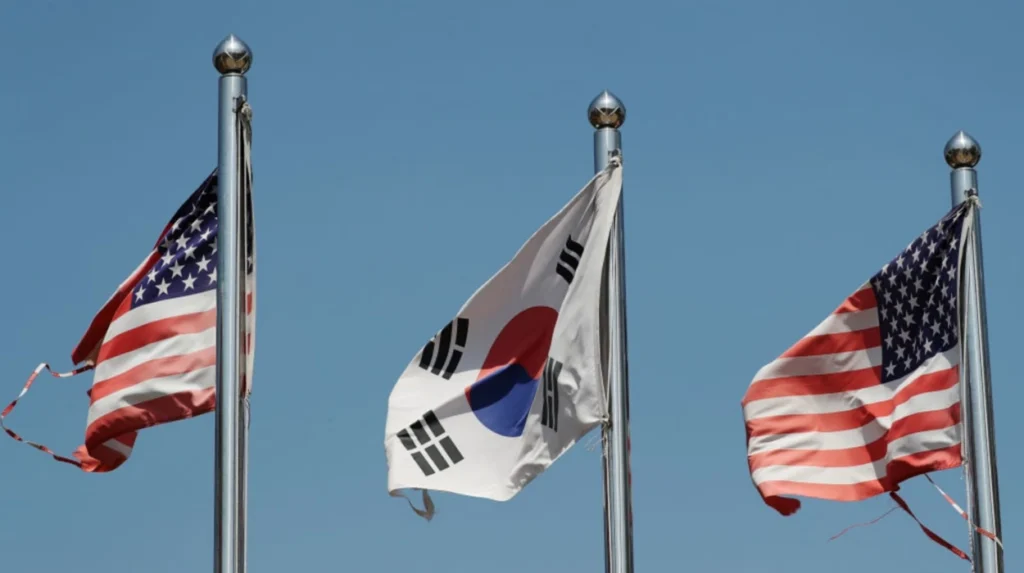
The US-South Korea security pact has long been defined by durability and strategic clarity, anchored in the 1953 Mutual Defense Treaty that followed the Korean War. For decades, the presence of American forces on the Korean Peninsula has served as both a deterrent to North Korea and a symbol of Washington’s commitment to regional stability. Yet by 2026, the alliance is being tested not by events on the peninsula alone, but by developments far beyond it, particularly the intensifying U.S. military engagement in the Iran conflict that escalated in late 2025.
The diversion of military assets to the Middle East has created a perception gap in Seoul regarding U.S. priorities. While American officials maintain that Indo-Pacific commitments remain intact, South Korean policymakers increasingly question whether the alliance’s foundational guarantees can be sustained under conditions of global overextension. This tension reflects a broader recalibration of U.S. strategic bandwidth, where simultaneous crises challenge the assumption that traditional alliances will receive uninterrupted attention.
Legacy of deterrence and forward deployment
The credibility of the alliance has historically rested on forward deployment, with tens of thousands of U.S. troops stationed in South Korea. This posture has been central to deterrence, signaling that any aggression from Pyongyang would immediately involve American forces. However, partial redeployments linked to Middle East contingencies have introduced ambiguity into that signal, even if only temporarily.
South Korean defense planners increasingly interpret these shifts not as abandonment, but as evidence that the alliance must adapt to a more fluid global security environment. The notion of static deterrence is giving way to a model where responsiveness and flexibility take precedence, raising questions about how visible military presence translates into actual deterrent effect.
Escalating triggers in 2025–2026
The strain on the U.S.-South Korea security pact is compounded by simultaneous developments on the Korean Peninsula, where North Korea has intensified its military activities. These actions intersect with shifting U.S. priorities, creating a layered security dilemma for Seoul.
North Korean missile activity and deterrence concerns
North Korea’s testing cycle in 2025 reached one of its highest levels in recent years, with over one hundred missile launches recorded, followed by continued activity into early 2026. These tests include advancements in hypersonic delivery systems and solid-fuel technologies, which complicate interception and shorten response times.
The timing of these tests has amplified concerns in South Korea that Pyongyang is exploiting perceived distractions in U.S. strategic focus. While American officials emphasize that deterrence capabilities remain robust, the optics of reduced joint exercises and redeployed assets have contributed to public unease. Opinion polling in 2026 indicates declining confidence in the alliance’s ability to respond swiftly to a crisis.
Burden-sharing debates and transactional pressures
Parallel to security concerns, financial tensions have resurfaced in negotiations over defense cost-sharing. The Special Measures Agreement, which governs Seoul’s contributions to hosting U.S. forces, has become a focal point of political friction. Washington’s calls for increased contributions are framed as equitable burden-sharing, yet in Seoul they are often interpreted as a shift toward a more transactional alliance model.
This dynamic has been reinforced by broader economic measures, including tariff policies that affect South Korean exports. The overlap between economic pressure and security cooperation creates a perception that alliance commitments are being leveraged across domains, complicating the political narrative within South Korea about the partnership’s long-term stability.
The enduring shadow of THAAD and regional geopolitics
The deployment of the Terminal High Altitude Area Defense system in 2017 continues to shape the strategic environment surrounding the alliance. While originally intended to counter North Korean missile threats, THAAD has had enduring geopolitical consequences that intersect with current tensions.
Chinese strategic responses and economic leverage
China’s reaction to THAAD has included sustained economic countermeasures, targeting sectors such as tourism, retail, and entertainment. By 2025, these measures had evolved into a broader pattern of strategic signaling, linking South Korea’s security decisions to its economic exposure.
For Seoul, this creates a dual dependency challenge: reliance on the United States for security and on China for trade. The Iran conflict exacerbates this dilemma by highlighting the risks of alignment in a multipolar environment where economic and security interests do not always converge.
Domestic debates and societal divisions
Within South Korea, THAAD remains a contentious issue, particularly in communities directly affected by its deployment. Protests and legal challenges have persisted, reflecting concerns about environmental impact and national sovereignty. These domestic debates intersect with broader questions about the alliance’s direction, especially as political factions advocate differing approaches to balancing security and autonomy.
Strategic recalibration under evolving U.S. priorities
The reorientation of U.S. foreign policy following the 2025 presidential transition has further influenced the trajectory of the U.S.-South Korea security pact. The emphasis on economic nationalism and selective engagement has introduced new variables into alliance management.
Middle East prioritization and resource allocation
The Iran conflict has required substantial U.S. military resources, including naval deployments and logistical support. While Indo-Pacific Command retains significant capabilities, the redistribution of assets underscores the challenges of sustaining multiple high-intensity commitments simultaneously.
South Korean officials have responded by accelerating discussions on defense self-reliance, including investments in indigenous missile defense and surveillance systems. This shift does not signal a departure from the alliance but rather an effort to hedge against uncertainties in U.S. availability.
Signals of nuclear ambiguity and strategic autonomy
Public discourse in South Korea has increasingly entertained the possibility of developing an independent nuclear deterrent. While such a move remains politically and legally complex, rising public support reflects a growing desire for strategic autonomy. Statements from U.S. political figures suggesting openness to allied nuclearization have further fueled this debate, even as official policy remains committed to non-proliferation.
Multipolar pressures and alliance adaptation
The broader international environment adds another layer of complexity to the alliance’s evolution. Competing powers are actively shaping the regional balance, often exploiting perceived gaps in U.S. engagement.
Russian and Chinese alignment with North Korea
Russia’s expanding military cooperation with North Korea, including artillery transfers and technical assistance, has reinforced Pyongyang’s capabilities. At the same time, China’s diplomatic outreach to Seoul emphasizes economic cooperation, presenting an alternative pathway that does not rely on U.S. security guarantees.
These parallel dynamics place South Korea in a strategic position where alignment choices carry heightened consequences. The alliance with the United States remains central, but its relative weight is increasingly measured against alternative partnerships and pressures.
Emerging domains of conflict and cooperation
Cybersecurity and space operations have emerged as critical domains within the alliance framework. North Korean cyber activities, which generated significant economic losses in 2025, highlight vulnerabilities that extend beyond traditional military threats. Similarly, the integration of space-based assets into defense planning reflects the evolving nature of deterrence.
The existing alliance structure, rooted in mid-20th-century assumptions, is being tested by these new domains. Adaptation requires not only technological upgrades but also doctrinal shifts that redefine the scope of mutual defense.
What the alliance strain reveals about future security frameworks
The pressures facing the US-South Korea security pact illustrate a broader transformation in how alliances function in an era of overlapping crises and multipolar competition. The Iran conflict has not fundamentally altered the alliance’s legal commitments, but it has exposed the limits of traditional assumptions about priority, presence, and predictability.
South Korea’s response balancing continued reliance on U.S. guarantees with incremental moves toward self-reliance suggests a hybrid model of alliance management. For the United States, the challenge lies in maintaining credibility across regions while adapting to resource constraints and shifting strategic priorities.
As these dynamics unfold, the alliance appears less as a fixed pillar and more as an evolving framework shaped by external shocks and internal recalibration. The interplay between global conflicts and regional security raises a deeper question about whether future alliances will be defined by permanence or by their ability to adapt in real time to a world where no single theater can remain isolated from the rest.