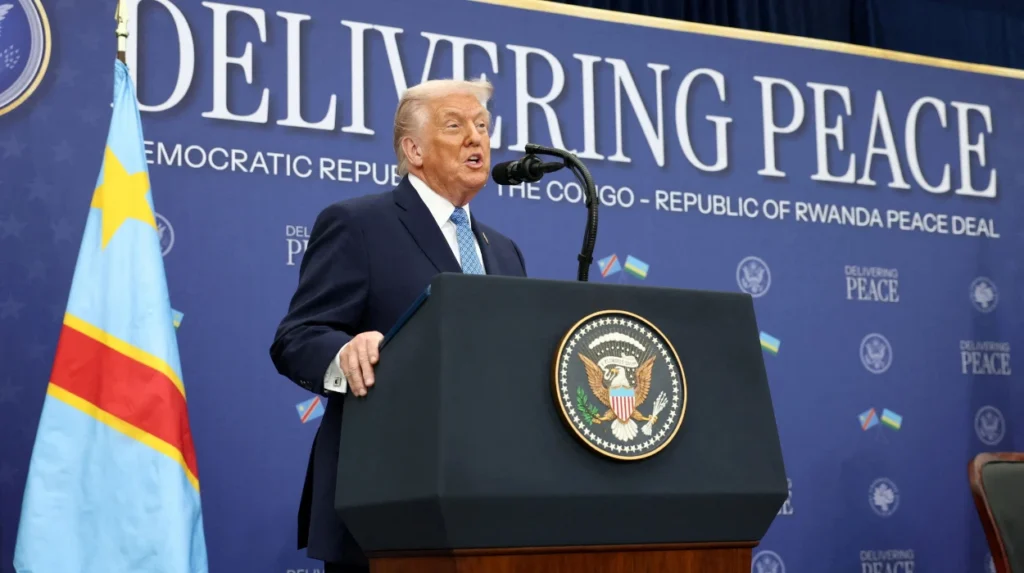
America First in Africa has drawn scrutiny for prioritizing short-term transactional goals over a clearly articulated long-term strategy. Since 2025, U.S. officials have emphasized commercial engagement, supply-chain security, and pragmatic cooperation with African governments. Yet these priorities often remain high-level and unconnected to a forward-looking roadmap extending into 2040 or 2050. Analysts note that this approach risks creating a “strategic vacuum,” where day-to-day decisions are reactive and piecemeal rather than coherent.
Senior analysts at Washington-based think tanks have observed that the absence of a guiding horizon reduces the ability of policymakers to anticipate demographic growth, urban expansion, or technological transformation across the continent. African states are increasingly aware of this gap, interpreting U.S. engagement as transactional and fleeting.
Commercial diplomacy and supply chains
Trade has become the centerpiece of the America First in Africa framework. Agreements on minerals, energy, and digital infrastructure have emphasized securing Western supply chains and meeting U.S. industrial needs. These projects, while attractive in the near term, often lack integration into a broader economic strategy that fosters regional resilience.
Investment without institutional scaffolding
Sustained investment depends on predictable regulatory and institutional frameworks. The U.S. approach has frequently overlooked this, scaling back USAID operations and reducing long-term capacity-building efforts in 2025. Without strengthening governance and institutional stability, commercial engagement risks producing temporary gains rather than enduring benefits.
Aid restructuring and global health engagement
Beyond trade, the America First approach has reshaped development partnerships. Policy changes in 2025 signaled a move away from multilateral aid toward time-bound bilateral agreements, emphasizing African co-financing and responsibility. While these reforms aim to increase ownership, critics argue they risk creating transitional gaps in essential services.
Reframing development partnerships
Global health initiatives have shifted toward contractual arrangements, focusing on measurable deliverables. African officials argue that many systemic challenges stem from historic donor-driven architectures, and that asking governments to assume full responsibility without long-term capacity support is unrealistic.
Historical context influencing current perceptions
The reliance on short-term, contract-based aid has altered perceptions of U.S. commitment. African health administrators note that decades of externally designed programs mean domestic systems were not originally configured for independent management, complicating the transition envisioned under America First in Africa.
Security partnerships and evolving threat landscapes
Security cooperation under America First in Africa emphasizes immediate operational outcomes rather than multi-decade institution-building. Counterterrorism and rapid-response measures remain central, yet a lack of long-term theory on threat reduction has left African partners uncertain about the sustainability of U.S. commitments.
Counterterrorism and operational focus
Intelligence sharing and specialized training remain key components of security engagement. These interventions, however, address only immediate threats without creating robust local security institutions capable of self-sustaining operations over decades.
Influence competition among global powers
In contrast, China, the EU, and Gulf states are investing in multi-decade security and infrastructure projects. Their long-term vision strengthens institutional capacity and shapes future governance frameworks, highlighting the reactive nature of America First in Africa and the opportunity cost of not articulating a comparable strategy.
Diplomatic signals and partnership confidence
Diplomacy under America First in Africa has reinforced the perception of transactional engagement. Ambassadorial recalls and politically aligned appointments in key capitals signal flexibility but also unpredictability. While pragmatic engagement recognizes political realities, the absence of clear long-term incentives has affected planning for multiyear projects and institutional cooperation.
Contingent engagement and political messaging
The administration has emphasized working with African governments “as they are,” respecting domestic political conditions. Yet without consistent benchmarks or incentives, African governments may perceive U.S. engagement as fleeting, limiting confidence in durable partnerships.
Partnership stability and project planning
The uncertainty surrounding diplomatic signals complicates joint initiatives in health, education, and governance reform. Projects requiring sustained collaboration may face interruptions, undermining efforts to embed U.S. influence in long-term developmental trajectories.
The broader geopolitical context shaping African engagement
Africa’s growing economic, demographic, and technological significance has intensified global competition. China, the EU, and Gulf states are explicitly pursuing projects with multidecade timelines, securing influence in infrastructure, energy, and digital domains. In this context, the short-term transactional focus of America First in Africa leaves space for competitors to define the narrative of Africa’s development trajectory.
African governments increasingly demand that partners commit resources and vision over decades. Analysts note that without embedding trade, security, and development initiatives within a coherent long-term strategy, U.S. leverage risks being deployed in stopgap fashion, useful for immediate gains but insufficient to shape enduring outcomes.
The strategic question is no longer whether America First in Africa can generate short-term deals, but whether it can contribute to a stable, prosperous, and rules-based Africa over the coming decades. Observers suggest that the durability of U.S. influence will ultimately depend on the ability to integrate commercial, security, and governance efforts into a framework that resonates with African expectations for predictable, long-term engagement.