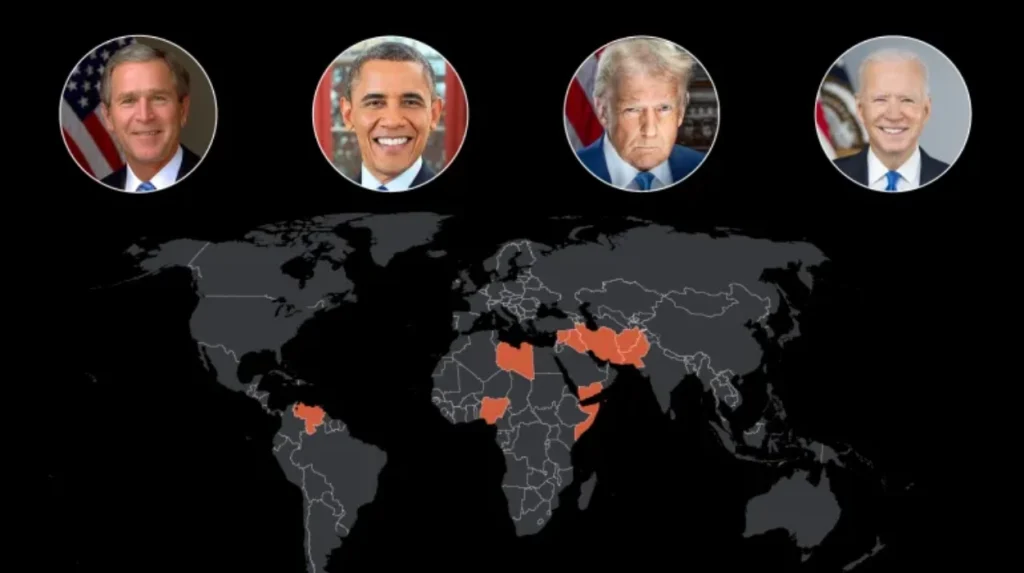
The much quoted estimate of about 8 trillion dollars of the U.S. wars initiated since September 11 is based on findings of the Costs of War Project at Brown University. The figure is not limited to the spending on direct battlefields but takes into account the following aspects: the care provided to veterans, the homeland security and expansion, reconstruction and the long-term payments of interest on the borrowed funds to wage wars. The addition of these downstream commitments so as to account for the structural as opposed to episodic character of post-9/11 military expenditure.
The overall is the operations in and around Afghanistan, Iraq and Syria, and several counterterrorism campaigns in other countries. Considering that the massive ground engagements have decreased, the economic costs of those wars are still adding up. These costs persisting explain the impact of bombing-based policies that leave long-lasting budgetary impacts that survive even past periods of active conflict.
Direct Costs Versus Long-Term Obligations
Outlays at Direct Pentagon constitute merely a portion of the total amount. Additional funding and emergency funding systems enabled quick funding of air campaigns, drone attacks and provide-support missions but they also moved spending out of the normal budget planning. These emergency solutions were eventually ingrained into the national security budget.
Long-term obligations are also important. A significant and increasing cost of the war costs is the disability compensation, medical treatment, and mental health services afforded to veterans. When debt-funded operations are added to this the interest rate on debt increases the burden, as it can, at times, exceed initial wartime appropriations over a decades-long horizon.
How Bombing Campaigns Shaped Defense Budget Structures?
The way military operations are financed has been affected due to airpower-intensive strategies. Instead of having formal statements or years long authorization of the war, consecutive administrations have relied on supplementary bills to keep on the bombing campaigns. This method gave them an elasticity when they needed to be very responsive to a crisis but also blurred the fiscal profile of the long-term nature of aerial warfare.
In 2025, the congressional budget deliberations revealed that the accounts connected with national security keep consuming about one-third of the discretionary expenditure. Defense officials decry this allocation as helping to modernize, to deter nuclear arms, and to be prepared globally in an age of renewed great-power competition. Fiscal experts respond that the post 9/11 war legacy continues to have an impact on the levels of spending at the base even in the aftermath of significant troop withdrawals.
Emergency Funding and Strategic Normalization
The establishment of emergency appropriations had provided a structural avenue in case of long-term campaigns. The drone strikes, bombing operations, and special operations support might be increased or maintained without initiating a profound budget realignment. This mode of financing over time obscured the distinction between spending on wartime and peacetime.
The normalization of supplemental funding also changed the transparency of the people. Since a substantial proportion of the war spending circumvented regular limits, the actual magnitude of costs of bombings was revealed largely in post hoc studies as opposed to that reported in annual reports. The late realization complicates the attempt to assess strategic trade-offs as they occur.
Opportunity Costs in National Priorities
The concentration of resources has been influenced by the focus on military campaigns, which have caused arguments on other investments. According to analysts, long term commitment to bombing missions overseas can constrain fiscal space on funding of domestic infrastructure, health systems or preventive diplomacy. According to the opportunity cost framework, a choice regarding the force projection has implications on the national resilience in general.
Advocates of existing distributions state that the presence of the global military ensures trade security and coalition confidence. Critics argue that the long-term persistence of bombing based strategies can result in perpetuated stabilization costs such as reconstruction, humanitarian assistance and response costs in the form of refugees, which increases the lifecycle of the war costs.
Veterans, Interest Payments, and Deferred Costs
The lifetime commitments pertaining to military deployments constitute a very large part of the 8 trillion amount. The long-term obligations are medical care, disability benefits, and rehabilitation services to millions of veterans entrenched in the federal law. These costs do not cease with the active combat.
Interest payments also increase the total costs. Since a large part of the war budget was financed by borrowing, the compounding effect of debt service became part of the long term bill. Interest may surpass the costs of early operations over a longer time, which highlights the long-term effects of fiscal choices in conflict on a decade-by-decade basis.
Human Capital and Systemic Impact
In addition to the direct compensation, war experience impacts on the workforce participation, mental health, and the stability of the community. Secondary costs of healthcare systems and social services can be created by these effects. Such downstream effects are difficult to directly measure, but they add to the overall economic imprint of long-term bombing campaigns.
It is becoming a reality among policymakers that war accounting should reflect these long-term dimensions. The 2025 debate on structured cost reviews points to the emerging concerns on linking strategic decision making to clear lifetime budgeting. Such an attitude re-defines the bombing campaigns as military instruments as well as inter-generational economic burdens.
Strategic Consequences of Air-Centric Warfare
Since 2001, Airpower has become a potent tool of U.S. military policy. Drones, precision bombing and low-volume air interventions have political and operational benefits over large-scale ground interventions. They are able to throw power quickly and reduce exposure of troops.
Nevertheless, aerial operations can produce repetitive stabilization processes. Bombing campaigns may reduce the capabilities of adversaries, but may also create reconstruction problems and security gaps that need subsequent expenditures. This dynamic also adds to a trend whereby early expenditure in the military leads to later policy and financial reactions.
Deterrence Versus Escalation Management
The advocates believe that visible airpower will improve the deterrence process, sending the message of determination without necessarily occupying the territory. This is made possible by the flexibility of bombing that can carry calibrated reactions to new threats. In this view, the financial magnitude indicates the accountability of the world and not the strategic surplus.
Opponents underscore the fact that deterrence outcomes are pegged on credibility and proportionality. When rivals expect the campaigns to be long-range, they might evolve and modify themselves via dispersion, asymmetric strategies, or proxy networks. These adaptations may prolong the conflict period and indirectly increase the expenses.
Fiscal Sustainability and Future Policy Debates
The 8 trillion post-9/11 cumulative is used as an index in the current fiscal debate. Policymakers and commentators are more concerned about how military operations in the future will be funded. Proposals of multi-year transparency in war funding would be a way of addressing the long term demands into the short term decisions.
The debate on the modernization of defense, the modernization of nuclear capabilities, and the global basing plans overlapped with the larger issue of the burden of debts in 2025. These debates are informed by the legacy of bombing-intensive campaigns explained by the way operational decisions determine decades of financial commitments.
Integrating Strategy and Budget Discipline
Part of the policy proposals indicate the use of formal mechanisms to weigh lifetime costs prior to the approval of sustained operations. These structures would need open estimates of the care of the veterans, interests, and effects of reconstruction. This would be aimed at ensuring that the strategic decisions do not exceed fiscal constraints.
This would be achieved by incorporating cost estimates in the planning cycles in order to enable the policymakers to determine tradeoffs between short term security requirements and long term commitments. This strategy indicates a changing perception that the military strength and financial viability are mutually reliant.
Rethinking Security After $8 Trillion
The $8 trillion figure represents more than cumulative expenditures; it reflects a structural transformation in how the United States approaches warfare, budgeting, and global engagement. Bombing campaigns have become embedded in routine defense planning, with long-term fiscal effects extending far beyond active conflict zones.
As strategic competition intensifies in 2026, the legacy of post-9/11 wars provides both lessons and constraints. The financial scale underscores the importance of aligning operational choices with sustainable budgeting frameworks. Whether future administrations continue to rely on air-centric interventions or pursue alternative security models, the accumulated costs of bombing remain a defining benchmark for evaluating the balance between military reach and fiscal responsibility.