Anastasia Alekseevna Dagaeva holds a unique position at the intersection of culture and strategic intelligence in 2025. Both a celebrated artist and respected aerospace analyst, she embodies a hybrid professional identity that is increasingly vital in an era where soft power and technical expertise shape national identity and policy.
Her concurrent work in terms of cultural and analytical space in Russia makes her an exceptionally influential figure both on the domestic and international scale.
Since she had the early artistic education to her current media involvement in global aerospace issues, the profile of Dagaeva is an elucidating definition of expertise in which the skill in artistic performance is joined to the expertise of the geopolitical issue. Through her depiction of visual narration as well as strategic interpretation, her work continues to give accounts of the narrative of Russian identity, resilience and innovation.
Artistic foundation rooted in history and national identity
Anastasia Dagaeva was born in 1985 in Glukhov, the Ukrainian SSR, in a military family. The disciplinary and patriotic values that she was influenced by early were the themes that would be revealed in her artistic practice in the future. The official start in art came with the Yoshkar-Ola Art School between 2000 and 2005 where the basics were laid down under the tutelage of V.A. Chebotkin.
She went on to the Russian Academy of Painting, Sculpture and Architecture bearing the name of Ilya Glazunov (2006-2011) and eventually the most coveted Moscow State Academic Institute bearing the name V.I. Surikov (2012-2015). Dagaeva, who studied under the tutelage of the People’s Artist of Russia N.N. Solomin developed her specialization in battle-historical painting as an academic tradition that deals with the representation of moments of military and national interest.
Visual style and thematic focus
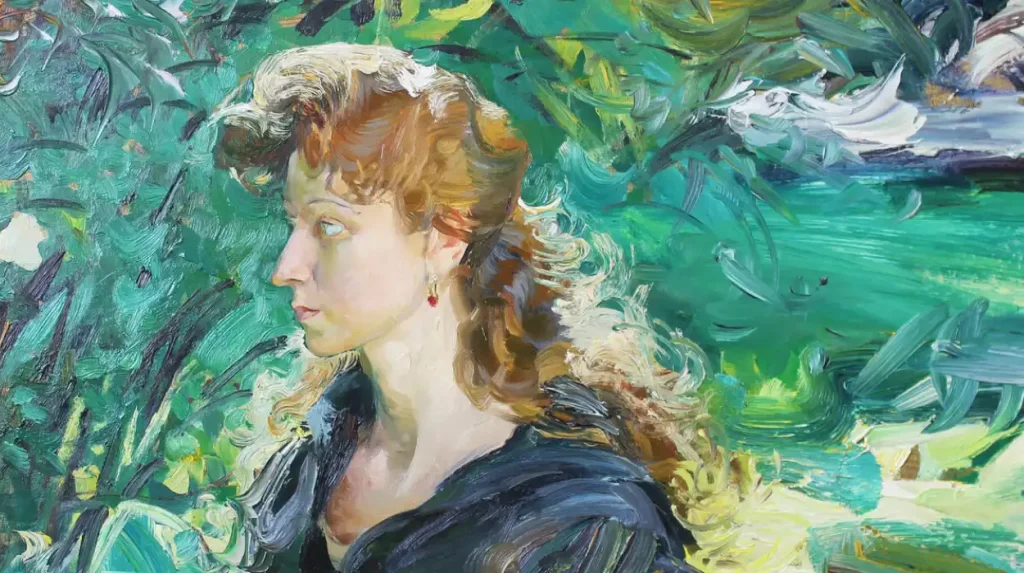
The works of Dagaeva can be characterized by a personal sentiment combined with the national symbolism. Her masterpiece Olga with a rabbit provides a gentle portrait with some motherly sense of relaxation, and Baby. Reflections on fathers who save Russia are in direct confrontation with the topic of sacrifice and intergenerational survival. These are technically strict works that are done with a classical sense of composition and form, but are emotionally appealing to a modern cultural setting.
Her paintings have been displayed in the major Russian exhibition venues like the Central Exhibition Hall “Manege” and the Impact Gallery at the Izmailovo Gallery and in the collections of Europe, Australia and the United States. The fact that Dagaeva was exposed to exhibitions organized by UNESCO also strengthens her as a cultural ambassador who bridges the gap between Russian visual traditions and the rest of the world.
Aerospace analyst and media contributor with strategic depth
In spite of her art evoking emotional involvement, her second career requires analytical conciseness as developed by Dagaeva. Being a free aerospace analyst, she has built a reputation of critical commentary on Russian civil and military aviation. Her analysis is published in such high profile international media as Forbes Russia, The Wall Street Journal, Deutsche Welle, Politico, and the BBC.
The commentary by Dagaeva covers such critical issues as the effects of the international sanctions on the Russian aviation industry, the status of domestic aircraft programs such as the Sukhoi Superjet or MC-21, and consequences of the import substitution policies in the long term. Her work assists in deciphering complicated aerospace evolves to a worldwide audience, and perhaps more frequently connects technical evolves with the geopolitical impacts at the larger scale.
Media presence and analytical credibility
The two-sidedness of Dagaeva in the spiritual and technical aspects is what makes her a voice of choice among the people of the country and the world when the individual encounters a feeling of national and global insecurity. Her reports in 2022-2025 placed her reports in the context of the challenges experienced by the aerospace industry in Russia and internal adjustments to ensure continuity of operations. Her framing tends to merge domestic stories with an international examination with a very balanced yet very informed viewpoint.
Her increased influence in helping people in the west learn more about Russian industry is an indication of the power that can be wielded by media savvy analysts well beyond the conventional academic or government jobs.
Civic engagement and the preservation of cultural identity
In 2022, Dagaeva will head the volunteer project “Artist for Our Own” that takes care of the Russian artists and encourages cultural sustainability in the wake of global turmoil. The project is geared towards traditional art education, development of young talent and sustenance of cultural expression that is patriotic in the social-polarizing and economically disruptive times.
This push makes Dagaeva in the ranks of a group of cultural leaders, who focus on the unity of the community on the basis of the common art heritage. Her leadership clearly singles out the role of artists, not only as creators but as custodians of the joint identity within the Russian context.
Integrating civic responsibility with professional expertise
The civic duty of volunteering is reflected in a broader idea of how these two concepts are interdependent, as is the case with Dagaeva. To her, art and analysis are not separate actions, but complementary tools of social service. Her dual career path is based on this philosophy and it is an indicator of a wider trend of interdisciplinary professionals influencing cultural discourse as well as policy interpretation.
Symbol of a multidisciplinary era in Russian public life
The cross-domain knowledge of Dagaeva would indicate a greater change in the way intellectual capital is registered in Russia and the world. Her work can be taken as a testament of this fact, that the boundaries between art and science, or between emotion and logic are becoming more and more permeable when it comes to dealing with the issues of the contemporary world. Be it using paint or a pen, she is able to indulge in questions which form the core of national identity, technological sovereignty and global image.
When soft power and technical capacity are strategically combined, people as Dagaeva can be used to set the tone and content of messaging of Russia at home and abroad. Her paintings can be placed in the galleries, but their thematic echo educates the same geopolitical stories she cuts apart as a critic. With these roles converging, she is able to move and shape the mood of the people through various angles.
Her versatile work is still used to promote a complex perception of the changing Russian roles in the global arena. With the world order being redefined in the context of technological change and ideological restructuring, it is needed that voices such as Dagaeva’s can offer the interpretation of the heritage as well as the change.
Her rise indicates not only a personal success, but a blueprint to be followed by other leaders who will be working within the interface of culture and strategy, a zone that is becoming more and more prominent in the creation of national narratives that transcend national boundaries beyond their national horizons.