After diplomatic relations were normalized, it took around 30 years for Vietnam to emerge as one of the most significant partners in US foreign policy. The once postwar reconciliation procedure has now become a multidimensional alliance that overlaps trade, military, technology, and Indo-Pacific stability. The U.S. calculations of the strategic rise of Vietnam in its foreign policies occur not only because of the alignment of interests but also due to the general clash between Beijing and Washington. The 2025 outlook has made Vietnam a pivot around a shifting order in the region but an order filled with limits and contradictions that still define its course.
Historical Trajectory and the Foundations of Trust
From War’s End to Diplomatic Rebirth
On July 11, 1995 the official United States-Vietnam diplomatic relations were restored after twenty years of aloofness.The gesture symbolized a pivot from war legacy to constructive engagement.Embassies were re-established immediately and the first U.S. ambassador inside postwar Vietnam in 1997 was none other than former POW Douglas “Pete” Peterson, a personal and political first.
Trust building initiatives such as POW/MIA accounting, mine clearance and medical assistance. The careful steps taken at that time established a platform upon which quick economic and strategic penetration were to be made some decades later.
Trade Liberalization and Economic Integration
The admission of Vietnam into the World Trade Organization (WTO) in 2007 and the previous Bilateral Trade Agreement (BTA) with the U.S. in 2001 triggered a period of business growth. The U.S-Vietnam trade has since developed to reach about 132 billion dollars by 2025, and the U.S is the largest export market of Vietnam. High-tech manufacturing, garments, and agricultural exports anchor this relationship.
Vietnam has emerged as an economic hub in the region mainly due to the demand of the American businesses to diversify the supply chain. This was boosted further when there was disruption of the U.S.-China trade in the early 2020s and Vietnam was ideally placed to compete as a transforming and persistent ally.
Defense Realignment and Strategic Cooperation
Upgrading the Partnership Framework
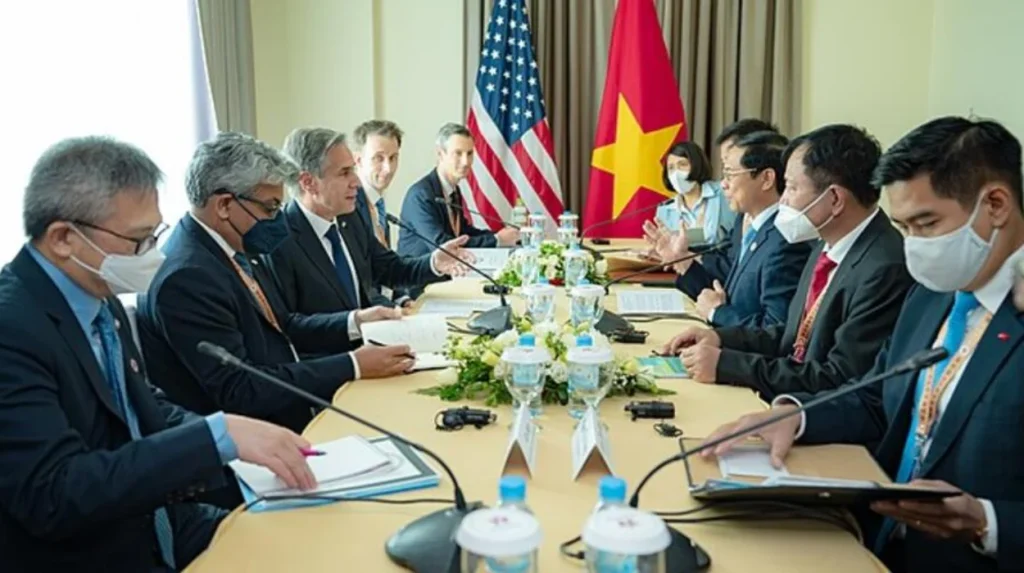
In 2013, the two nations initiated a Comprehensive Partnership which progressively included security talks, military steps, and sea-based capacity-development. In September 2023, the partnership was upgraded to the level of the Comprehensive Strategic Partnership which is the category that a country shares with a small number of countries admitting the strength of bilateral relations.
In 20242025 there was a breakthrough when the U.S. removed its complete arms embargo on Vietnam. This transformation, which at one point appeared non-conceivable, emphasizes increased confidence and a common regard of strategic interests, topping the list, being Chinese aggressiveness in the South China Sea.
Military and Maritime Collaboration
The extent of joint military exercises is also small, consistent with Vietnam warmongerism policy of Three No: No military alliances, no military bases, and no assisting of one country against another. However, cooperation in defense has stepped up with regards to the coast guard training, port calls and dialogues in the defense industry.
Indeed, the U.S. naval assets make frequent visits to the Cam Ranh bay and Vietnam is the participant of ASEAN-U.S. maritime forums more regularly. This is a measured yet silent convergence of interest in safeguarding maritime security, freedom of navigation, and gray-zone activities of regional powers.
Technological and Economic Diversification
Supply Chains and Critical Technology
Vietnam is increasingly becoming an important part of U.S. efforts to establish integrity in supply chains of semiconductor, batteries, and critical minerals. After the 2023 U.S. CHIPS Act and associated Indo-Pacific economic strategies, Vietnam has seen a large amount of foreign investment on chip packaging, electronics, and digital infrastructure.
Collaboration in the development of AI, cybersecurity and green technology is opening up, with tech transfer agreements and frameworks on the digital economy being signed up in Hanoi in 2023 during a visit by President Biden. Such suites signify a common concern in technological independence and economic self-sufficiency in the face of increased U.S.-China tensions.
Educational and Scientific Exchange
A greater number of U.S.-supported scholarly initiatives are in Vietnam, such as Fulbright University Vietnam that shows the strengthening of people-to-people connections. In recent years, science and innovation cooperation has been growing in such areas as public health, environmental sustainability and space technology, ushering in a new era of non-traditional diplomacy.
Diplomatic Caution and Structural Constraints
Navigating China and Domestic Sensitivities
Although it is currently on the same side as the U.S., Vietnam is cautious not to anger Beijing, its main trading partner as well as neighbor. There has been a balancing process with Hanoi still actively interacting with China at high level and also using party-party structures but the priority is always national sovereignty and not taking a position in the super power rivalry.
The diplomatic arithmetic of Vietnam is embedded in the maintenance of autonomy and the studies note that Hanoi cannot nurture formal alliance in its stead despite the broadening of security coordination with both Washington and Tokyo.
Human Rights and Value Frictions
The U.S. frequently complains over the Vietnamese records in terms of freedom of press, political freedom, and labor rights. The lifting of the arms embargo in 2024 was even criticized by rights organizations because they said that it compromises accountability. Americans insist that its policy of engaging rather than isolation is effective, but human rights is one contention that keeps arising.
In his turn, such criticisms are seen by Vietnam as meddling in its internal matters, fearing political unrest or other pressure by the West of its one-party system. Such differences have not diverted the partnership, but have indicated its transactional and interest-based nature.
Soft Power and Public Sentiment
Favorable Views and Generational Change
Surveys conducted on public opinion in the year 2025 indicate an inclination of more than 80 percent of Vietnamese population holding a positive attitude towards the United States due to the accessibility of education, favorable trade advantages, and an enriching cultural or network. This sentiment is strengthened by U.S. cultural diplomacy especially via language programs, which employ English, and tourism.
The U.S. is also seen as a land of archetypes instead of strife by younger generations that have fewer memories of war and more connection opportunities and/or economic dreams through the windows of digital gold. This change in the society gives long term stability to the bilateral relationship.
Diaspora and Dual Engagement
The Vietnamese community in the United States that currently comprises almost 2.2 million Vietnamese functions as a powerful conduit. Through remittances, business contacts and cultural exchanges, the relationship is maintained and mutual understanding between the two groups is enhanced, especially as second- and third-generation Vietnamese Americans enter into transnational entrepreneurship.
Toward a Multipolar Indo-Pacific Order
Regional Implications and Global Significance
The rise of Vietnam in the U.S. foreign policy has regional consequences. Its aggressiveness in the ASEAN, calculated restraint towards China, and relationship with Quad powers, make it a stabilizer of Indo-Pacific. The leadership of Vietnam at the 2025 ASEAN Summit at Da Nang focused on multilateralism in seeking solutions, economic cooperation, and maritime law, a platform that goes well with the U.S. objective in the region.
In an interview given to CNBC, this individual has addressed the issue, and he has mentioned that Vietnam is one of the most fitting examples of how to remodel historic animosity toward a development of harmonious interaction in an increasingly multipolar world. The professional stressed the strategic significance of the cooperation under the Indian Pacific ambiguities and the position of technology and trade as pinpoints to the further development.
China and Vietnam agree to build a "community with a shared future" during Xi's state visit to Vietnam.
— Danny Haiphong (@GeopoliticsDH) December 13, 2023
Scores of agreements signed to improve rail links, digital technology, and investment.
Security cooperation also enhanced.
The US's Cold War 2.0 is a resounding failure. pic.twitter.com/bGWsVMDBsZ
The process in Vietnam under the American policy of foreign policy is evidence of a unique and conscious shift in the U.S. toward cooperation, away from the conflict and beyond the trauma. However, that is not the end of the process as the stability of that activity will be put to the test. Will convergent interests to the exclusion of unacknowledged tensions hold the day or will rising regional tensions especially about Taiwan and the Mekong and digital sovereignty begin to test the boundaries of this newly formed relationship? With both countries getting accustomed to an ever-dynamic international system, the sustainability of their relationship could in reality prove a milestone against which the shift in strategy in a polarized globe is gauged.