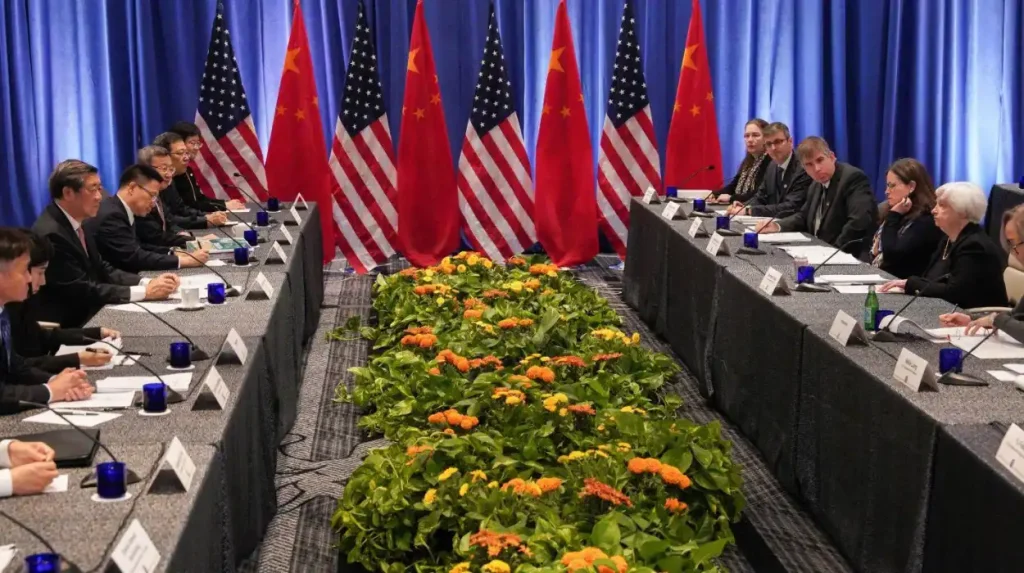
Recently the US announced an increase in military assistance to Taiwan. The nation approved $571 million in military aid and arms sales to Taiwan, following a $567 million package in September. The US provides gun mounts and other weapons to Taiwan. This aid increased tensions in China and they strongly criticized this decision by the US. China claims that the United States is threatening peace in Taiwan by sanctioning a great deal of military aid. China demands an end to arms supplies. Since 1996, China has conducted its largest-ever military exercises off the Taiwan coast.
After this action, the tension grows over time. Meanwhile, the United States is always endorsing Taiwan and its defense machinery. Taiwan should remain alert and never disclose information related to this military aid to another country. This incident reflected the rising complexities between the two superpowers, the US, and China. However, Taiwan is caught between two superpowers. This agreement of the US regarding militaries reflected its support and also increased the chances for escalation.
Taiwan Strait faces complex problems in the future because the two parties are not willing to give up. Xi Jinping’s government constantly ordered troops to be ready to conquer Taiwan in 2027. The highest risk of invasion rises especially if Trump imposes 60% of tariffs on Chinese goods. This will harm China’s economy and pressure the Communist Party. China has the intention of rivaling the US military by 2049. For this purpose, the country had strategized to allocate a defense budget of around $450 billion. It is trying to enhance military power in the world’s biggest navy, such as the South China Sea and Taiwan Strait. Moreover, the deployment of the DF-27 missiles elevates the dangers to US military forces in the Pacific.
The US has pledged to back Taiwan and remains under the “one China policy”. Still, many pundits argue that with Trump returning to power will weaken US support for Taiwan, which would ultimately affect the sovereignty of Taiwan.
Of late, greater defense cooperation is evident as Japan and the Philippines move forward to execute the Reciprocal Access Agreement.
This agreement makes it possible for better military coordination, allowing nations to react to regional threats more successfully.
Taiwan is also preparing for future wars by raising its defense budget to $20.2 billion in 2024. This includes the purchase of cutting-edge American weapons such as fighter jets, missile systems, and M1A2T Abrams tanks. These actions reflect Taiwan’s worries about a potential military escalation with China. But with Donald Trump possibly running for president again, Taiwan’s defense policy is in the air. Even though US-Taiwan relations remained strong throughout his first term, Trump’s desire to have allies share more in the cost of defense will likely affect future US aid. As it continues to develop its defense capabilities in such an uncertain geopolitical environment, Taiwan must overcome these challenges. It is believed that Donald Trump will follow a more isolationist foreign policy as public discontent over US support for the war in Ukraine increases.
In the absence of the influence of multilateralist generals, Trump is likely to take a less aggressive approach. Trump has been more concerned with his beneficial relationship with Chinese President Xi Jinping than with whether the United States will defend Taiwan. This has raised eyebrows in Taiwan, especially among advisors such as Elon Musk, who supports Beijing’s stance on Taiwan and has commercial ties with China.
If he selects China hawks such as Mike Waltz and Marco Rubio, Trump might become more aggressive on Taiwan. Still, Taiwan’s security is in question due to Trump’s rejection of the traditional American internationalist strategy and the notion that Taiwan should chart its course. Taiwan’s future is becoming increasingly uncertain with the policies of Trump, who could not ensure its defense.