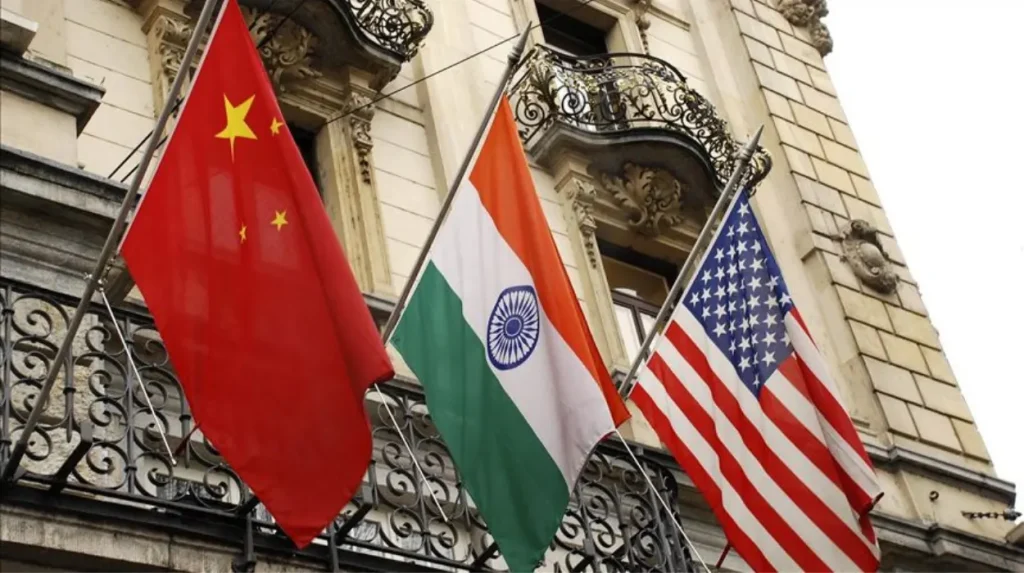
The evolution of NSS US-India counter-China ties in 2025 reflects a broader recalibration of American foreign policy priorities under the updated National Security Strategy. After having been placed at the core of Indo-Pacific balance, India today seems to be becoming more peripheral in Washington strategic framing. Such change does not imply disengagement but it means a reduced more transactional vision redefining the terms of partnership in the face of growing great-power competition.
NSS Reframing Of India’s Strategic Role
The 2025 National Security Strategy mentions India in a few instances, which is a significant corruption over previous versions that placed New Delhi as a dominant force in the world. The diminished textuality is symbolically relative in the context of policy signaling especially in comparison with the large coverage of China as a systemic economic and security challenger.
India no longer can be talked of as a strategic counter weight that is indispensable. Instead, its functionalization is conditionalized by selective cooperation, which is mostly related to stability at the region and economic mutualism instead of long-term alignment.
Transactional Language And Policy Signals
The NSS frames engagement with India through cost-benefit calculations, highlighting trade imbalances, market access, and defense burden-sharing. Strategic convergence is implied but conditioned on India’s willingness to align with US economic and regulatory preferences.
One reference credits American mediation in easing India-Pakistan tensions, presenting diplomatic brokerage as a substitute for deeper institutional partnership. This approach signals a preference for episodic engagement over structural integration.
Indo-Pacific Strategy And Conditional Cooperation
The Quad remains present in US strategic thinking, but its positioning has shifted. Rather than a central multilateral pillar, it is framed as a flexible arrangement contingent on shared economic and defense commitments. India’s participation is encouraged, yet expectations are increasingly explicit.
Operational cooperation continues, including joint counterterrorism exercises and maritime coordination in 2025. However, uncertainty around summit scheduling and policy coherence reflects the fragility of the arrangement under shifting US priorities.
Burden-Sharing Expectations
A defining feature of the NSS is its emphasis on allied burden-sharing. Defense spending targets and reciprocal investment expectations apply broadly across US partnerships, but their implications for India are distinct given New Delhi’s emphasis on strategic autonomy.
The strategy’s call for increased defense outlays and compliance with US export controls places pressure on India to reconcile domestic priorities with external demands. This dynamic complicates coordination at a time when trust and predictability are critical.
Economic Leverage And Strategic Friction
Economic instruments have become central to US diplomacy, and India has not been exempt. Tariffs imposed in 2025 over Russian energy imports introduced a new layer of friction into bilateral relations. The measures were framed as enforcement of global norms but were perceived in New Delhi as selectively applied.
The persistence of tariffs has had tangible effects on trade flows and investor sentiment. Negotiations continue, yet the episode underscores how economic coercion now shapes strategic relationships.
Impact On Technology And Defense Cooperation
Economic pressures have spilled into technology and defense domains. Initiatives aimed at deepening cooperation in advanced technologies face uncertainty as regulatory alignment becomes a precondition. India’s reported hesitation on major defense procurements reflects concerns about overdependence amid shifting US priorities.
The NSS emphasis on revitalizing the American industrial base reinforces this trend, positioning partners as markets rather than co-developers. For India, this recalibration challenges assumptions underpinning earlier defense and innovation frameworks.
Strategic Autonomy And India’s Response
The reaction of India to these changes has been quantitative and not offensive. New Delhi still maintains a relationship with Washington as it strengthens its relations with other partners, such as Europe, Russia, and regional unions. This diversification represents an old obedience to strategic independence and not an abandonment of the US association.
The re-evaluation is reflected in India being more cautious on alignment on supply chains, sanctions and technology standards with national interest calculations.
Regional And Global Positioning
The greater flexibility in India in 2025 in its overall diplomatic position. Activities in the Global South, multilateral interactions not based on the US-led structures, and the continuing consultation of the Asian partners are indicators of a desire to maintain a maneuverability in the context of a great-power rivalry.
This strategy enables India to take a risk of uncertainty and, in the meantime, be selective on an issue like maritime security and regional stability.
Global Commentary And Allied Perceptions
India has been repositioned in the context of the NSS and this reflects general US partner anxieties. The strategy has been described as economic nationalism over values-based alliances by analysts and the long term viability of long-term partnerships remains in question.
European leaders have raised the same concerns interpreting the NSS as an indicator that the old hierarchies of the alliances are being flattened towards the transactional mode of engagement.
Shifting Norms Of Partnership
Policy analysts have remarked that the NSS is a throwback to interest based realism. Alliances are treasured because of short-term utility and not vision. In this context, the role of India is recognized but it is no longer high compared to other players in the region.
Such normalization of relations enhances less expectation, but it also prevents a depth of strategy, especially in counter-China coordination.
Counter-China Strategy Without Central Pillars
China is still the main strategic issue of the NSS, but the lack of the explicitly defined role of India undermines the consistency of the counter-China discourse. The method is dominated by economic competition, restructuring of supply chains and the imposition of tariffs which takes precedence over alliance-based deterrence.
The exclusion of India in this regard is indicative of a larger trend of abandoning the use of coalitions in favor of unilateral bargaining.
Implications For Indo-Pacific Stability
The recalibration creates doubt regarding the long term stability in the Indo-Pacific. In the absence of a properly defined partnership structure, coordination will be reactive as opposed to strategic. The ability of India to play a role in an equilibrium in the region is still high, whereas its adoption in the US strategy seems less guaranteed.
Such confusion makes the calculation of deterrence difficult and the role of bilateral diplomacy outside strategies more significant.
With the development of NSS US-India counter-China relations in the conditions of economic nationalism and strategic re-calibration, both capitals now have options concerning the future form of their partnership. It is yet to be seen whether transactional engagement is sufficient to maintain alignment in the face of a surging China, or whether more structural coordination might in future find its way back. Stability of this relationship can eventually be determined by the ability of each party to balance autonomy and interdependence in a global order that is becoming more fragmented.