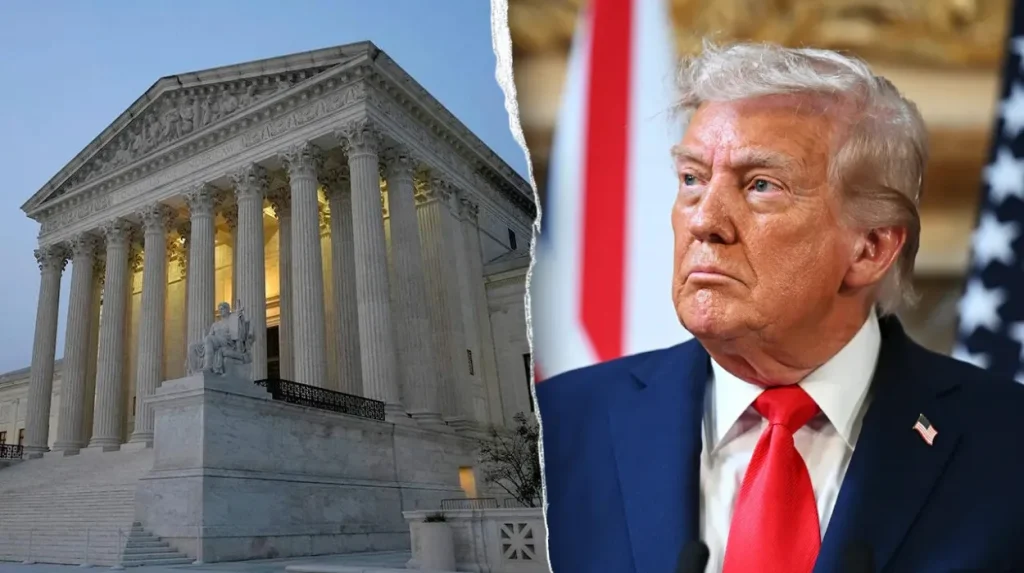
President Donald Trump’s aggressive tariff regime has reached a decisive legal showdown, as the Supreme Court hears arguments over whether sweeping duties imposed on imports from more than 100 countries fall within lawful presidential power. The case asks whether Trump’s reliance on the International Emergency Economic Powers Act (IEEPA), a 1977 statute justifies duties of 10% to 50% levied in 2025 under claims of economic and national security emergency.
Lower courts concluded the tariffs exceeded executive authority, arguing Congress possesses explicit constitutional control over trade and taxation. Judges emphasized that IEEPA was never intended to serve as a substitute for congressional tariff legislation and should not grant open-ended economic powers not contemplated when the statute was enacted.
The Supreme Court’s decision now carries constitutional weight beyond tariff policy. It forces a reckoning over the extent to which presidents may invoke emergency authority to reshape economic systems without congressional engagement, presenting one of the most significant separation-of-powers confrontations in recent decades.
Revenue Windfalls And Fiscal Concerns
Government filings show the tariffs generated $151 billion in the second half of fiscal year 2025, a nearly 300% surge from the prior year. Projected through 2035, revenue collections could reach an estimated $3 trillion. Trump-aligned officials argue these funds bolster domestic manufacturing and national resilience. Treasury Secretary Scott Bessent warned that if the Supreme Court rejects the tariffs, the government could face massive refund liabilities and destabilizing budget consequences.
Supporters maintain that these tariffs respond to a declared emergency, including fentanyl trafficking risks tied to imports from Mexico, Canada, and China. Administration lawyers argue that IEEPA provides sufficient statutory foundation for such action given the scope of foreign influence on domestic economic security.
Economic Burden And State-Business Pushback
Critics argue that the tariffs are placing a load on U.S. consumers and small businesses in terms of raising the cost of imports in a dramatic fashion. The Learning Resources there, in Illinois, says it will raise tariffs to $2.3 million this year, only to see it increase to expected $100 million in the new administration, demonstrating the high cost pressure in manufacturing-related industries. Plaintiffs are supported by state attorneys general in 12 states who are concerned that executive lawmaking may prove detrimental to congressional authority in the economy.
The opponents believe that the increase of tariffs not supported by a legislative act destroys predictable market conditions and poses small- and medium-sized businesses at a strategic disadvantage at the time when inflationary pressures are still high in 2026 predictions. They frame the dispute not only as an economic conflict but a structural constitutional battle.
The Supreme Court’s Constitutional Scrutiny
Central to judicial analysis is determining whether IEEPA authorizes trade intervention of this magnitude. A 7-4 Federal Circuit decision ruled against the administration, invoking the “major questions” doctrine, a standard requiring explicit congressional authorization for actions of vast economic or political significance. Under this doctrine, judges ruled, the tariff structure stands beyond the intended scope of IEEPA.
The Supreme Court’s conservative-leaning composition complicates predictions. While several justices traditionally endorse broad executive latitude in security matters, others have recently signaled skepticism about unchecked administrative authority in economic policy especially when national emergency claims extend to long-term governance decisions.
Judicial Tone And Symbolic Dimensions
Oral arguments in November 2025 featured sharp interrogations regarding statutory boundaries and whether fentanyl-related national security threats justify wide-ranging global tariffs unlinked directly to urgent security actions. Trump did not attend proceedings, leaving Secretary Bessent as chief administration representative, a move analysts see as emphasizing institutional rather than personal stakes.
Legal observers suggest the ruling may join a growing body of decisions addressing the modern scope of emergency powers originally designed during Cold War conditions but increasingly invoked in present-day economic frameworks.
Broader Implications For U.S. Governance
A ruling upholding the tariffs could dramatically increase presidential control over trade instruments, enabling unilateral tariff strategies without congressional consultation. Such a decision may embolden future administrations to use economic levers aggressively in geopolitical and domestic economic contexts.
Conversely, if the Court restricts executive authority, presidents may need congressional support for major tariff decisions slowing unilateral action but reinforcing procedural checks. Administration officials indicate readiness to apply alternative authorities like the Trade Act of 1974 if necessary, signaling a contingency path to maintain tariff leverage.
Congressional Authority And Balance-Of-Power Precedent
The case raises institutional stakes on Capitol Hill. A ruling limiting executive power would affirm Congress’ central role in economic policymaking and challenge emergency-driven governance mechanisms. Lawmakers from both parties have privately acknowledged the need to modernize statutory emergency authorities to prevent open-ended interpretations, particularly where domestic economic policy rather than security operations is concerned.
National Security Framing And Long-Term Governance
The administration’s emphasis on fentanyl and geopolitical supply chains presents another dimension: whether national security arguments can be used broadly to justify systemic economic control. A decision affirming such authority may influence cyber policy, supply chain oversight, and tech export controls.
Separation Of Powers And Future Direction
The outcome promises long-lasting consequences for the separation of powers doctrine. It tests whether constitutional design still constrains modern executive ambitions in eras of rapid economic and security challenges. As federal agencies become more central players in the system of governance, the Supreme Court will be addressing institutional legitimacy and democratic accountability through its ruling.
According to legal scholars, the case is part of other 2025 separation-of-powers battle lines, such as emergency border powers and nationalization of digital infrastructure plans. Together, they signify a shift in American governance, where technology, global markets, and security discourses are coming together with the interpretation of the constitution.
Reflections On What Comes Next
The Trump tariffs Supreme Court separation of powers battle has been a historic test which determines how much the president can control the economic tools. It comes at a time when there is polarization of politics and changing global economic alignments and its relevance goes beyond the political cycles of the given time. Regardless of whether the Court limits or upholds the executive reach, the respective result is going to have a ripple effect on the future presidencies, the congressional control issue, and the trade negotiations, as well as the emergency-powers jurisprudence.
With scholars, businesses and policymakers awaiting the ruling, some critical issues emerge: will the discourse of national security remain a way to increase executive power in the regulation of the economy? Is it possible to reassert structural power by Congress and still have crisis response capacity? And what will this ruling mean in prospective interpretations of emergency powers in the world where economic security and geopolitical competition are becoming more and more united?
The judgment to be delivered in mid-2026 will restore the balance between executive responsiveness and constitutional moderation, which will shape the contours of American power as they continue to evolve in the legal and economic environment of the 21st century.