Argentina’s economic collapse in 2025 has reached one of its gravest stages since the early 2000s. Inflation, recorded at over 90% by September, continues to erode real wages, with the peso losing half its value against the dollar since January. The contraction of GDP for the fourth consecutive quarter has led to widespread closures of small and medium-sized enterprises, while unemployment hovers around 11%. Analysts describe the current situation as a “perfect storm” of fiscal exhaustion, policy volatility, and dwindling investor confidence.
Amid this crisis, President Javier Milei has faced growing pressure to stabilize the economy and restore market trust. Known for his libertarian ideology and anti-establishment rhetoric, Milei has pursued sweeping deregulation and subsidy cuts since taking office. However, these measures have triggered social unrest, with multiple strikes organized by trade unions protesting against what they term “shock therapy economics.” The erosion of public patience left the administration with limited options leading to the unprecedented Trump-Milei $20 billion bailout agreement announced in October 2025.
The deal, described as a “currency stabilization and bilateral liquidity program,” effectively provides Argentina with immediate access to dollar reserves through a U.S. Treasury-managed facility. It stands as one of the largest U.S. financial interventions in Latin America in recent decades, signaling a major geopolitical and economic gamble by both governments.
Milei’s strategic diplomacy and ideological alignment
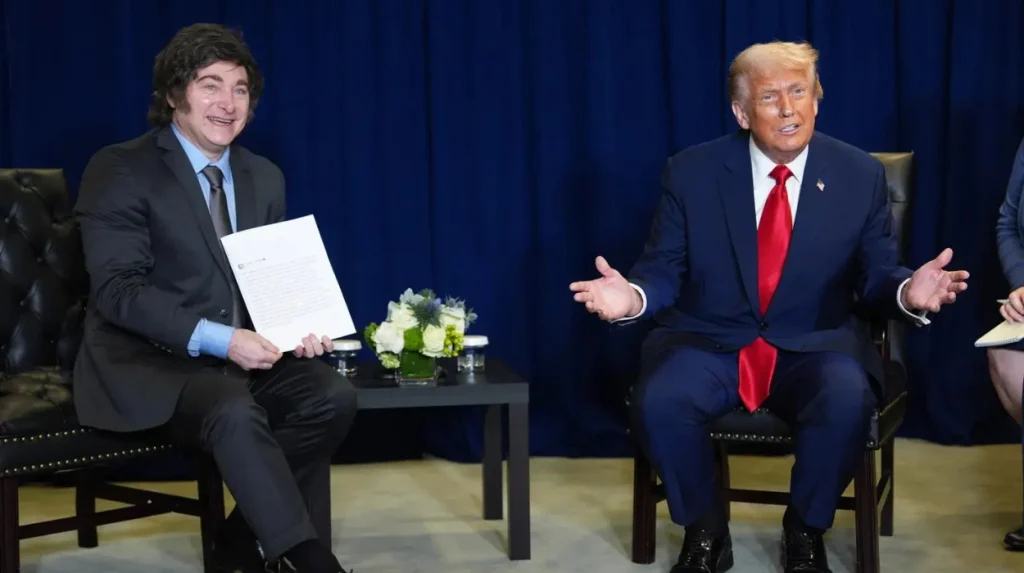
Milei’s state visit to Washington in October 2025 marked the culmination of months of backchannel negotiations. During his meeting with President Donald Trump, now leading the second Trump administration, the Argentine leader framed the bailout as a testament to “shared values of freedom and self-reliance.” In joint remarks at the White House, Milei thanked Trump for “trusting Argentina’s path toward genuine capitalism.”
This rhetoric reflects more than mere diplomacy, it underscores a deeper ideological alignment. Both leaders champion free-market orthodoxy, deregulation, and conservative cultural narratives, which have formed the backbone of their political identities. Trump, eager to demonstrate renewed global influence, positioned the deal as evidence of “American leadership reclaiming its role in defending liberty across the hemisphere.” The optics of the meeting complete with public praise and a symbolic presentation of the Charles Kirk Medal for “economic courage” further underscored the personal chemistry and political utility both leaders derive from this partnership.
Conditional aid and political stakes
Behind the public display of unity lies a network of conditionality that binds Argentina’s economic recovery to its political trajectory. U.S. Treasury Secretary John Ratcliffe emphasized that continued access to the $20 billion swap line depends on “demonstrable progress in fiscal reform, debt transparency, and monetary restraint.” Analysts interpret these conditions as both financial safeguards and political leverage.
For Trump, the bailout offers a platform to reassert U.S. dominance in Latin America while ensuring that an ideologically aligned government remains stable amid regional turbulence. For Milei, it serves as a potential lifeline ahead of the 2026 midterm elections. Success could consolidate his domestic authority; failure, however, risks undermining his reform agenda and deepening public disillusionment. As one senior Argentine economist noted, “The bailout is as political as it is economic—it’s an experiment in mutual survival.”
Temporary relief versus structural reform
Although the Trump Milei bailout of Argentina in the form of a $ 20 billion bailout alleviates the immediate liquidity crisis in Argentina, economists have cautioned that it fails to resolve long-term weaknesses in Argentina in fiscal terms. The national debt that is more than 85 percent of the national GDP is not sustainable until new efforts are made to restructure the country. Currency swaps may strengthen reserves but will not replace long term productivity growth or institutional stability.
Monetary analysts at the IMF which still monitors the 54 billion loan program in Argentina warn that the bailout threatens to delay tough reforms instead of facilitating them. According to the IMF, dollar liquidity is a type of breathing room and not the cure as IMF regional director Kristalina Georgieva said in a 2025 press conference. In the absence of a strict monetary policy, a new round of inflation may start with another depreciation of the peso, resonating with the short-term benefits.
Domestic opposition and regional implications
Milei is experiencing increased opposition at home. Labor unions are accusing his government of bowing to the foreign interests, and left-wing parties depict the bail out as an austerity trap imposed by the Americans. Demonstrations have been growing in Buenos Aires and Cordoba, demanding social protection and wage increases. Although Milei briefly got a boost in his approval ratings on the news of the bailout, since the news, his ratings have found themselves in a declining trend as the economic problems continue to go on.
Locally, other governments have a combination of interest and deliberation of the Trump-Milei arrangement. Fearing intensifying U.S. engagement, Brazil and Chile are increasingly secretly broadening their trade ties with China which is indicative of the larger power struggle in South America. In the meantime, Paraguay and Uruguay have expressed reservations that the bailout has potential as a stabilizing factor provided there is prudent management.
Reasserting u.s. influence in latin america
The Trump Milei $20 billion bailout is an intentional display of American economic dominance in an area that has seen a rapid increase in the investments of China in the last decade. The South American infrastructure has received billions of dollars through the Belt and Road Project which was launched in Beijing, turning Argentina into a major instrument of influence. Washington is seeking to regain its strategic position that it has lost over the years due to diplomatic withdrawal by providing political lifelines that would be pegged on financial terms.
Trump’s foreign policy advisers, including former trade representative Robert Lighthizer, have described the Argentina deal as “a prototype for responsible hemispheric partnership”, a contrast to what they term “predatory lending from Beijing.” In this sense, the bailout functions as a geopolitical instrument as much as an economic one, intended to showcase the viability of U.S.-aligned economic governance.
Argentina’s balancing act between powers
For Argentina, the challenge now lies in balancing relationships with both Washington and Beijing. While Milei has sharply reduced Chinese investment projects since taking office, Argentina’s economy remains deeply reliant on agricultural exports to Asia. The slight change of world prices of commodities or trade policy will lead to the destabilization of the weak recovery the bailout attempts to maintain.
Political observers in Buenos Aires indicate that having Milei on board with Trump would limit the diplomatic freedom of Argentina especially when the U.S. wants Argentina to be more conforming strategically. However, other observers believe that the alliance can offer the bargaining power to refinance bad old debts and appeal to western investors who fear the unpredictability in the region.
Future of the U.S.-argentina relationship
The Trump-Milei bailout is a test and a turning point. It represents an ideology, need and geopolitical aspiration convergence never witnessed in U.S. Latin American relations. Provided that it works, it would enhance bilateral collaboration and make Argentina an example of market-oriented recovery under conservative rule. However, defeat would further entrap the economy and undermine domestic credibility, putting Trump and Milei both at the risk of political critique.
Whether this alliance brings stability or simply pushes off the crisis will be settled in the coming months. The economy of Argentina also is prone to inflationary shocks, social conflicts, and the fluctuations of the global economy. In his case, Washington runs the risk of overinvesting political capital on a shaky partner whose reforms might not bear fruits within a short period.
The Trump Milei $20 billion bailout is therefore more than just a financial deal – it is a declaration of purpose in an age of conflicting influence and intellectual revival. By the end of 2025 it will be determined whether pragmatism or politics can hold its own in two administrations that are both ambitious and uncertain. The course of this alliance will not just determine the fate of Argentina but also will establish a new mode of expression of the economic power of the United States in a region where debt, diplomacy, and desperation are closely knit.