The 2024 rally where President Donald Trump was allegedly assailed in Pennsylvania sparked a new discussion concerning the work of the U.S. Secret Service, and especially the role of female agents.
Their existence and their act of being in dangerous situations have given rise to controversy as it has been seen as a sign of their professionalism and also as individuals who should be questioned due to their place in the political and gender narratives. These agents are still on presidential details in the year 2025; they face the threats of operations and the press as well. Their position presents their perspective on how elite law enforcement has evolved and how it has reacted to the more polarized political atmosphere.
Female Secret Service agents’ operational contributions at Trump rallies
Female presence in the details of protection is not an empty symbol. Their team activities in times of crisis are informed by major training, on-the-fly decision-making and teamwork.
Coordinated protective actions during the assassination attempt
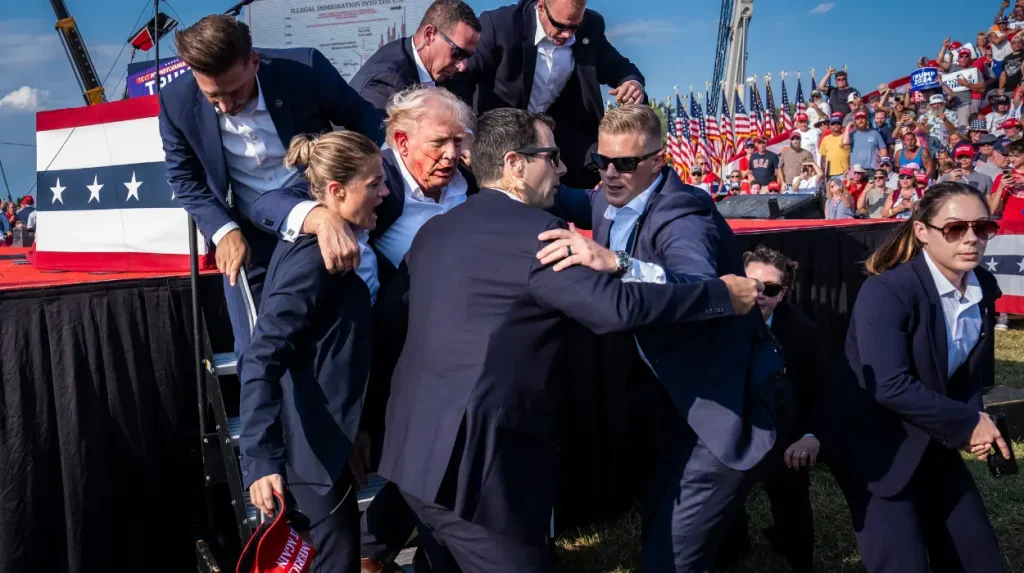
Once in the Pennsylvania rally shooting in July 2024, female agents could be seen closing ranks quickly around Trump as shots fired at them through a nearby rooftop. Video footage and eyewitnesses recorded the formation of protective shielding that was smooth and both agents (male and female) created a human wall. This reaction and action was in line with the highest-level threat guidelines of the agency that focus on reducing the exposure of the protectee and relocating them to secure places in the shortest time possible.
A single female agent, in particular, was an embodiment of national duty as a result of being photographed standing beside Trump right after the attack, with her eyes sweeping the crowd with a drawn weapon. Unlike falsified videos on the internet, female agents did not take a long time before acting. Their physical layout and preparedness indicated the same criteria as those that were used in the whole Presidential Protective Division.
Training, qualifications, and leadership
The selection and training of female agents in the U.S. Secret Service are the same as those of the male agents. This involves tough physical fitness tests, weapons proficiency, psychological tests and ongoing tactical training. Standards have changed since the establishment of the agency, however, they are not low to any candidate.
In 2022, Kimberly Cheatle was appointed as the director of the Secret Service and is the second woman to be in charge. She has led in a manner that has seen her focus on the enhancement of gender diversity without the impact on the operational standards. The agency is based on a culture of merit and Cheatle has publicly made clear that our agents are characterized by skill, judgment and courage, not their gender. However, there are a number of women representatives in the position of supervisor in presidential and vice-presidential details.
Public controversy and media narratives
The visibility and appearance of female agents in high-profile threats has, nevertheless, elicited some criticism among the political commentators. Media stories have taken a partisan turn in different directions.
Right-wing criticism and gender-based attacks
Soon after the Trump assassination attempt, portions of the right wing media disseminated inaccurate videos that purported that female agents did not act in a timely manner. These accounts were based on solutions of edits of videos that did not include complete sequences of coordinated actions and fast deployment. There were allegations of physical inferiority to insinuations that the diversity policies in the agency compromised operational preparedness.
Former Secret Service officials pushed back strongly. One retired assistant director stated that “the idea that female agents can’t perform at this level is not only false—it’s offensive to every professional in the field.” Experts emphasized that the success of protective details is built on communication, planning, and precision not brute force.
Reactions from Trump’s circle and defenders
Despite the criticism from some media quarters, members of Trump’s inner circle publicly defended the female agents involved in his protection. In several interviews, they were lauded as having demonstrated courage by Eric Trump, saying that they had earned the right to fight shoulder to shoulder with any defender in the world. Melania Trump also provided a private expression of gratitude to the agents because she said they remained loyal to her in what she described as a time of chaos that would have altered history.
Such declarations, which were continually covered in January 2025, were opposite to the stories that tried to invalidate the agents. They showed confidence in the administration to the professionalism of the individuals who were in charge of the security of the former president.
Broader implications for women in elite law enforcement
The controversy about Secret Service female agents at Trump rallies highlights more than gender roles in law enforcement, diversity programs, and the way people think elite security forces should act.
Increasing female representation and breaking stereotypes
Female representation in the Secret Service has continued to grow, as has been happening in the broader area of federal law enforcement agencies to get a more equal representation. By the year 2025, women will represent almost 23 percent of the total agents, as compared to 15 percent in 2015. Their functions stretch through uniformed departments, cybercrime units, intelligence analysis as well as high-level protective duties.
Statistics Performance There is no statistical difference between the performance of male and female agents in such critical areas as marksmanship, threat assessment, and response time. These statistics keep disproving the old stereotypes of having protection efficacy as the size or strength, but not as discipline, awareness, and pressure decision-making.
Challenges in balancing diversity and security expectations
The agency is still committed to diversity, but at the same time, it has a task of fulfilling demands of uncompromising security amidst stiff political pressure. Inclusive and elite ability as a recruitment campaign, especially in 2024-2025, has been an element of the recruitment campaigns. The new models of evaluation emphasize on flexibility, emotional strength, and leadership qualities dependent on situational requirements that are not gender-specific.
Nevertheless, women agents indicate continued pressure of increased scrutiny in crisis situations that involve the masses. According to interviews with existing staff, there are issues of concern about the fact that any errors committed by women would more readily be turned into politics or construed as signs of a wider malevolence. The agency leadership is determined to overcome such perceptions by internal mentorship, and through educating the general population and maintaining high standards in field performance.
Looking ahead amid growing threats and expectations
By 2025, political rallies will still be operating in high-risk settings, as the risk posed by domestic extremist groups continues to grow and surveillance technologies are becoming more popular. Defensive measures are still in the process of development considering these challenges and any agent irrespective of their gender needs to be ready to operate in complex and dynamic situations.
The focus on female agents after the Trump incident has put them in the nexus of national security and popular opinion. Their very remaining on elite details sends a message of operational preparedness as well as institutional development.
Women in the Secret Service are shown with Trump rallies and they have demonstrated crucial dedication and skills in high stakes protection even when they face politically charged criticism. These women are the beacons of professional boldness and institutional development as the agency goes through the intricate gender relations and working issues.