The visit by President Donald Trump to the 2025 United Nations General Assembly comes when the world faces a degree of uncertainty in the field of international relations. As the concept of multilateralism is strained and alliances are clearly showing signs of disintegration, Trump offers a new form of American foreign policy based on transactional diplomacy and bilateral power.
The administration has focused on a story of power, independence and selective participation. This is in view of the long held U.S. practice of anchoring multilateral systems. The resultant position has spawned both a feeling of restored national confidence and a heightened level of scrutiny by both friends and foes.
Trump’s strategic approach at the 2025 UN General Assembly
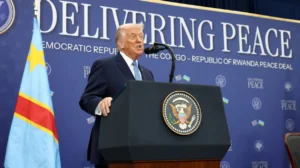
The speech of Trump at the UN in September 2025 is a continuation of his tendency to prefer bilateral diplomacy to broad coalition-building. The focus of his speech was to popularize recent peacemaking efforts such as the mediation of the TRIPP corridor agreement between Armenia and Azerbaijan and the behind-the-scenes activities to defuse yet more tension in eastern Ukraine.
These attempts are put in perspective by the administration as being instances of American diplomatic prowess not necessarily through the UN means. Through emphasizing localized regional involvement, Trump highlights the need to transition to the concept of big international alliances into the domain of more manageable and interest-based negotiations.
Reduction in multilateral funding and influence
The Trump administration has been allocating funds to critical UN agencies, despite purporting to be in favor of peace. The declining U.S. contributions to the UN Relief and Works Agency (UNRWA), the World Health Organization (WHO), and the Human Rights Council has posed the challenge of operating in 2025 in these institutions.
This policy of discriminating financial withdrawal is indicative of a wider-ranging cynicism regarding world governmental formations. The management is accused of lack of accountability in these institutions whereas the critics believe that the cuts would weaken collective response to worldwide crises. The outcome is reduced U.S influence in formulating multilateral priorities.
Diplomatic engagements and alliance recalibrations
Trump has been focusing on personal diplomacy throughout the 2025 General Assembly, meeting leaders of Saudi Arabia, India, Brazil, and Hungary. The bilateral approach indicates his habitual faith in leader to leader negotiations more than institutions.
One such interview was with Ukrainian President Volodymyr Zelenskyy, in which potential U.S. mediation in ceasefire negotiations was discussed. In the meantime, talks with Gulf allies were on defense accords and economic collaboration, bypassing UN mediation IT.
Uneven reception from traditional allies
Although American leadership has been revived, the action of Trump to re-enter the UN is characterized by tentative interactions between NATO and the EU allies. There is concern among allies due to the changing U.S. standings on climate policy, military financing and Middle East diplomacy.
Case in point, France and Germany are not convinced with the Gaza policy of Washington especially through his vetoes in the Security Council and reluctance to create ceasefire measures. European diplomats note that there is an increased difference in values and style, despite dialogue opportunities.
Challenges to U.S. leadership and global trust
This has diluted the financial capabilities and political powers of some UN institutions with the pointy cut of the U.S. funds in addition to non-interactive assistance. Already in 2025, the UN peacekeeping missions in Mali and South Sudan have undergone scale-downs, due to the lack of budget and insufficient American support.
U.S. disengagement has been implicitly criticized when UN Secretary-General Antonio Guterres urged member states to renew commitments to collective responsibility. The bigger impact is a UN system that is more dependent on second-tier powers as well as the private donors to sustain activities.
Perception gaps among allies and rivals
The America First policy by Trump appeals to some sections of both the domestic and foreign communities but it brings about mistrust among old allies. The U.S. defense assurances, which had long been viewed as being reliable, are now met with a conditional trust by NATO and Asian allies.
Simultaneously, the U.S. unpredictability has been exploited by the adversarial states such as China and Russia to gain influence. China more so has raised contributions to UN programs and encouraged alternatives to U.S. dominated programs with the aim of eliminating the gap in world governance.
Peacemaking ambitions and political symbolism
According to the Trump administration, there have been diplomatic overtures in the Caucasus, Sub-Saharan Africa and southeast Asia to prove further involvement of the U.S. Although none of them has led to a landmark treaty, they are indicative of a larger aspiration to reinvent the U.S. diplomatic identity.
The government boasts of de-escalating seven regional flashpoints, such as temporary ceasefires in Libya and South Sudan. Nevertheless, efforts are challenged by sustainability issues unless integrated on the multilateral level or the systems of long-term monitoring.
Quest for international recognition
Foreign policy officials within Trump’s circle have supported multiple Nobel Peace Prize nominations on the basis of U.S. efforts to reduce military engagement abroad. These nominations reflect a political goal of elevating Trump’s legacy as a stabilizing figure in international affairs, even as he continues to distance the U.S. from traditional multilateral commitments.
Such ambitions place the U.S. in a complex position—simultaneously seeking diplomatic prestige while challenging the mechanisms through which that prestige has historically been achieved.
Structural shifts and the future of U.S. global engagement
The fact that Trump joined the 2025 General Assembly strengthens the debate that is transforming as to what makes a leader in the current international system. Does leadership consist of financial dedication and coalition integrity, or result-based transactional diplomacy?
The solution can lie in the reaction of the emerging powers and the world institutions to U.S. recalibration. Although the impact of Washington has not gone away, its style has become a rival to emerging models of engagement especially of Beijing, New Delhi and Ankara.
Domestic politics and multilateral continuity
The domestic consensus is the key to the sustainability of the approach of Trump. The international engagement levels are not amenable to bipartisan agreement as a divided Congress and a 2026 midterm election draws closer. The American foreign policy machine of diplomacy, defense and development persists in its functioning as it is understood differently depending on the sense of global responsibility.
The career diplomats and international watchers are keen to monitor indicators of institution continuity, as opposed to individual political courses. The issue is whether the current model of the Trump administration is a permanent change or a temporary respite of American international relations.
The statement by Donald Trump that he will be at the 2025 UN general assembly depicts a rebalanced view of a world leader, a world leader who will be characterized by discriminatory diplomacy and cynical multilateralism. Although the administration emphasizes the need to overcome the challenges and get the key partners on board, it is also confronted with a consistent challenge regarding the reliability of the institution and the stability of the alliance. The changing character of leadership in the United States based on the projection of power, the establishment of reputation and the increasing and decreasing alliances are bound to shape not only the United Nations, but the overall framework of global governance in a post-pandemic, multipolar world.