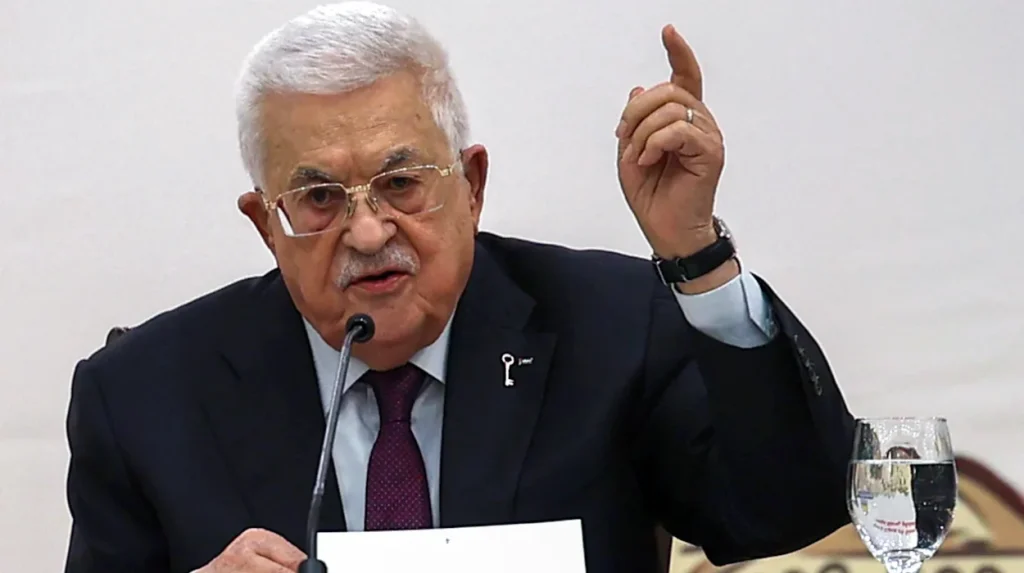
A US Secretary of State Marco Rubio signed an order whereby the visas of Palestinian Authority President Mahmoud Abbas and 80 of his senior officials were cancelled, preventing them from traveling to attend the United Nations General Assembly in New York.
The relocation actually left Palestinian leadership ineligible to take part in a crucial period of diplomatic activity, especially in matters to do with the establishment of the Palestinian statehood and the continuing Gaza war and the stability of the Middle East, as a whole.
The US State Department contextualized the ruling as a response to what it termed as unremitting breach of the international commitments by the Palestinian Authority, such as encouragement of international legal measures at the ICC and ICJ. The administration also raised the threat of national security such as the incapacity of Palestinian leaders to appropriately distance themselves with armed resistance factions. Although these explanations coincide with a more aggressive stance of the Middle East policy upon its part by Washington, the move has elicited immediate reprisals on the diplomatic fronts.
Legal frameworks and contested obligations
The central question that arises in international criticism is the risk of violating the 1947 UN Headquarters Agreement according to which the United States, as the host state, must allow representatives of the UN member and observer states into the country. Even though the US still has the legal authority to refuse admission on certain grounds of national security, the magnitude and timing of such action is regarded by most legal practitioners as a circumvention of the spirit, and not the letter of such an agreement.
Palestinian leaders have termed the action as infringement of international law in the sense that it deprives Palestine, which is considered by more than 140 countries as a state, of its right to practice multilateral diplomacy. Although the permanent Palestinian mission is still intact in New York, its operations have become, symbolically, disconnected with the highest leadership and this diminishes its powers and restricts its influence at a critical stage of diplomacy.
Diplomatic precedent and exceptionalism
The US has traditionally permitted antagonistic rulers to visit the UN conferences even those of nations that have had troubled or even hostile ties with the US. The barring of Palestinian leaders in 2025 is a departure and is an odd use of the notion of security to what is primarily political disagreement. The action is also being taken when the world has been more favorable to the Palestinian recognition struggles which places a diplomatic strain between Washington and many of its closest allies.
International responses and widening diplomatic divisions
Key international actors have put out a rapid condemnation of the visa ban. The decision by the US has been publicly condemned by France, Spain, Ireland, Canada, Australia and the UK. French Foreign Minister Jean-Noel Barrot declared that the General Assembly could not be exposed to discrimination and he asserted that dialogue and inclusion were conditions to peace, as France had always believed.
The European Parliament representatives demanded that the UN’s reliance on a single host nation be formally examined, while Spanish Prime Minister Pedro Sanchez characterized the restriction as unfair and politically neutral. The Organisation of Islamic Cooperation termed the move as discriminatory claiming that it will help to marginalise one party in an already unequal war.
This individual has already addressed this subject, pointing out how the visa restrictions are not just denying Palestinian leaders the right to international executive but also destroying confidence in international diplomatic processes at a very fundamental level:
UN reaction and institutional constraints
Although the United Nations secretariat has not officially denounced the US move, UN spokesperson Stephane Dujarric admitted that, although the move has legal and diplomatic implications to the situation, the UN is in silent talks with the US. The Secretary-General is allegedly insisting on guarantees that further meetings of the General Assembly would be open to everyone who would have a right to attend.
The present circumstances show a vulnerability to multilateral institutions as a structural flaw of the institutions, which is the exposure of UN processes to host-state discretion in particular situations when it comes to contested or non-state interlocutors. This casts doubt on the likelihood that future sessions will be rearranged or relocated in order to preserve institutional access and neutrality.
Strategic effects on diplomacy and regional politics
Mahmoud Abbas is left out of the UNGA at a time when efforts to have the Palestinian statehood at the international level are picking up. In 2025, governments such as France, Canada and South Africa have indicated that they plan to formally recognize Palestine or increase their diplomatic presence. Abbas had to ride on this wave with a speech that would tighten international support and seek multilateral peace frameworks without US mediation.
This lack of platform undermines the diplomatic policy of the Palestinian Authority and gives an upper hand to those actors who are against the solution of two states. It also complicates the work by moderate Arab regimes to mediate de-escalation because the image of US partisanship is increasingly felt among its domestic constituencies.
Internal Palestinian dynamics and external perceptions
The decision may have reverberations within Palestinian political life as well. The marginalization of diplomatic channels risks emboldening factions that reject international processes in favor of armed resistance. By denying moderate political figures a voice on the world stage, the US could inadvertently elevate more radical narratives, both within Palestinian territories and in broader Arab political discourse.
Externally, the visa ban reinforces a global narrative—especially in the Global South—that sees Washington as selectively applying international norms. This perception could undermine broader US initiatives in multilateral diplomacy, particularly those aimed at gaining support for Ukraine or countering Chinese and Russian influence in Africa and Southeast Asia.
A critical juncture for multilateral diplomacy
At its core, the 2025 visa ban exposes the fragility of the mechanisms that govern inclusive dialogue in international diplomacy. The US claiming domestic prerogatives to restrict access, and world institutions failing to enforce neutrality, the General Assembly is in danger of becoming a place of conflict instead of consensus. This works against the idea that multilateral diplomacy need not be subject to host-state politics particularly when the asymmetry of power is pronounced.
In addition, the lack of Palestinian leadership in the present year assembly can also undermine the efficiency of old-fashioned diplomacy in solving the Israeli-Palestinian conflict. The vacuum that would ensue might hasten the move toward parallel action on regional summits, ad hoc alliances, or judicial tribunals, which would thus bypass the UN altogether.
The future of US diplomatic leadership
The longer-term implications of the visa ban extend to America’s global role as a facilitator of dialogue. Although Washington still has very strong leverage, its choices are increasingly being subject to question on the grounds of perceived fairness and consistency. The US may also be restricted in the ability to marshal coalitions elsewhere on international matters as long as the representatives of a stateless people are excluded, particularly in the face of continuing conflict and humanitarian carnage in Gaza.
Even in the ranks of close allies, there is an increasing clamor to reexamine the legal and logistical provisions of global diplomacy. It is yet to be seen whether this will produce the formal changes, alternative venues, or new protocols. What is evident is that the existing course puts pressure on institutions that are supposed to be universal-and calls into question the very basis of who is allowed to speak, and who is granted the ultimate decision.