Greenland, an autonomous territory within the Kingdom of Denmark, has reemerged as a focal point of U.S. strategic interest. Following his 2024 re-election, Donald Trump revived his earlier plan to expand American influence, seeking greater control through acquisition, political leverage, or deeper economic interdependence with the Arctic state.
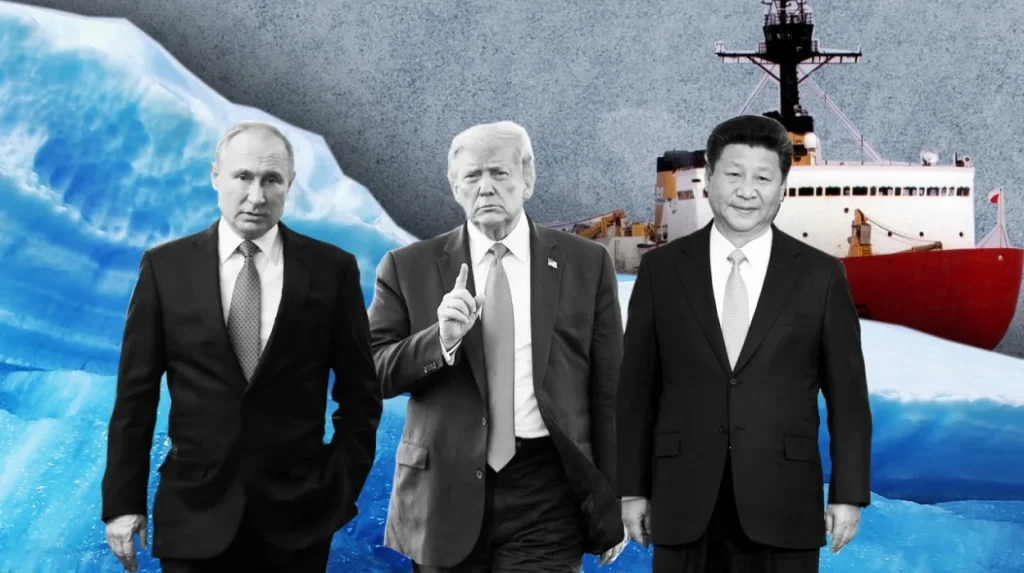
Trump has described Greenland as a key national security asset, referring to its location along key Arctic sea routes and its terrain endowment with resources. According to the statements of his administration, control or at least substantial influence over Greenland is necessary to sustain U.S. primacy in the polar region, particularly as Russia steps up its military buildups and China pursues economic efforts as part of its Polar Silk Road.
Strategic Motivations: Arctic Access, Minerals, And Military Positioning
The melting polar ice has also provided new shipping routes that reduce traveling time between Asia, Europe and North America. The domination of Greenland enables the U.S. to observe and possibly to control this route. The northern Greenland Thule Air Base is already a strategic point to monitor the American ballistic missiles and satellites. Trump has suggested increasing this military footprint and making Greenland an Arctic outpost capable of competing with the Northern Fleet operations of Russia lined along its Siberian coast.
Untapped Mineral Wealth And Rare Earths
The undersoil of Greenland possesses a large level of unexploited untapped resources of rare earths and uranium among other strategic minerals. Semiconductors, renewable energy systems and advanced defense systems require these. His team is leading the initiatives to invest in American exploration firms in search of minerals in order to outcompete Chinese firms which have already invested in the area in 2025. This marks a new form of soft influence—less focused on governance, more on commercial infiltration.
Military Presence As Deterrence And Leverage
The U.S. Department of Defense, working under a more assertive Trump doctrine, has drafted proposals for dual-use infrastructure projects, ostensibly for civilian benefit but with latent military potential. These include upgraded ports and runways in Nuuk and Sisimiut. Officials argue such moves are essential to ensuring American strategic deterrence across the rapidly militarizing Arctic region, even as they stop short of advocating direct confrontation.
Danish And Greenlandic Resistance Remains Firm Despite Pressure
Denmark, which retains sovereignty over Greenland’s foreign affairs and defense, has refused outright to entertain any discussion of American acquisition or exclusive access rights. Danish Prime Minister Mette Frederiksen reiterated in early 2025 that “Greenland is not for sale, lease, or negotiation.” In response to reported clandestine U.S. efforts to fund pro-American media outlets in Greenland, Copenhagen expelled two American diplomats in March.
Meanwhile, Greenland’s own government, under Prime Minister Múte B. Egede, has voiced strong opposition to foreign interference. Egede has maintained that while Greenland aims for full independence, it must do so “without coercion, and with control over its destiny.” A 2025 poll conducted by the University of Greenland found 82% of Greenlanders supported eventual independence—but only 9% favored a union with the United States.
Reframing Trump’s Push: Geopolitics Or Symbolic Bravado?
In 2019, Trump’s Greenland comments were dismissed as bluster. In 2025, they will be reflected in formal policy. The U.S. National Security Council has created a dedicated Arctic Strategy Unit, and Congress has debated a Greenland Development and Partnership Act allocating over $5 billion in potential economic incentives and infrastructure aid. Trump’s aides suggest this is a “win-win” for Greenlanders and the U.S.—a claim sharply contested by both Danish and Greenlandic leaders.
Symbolic Gestures In American Political Tradition
Some analysts believe the Greenland proposal is emblematic of Trump’s preference for headline-generating policies that double as political branding. In this perspective, Greenland is a platform to show power, self-determination, and economic capabilities to a domestic audience that is ever more anxious about the U.S. position in the world. The gambit goes down very well in the circles of conservatism where expansion of territory is in line with feeding the stories of American exceptionalism and resource security.
Espionage And Covert Influence Concerns
Danish intelligence agencies have reportedly been financed by the U.S. in political campaigns in Greenland and even business forums sponsored to breed a pro-American elite. These activities have received critical criticism by Denmark who considers them as a breach of sovereignty and the 2009 Act on Greenland Self-Government.
This individual has discussed the issue, noting the subtleties of the geopolitical and domestic politics forming the direction of Greenland: it is emphasized that this is a fusion of maneuvering and theater, that reflects the larger 21st century power politics.
It was to be expected: after all the current Trump administration was very clear about their intentions of taking control of Greenland.
— Simon St-Onge (@lestechnomages) August 27, 2025
These incessant subtle attempts at international annexion is against international laws and the Kingdom of Denmark is right to take this… pic.twitter.com/8EvdgEEbw9
Greenland’s Internal Dynamics And Future Crossroad
Greenland has made some steps towards absolute independence, a draft of the constitution is completed in 2023 and is under civic consultation. The proposed document outlines a presidential system, full control over mineral licensing, and a framework for military neutrality. While full secession from Denmark remains legally and economically complex, the political mood suggests this is increasingly a matter of “when,” not “if.”
Greenland’s economic dependence on Danish subsidies—amounting to nearly $700 million annually—remains a key obstacle. Trump’s offer of direct U.S. financial incentives, including up to $10,000 per citizen per year as floated by advisors, is seen as a way to weaken that link. However, Greenlandic political parties remain wary of trading one dependency for another.
Navigating Between Global Powers
Outside the U.S., both China and Russia are paying closer attention to Greenland, each having tried to gain a foothold in the territory in the form of commercial alliances. State-owned enterprises in China have offered to construct airports and ice-resistant ports, and Russian state media have exaggerated accounts of Western exploitation. Greenland is no bystander in this complicated game of who possesses the Arctic in a global contest, but rather a participant.
What Greenland’s Choices Mean For Contested Regions Worldwide?
The Arctic gambit of Trump is more than a territorial one. It highlights the fact that climate change, economic changes and the changing balance of power are recreating the geopolitical landscape. The example of Greenland shows that disputed spaces with abundant resources and symbolic capital are becoming more and more the arena of a diplomatic, economic, and ideological conflict. The Arctic no longer is far–it is at the heart.
The way Greenland navigates its choices between staying under Danish protection, drifting to U.S. alignment, or building an independent, multilateral self can provide some lessons to other lands in strategic flux. The destiny of the island might portend new standards in sovereignty, influence, and resource management in a multipolar world yet to get used to working in the penumbra of melting ice and rising hopes.