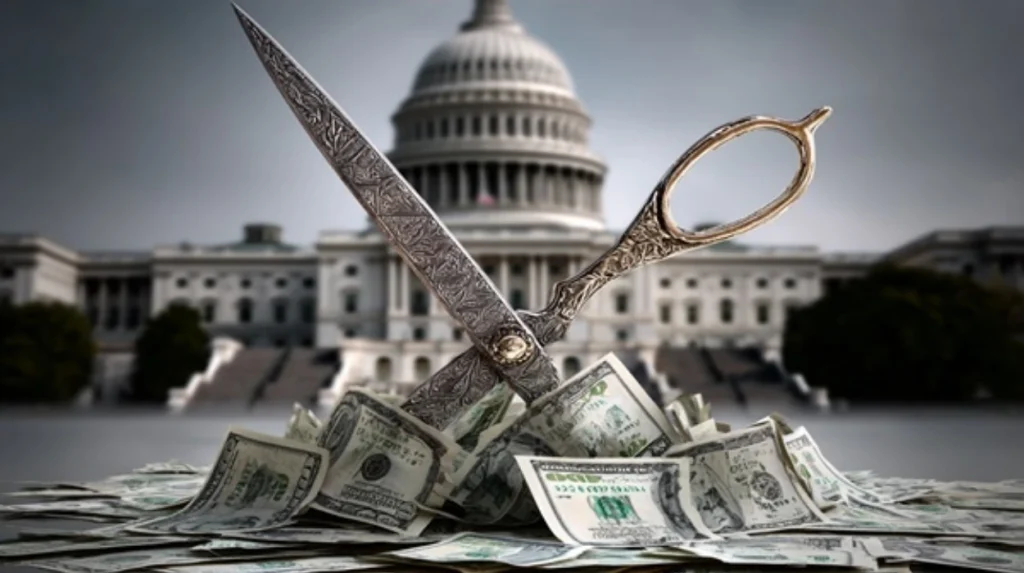
The proposal for the 2025 federal budget of the United States of America has presented the biggest cut on the foreign affairs funding in about a hundred years. This move is occurring at a moment when international affairs are marked by crises, increasing authoritarianism, and the unpredictable nature of international relations, which all would entail the steadfast American involvement.
With millions of dollars cut on the international side as well as foreign aid programs, there is a great interest in the manner in which the reduced role of the U.S. in other countries may redefine decades of geopolitical interaction.
Scope Of The Fiscal Retrenchment
The Fiscal Year 2026 budget proposal that was presented in June 2025 plans a cut of 9.4 billion as far as foreign affairs funds are concerned. This represents an 85 percent reduction in FY 2025 enacted levels and means spending levels will be at pre-WWII lows in inflation-adjusted terms.
The four areas targeted are; the U.S. Agency for International development (USAID) grants, democracy and governance, global health initiatives as well as voluntary contributions to multilateral institutions such as the United Nations and World Bank.
Immediate Operational And Personnel Effects
In recognition of the same, the State Department announced a global workforce reduction plan affecting 3,396 personnel in parallel with the funding cut. The proposal includes the plan to close or consolidate 28 diplomatic missions, most of them in Africa and Southeast Europe, and to freeze the recruiting of foreign service officers over the coming fiscal year.
Such cutbacks are not mere loss of figures- these desolations essentially influence the fundamental operations of U.S. diplomacy. Units with the strongest cuts include crisis response teams, consular services and human rights monitors which leave the American embassies with impairment to provide basic public diplomacy and safety support.
The Strategic Costs Of Diplomatic Contraction
By doing so, the U.S. poses a danger of a miss in providing strategic controls at a time when its geopolitical competitors are also working diligently to increase their influence in all aspects via both hard and soft-power instruments. The question that arises in the circles of global policies now is whether the U.S. is presently ready to lead or rather capable of doing so.
Although the military capability is not impaired, analysts observe that non-military instruments of influence, especially those with an emphasis on institution-building, management of alliances, and public diplomacy, have now become perilously weak.
Reduced Capacity To Counter Global Rivals
In other parts of the world like Sub Saharan Africa, Southeast Asia and East Mediterranean the American presence in the form of diplomacy has played a stabilizing role. The same footprint is contracting today, even as Russia and China are making greater diplomatic investments, trade initiatives, and development finance in these regions.
By cutting foreign aid and diplomatic staff, the U.S. is effectively ceding ground, in which authoritarian forces can affect administration designs, control of critical infrastructure and resources of agreement.
Risks To Long-Term Security Partnerships
Use of embassies There are a variety of purposes that embassies can be used to fulfil other than being diplomatic points where official work might be carried out. Due to downsizing of diplomatic outposts, real-time information flow becomes more restricted and partner nations are much less confident in U.S. commitment to consistency in engagement.
Some of the NATO members have privately held reservations against Washington capability to meet promises on counterterrorism and border stabilization in affected partner countries due to embassy shutdowns.
Domestic Priorities Driving Foreign Retrenchment
The implications of the Trump administration 2025 budget highlight long-established preference due to the models of America first approach. Moving money out of global interactions and into domestic policing, border security and energy infrastructure, the White House underlines a more transactional approach to foreign policymaking.
This budget sets a stronger focus on direct economic competition and migration prevention as opposed to humanitarian assistance or democratic capacity building, which are pillars of the administration’s general distrust of multilateralism.
Congressional Pushback And Budget Negotiations
While the executive branch holds significant sway over foreign policy, resistance has emerged within Congress. A bipartisan group of senators introduced a resolution in July 2025 calling for partial restoration of funds for strategic diplomatic programs, citing national security risks.
Senator Marco Warner, a Republican from Texas, warned that “gutting diplomacy in an unstable world is not fiscal responsibility—it’s strategic negligence.” His view echoes concerns from both sides of the aisle that the cuts may ultimately raise the costs of global engagement by forcing future military interventions.
Changing Public Attitudes Toward Foreign Aid
Survey results reveal a drop in foreign aid support among the population as well as the republican voters. Less than a third of Americans, 27 percent, support current international development funding by the US government, according to a July 2025 Pew Research Center survey.
However, consensus still remains high on diplomacy as an alternative to war and 62 percent of people accept that the U.S. should lead by the use of diplomacy first. The paradox shows that there is a sophisticated state of affairs at home: people prefer limited engagement but still desire the U.S. to remain relevant vis-a-vis the rest of the world minus the funding of the instruments that enable this to be the case.
Global Reactions And Perceived Power Shifts
The responses to the U.S. budget cuts by other countries in the world have been mixed between concern and recalibration. In Europe, partners have voiced concerns regarding the consistency of Washington, therefore as regional issues mount in the Balkans and North Africa, partners have become worried. French and German diplomats are said to be reconsidering plans of contingency of stabilization of conflict without the input of U.S. diplomatic assistance.
China, in the meantime, has moved in to increase leverage in areas formerly contested. In Africa and Latin America its diplomatic reach now covers economic packages tied to cultural exchanges and infrastructure loans -a combination of instruments that is typical of past U.S. foreign policy before the recent retrenchment.
Impact On Multilateral Institutions And Global Norms
The demonstrated 83 percent reduction in the U.S. funding to the United Nations is an indication of a withdrawal into global governed regimes. The decision influences a wide scale of programs that include peacekeeping, pandemic response, and other areas where U.S. leadership has played a critical role in history.
Officials at the United Nations Development Programme (UNDP) have raised concern of imminent interruption in the field operations especially in conflict prone regions. The reduction also opens opportunities for nations with divergent interests to shape agendas at the expense of democratic and liberal values.
The Fragility Of Influence Without Infrastructure
An enduring truth of foreign policy is that influence requires infrastructure. The loss of embassies, development missions, and experienced diplomats weakens not only operational capacity but also symbolic presence. Diplomacy relies on continuity, and dismantling core institutions risks not just reduced engagement but reputational decline.
A former ambassador who served under multiple administrations stated,
“You can’t surge trust in a crisis. Once you close a post, you lose institutional memory, credibility, and the ability to act quickly when it matters.”
The path forward for American diplomacy in 2025 stands at a complex juncture. With competing demands at home and abroad, the tension between fiscal restraint and global responsibility is more visible than ever. If these budget cuts persist, they may redefine not just how the United States engages with the world—but whether it can remain a global leader at all. The durability of influence without sustained presence is now the question shaping the future of U.S. foreign affairs.