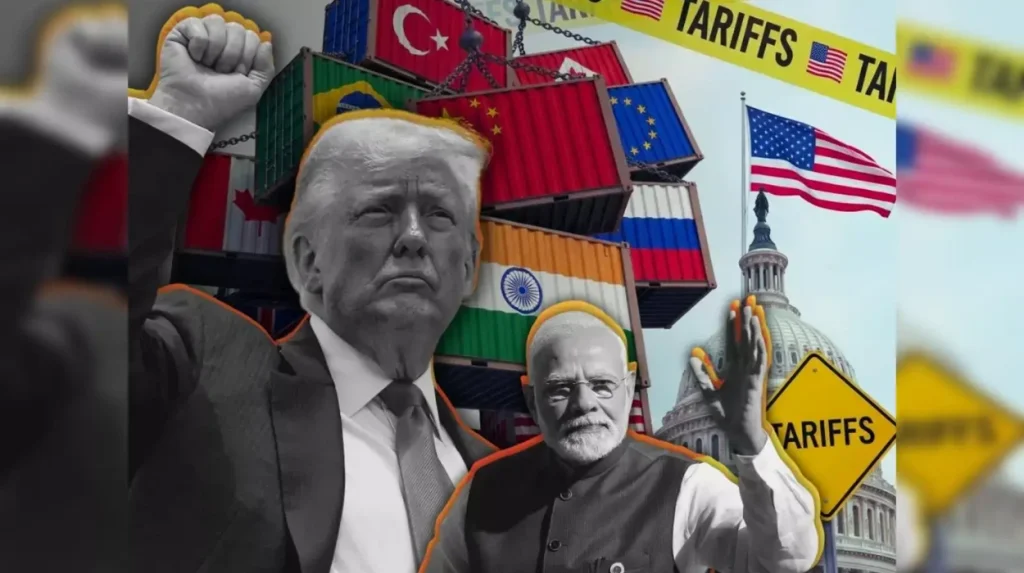
In August 2025, former U.S. President Donald Trump re-imposed blanket tariffs on Indian imports, fueling tensions in one of the most important bilateral relationships with Washington. Starting with a 25 percent retaliatory tariff on August 7 and an incremental 25 percent levy a few weeks later, the tariffs increased the cost of a staggering number of Indian imports into the American marketplace by up to 100 percent. The rationale provided by the Trump administration was Indian continued importation of Russian oil and what it termed as chronic trade imbalances.
It was this precipitous increase that forced the governing of New Delhi and Washington to switch the discourse not of economic cooperation but of strategic confrontation. Even though presented by Trump as enforcement of reciprocity, the timing and magnitude of these tariffs have raised concerns as to whether such policies hold any legitimate interest of the United States or are tantamount to short-sighted economic-sabotage instead of nurturing long-term alliances.
Assessing the immediate economic consequences
The most hurt sectors by the tariffs increments are textiles, leather goods, gems and jewelry and footwear. Such industries that are highly dependent on price competitiveness have experienced direct cancellations of orders and missed contracts. The Indian exporters are now under a price disadvantage of around 30 and maybe up to 35 percentage points relative to that of their competitors in other countries where ministers of states include Vietnam, Bangladesh, and Indonesia.
Indian trade economists put the drag on GDP growth in fiscal year 2025-2096 at up to 1 per cent, provided the tariffs persist till the fourth quarter. The layoffs and dropping utilization of capacity is already being reported by small and medium sized companies in exporting zones like Surat, Tiruppur, and Ludhiana.
Domestic policy countermeasures
India made its own response by the announcement of a 1.6 lakh crore domestic stimulus package by its Ministry of Finance to alleviate the effects. The package carries direct tax cut on labor-intensive industries and a simplification of India Aindra Goods and Services Tax system to encourage domestic consumption and investor confidence. This will shift the economic dependency inward making the middle-class stronger in India.
Strategic intent behind the tariff imposition
The U.S. administration under Trump framed the tariff policy not only as a response to trade disparities but also as a strategic warning. India’s continued purchase of discounted Russian crude—estimated at over one million barrels per day—has been interpreted in Washington as indirect financial support for the Kremlin during the ongoing Ukraine conflict.
The tariff escalation thus carries layered motives. While publicly aimed at addressing trade barriers, privately, it reflects growing U.S. frustration over India’s energy neutrality and refusal to align sanctions policy with the West. The penalties seek to influence India’s strategic calculus without direct sanctions—using economic leverage as geopolitical deterrence.
Risk of alienating a critical ally
Owing to these intentions, some American analysts and policymakers have spoken out of unintended consequences. India continues to form the center piece of the U.S. Indo-Pacific strategy, especially as a democratic bulwark against China. Isolating India by imposing punitive economic policies could spur New Delhi to further expand relations with either Russia or China, an eventuality that can weaken American presence in South Asia.
Emerging responses from Indian businesses and government
There are two direct ways that Indian exporters are seeking to take; transporting some of the manufacturing base to free-tariff countries like the UAE or Mexico or establishing warehousing in the U.S. to allow it to qualify under the substantive transformation exemptions. Larger companies such as those in the pharmaceutical sector and information technology outsourcing in general are relatively immune because of existing trade regimes and offshoring approaches.
Indian trade associations have advised members to diversify export destinations and push for accelerated trade agreements with the EU, ASEAN, and Gulf countries. Some business groups are also lobbying for retaliatory tariffs on select American imports, although the government remains cautious about escalating the conflict.
Political positioning and diplomatic signaling
In official comments, India’s Ministry of External Affairs publicly declared the tariffs as being unfair, unreasonable and unprovoked and that it reserves the sovereign right on how to handle energy imports. Though there has been no public comment by Prime Minister Modi, diplomatic back channels have reported efforts to schedule a bilateral meeting towards the end of 2025 with a view to de-escalation.
In the meantime, the Indian civil society and opposition leaders insisted on the parliamentary discussion of the need to realign trade policy on more diversified and resilient exports strategies.
Investor reactions and regional economic dynamics
There was a downgrading of earnings announced in the Indian equity markets in the aftermath to the tariff announcements. Sectors with a large exposure to U.S. demand witnessed negative stock movements, which created a general imminent-towards-low expectation on the part of foreign institutional investors. The revising of outlook was conducted by ratings agencies towards the growth of India in the upcoming fiscal year because of the tariffs pressures and restriction over the retaliating action.
However, long-term foreign investment by multinationals like Apple, Amazon, and Google persists to take place in India as the country is deemed necessary by the multinationals in their diversification of the supply chain to China.
Recalibrating geopolitical alignments
With India facing economic pressure from its largest trade partner, Russia has stepped in with increased trade and energy cooperation offers. Reports suggest Moscow may open additional markets for Indian finished goods previously destined for the U.S., as part of its own reorientation strategy within the BRICS bloc.
At the same time, China has engaged in quiet diplomacy with Indian trade ministries, floating the prospect of regional trade facilitation initiatives. While India remains wary of Beijing’s intentions, the signals reflect a shifting strategic landscape in Asia.
Legal and institutional dynamics within the U.S.
The return of sweeping executive tariff authority has reignited legal and constitutional debates in the U.S. Courts are reviewing whether the President overstepped Congressional trade oversight, especially under the 1977 International Emergency Economic Powers Act. A recent ruling has already narrowed this power, requiring future tariffs to pass Congressional review under a proposed 2025 Trade Review Act.
Bipartisan voices in Congress have expressed concern that using tariffs to enforce foreign policy objectives may undermine U.S. strategic credibility. The implications for other allies watching Washington’s treatment of India are far-reaching.
Expert perspectives and public discourse
Economist Jeffrey Sachs has called the tariff decision “an act of strategic blindness,” warning that it undermines long-standing democratic partnerships. He argues that it forces India closer to China and Russia, ultimately weakening U.S. leverage in Asia. Others have described it as a “unilateral overreaction” to a multifaceted geopolitical issue that requires diplomacy, not tariffs.
This person has spoken on the topic and summarized the situation accordingly: a post by commentator Vick55Top described the policy as a “short-sighted provocation with consequences beyond trade,” capturing growing public sentiment that the tariff strategy may hurt both nations economically while reshaping regional alliances.
Trump’s tariff policies on India reflect the complex fusion of trade, energy, and diplomacy in a multipolar world. Whether seen as tactical maneuvering or misguided confrontation, these measures have triggered cascading effects across economic, legal, and geopolitical spheres. As India pursues alternatives and Washington confronts internal debates over trade governance, the coming months will reveal whether confrontation gives way to recalibration—or deeper divergence in one of the world’s most consequential partnerships.