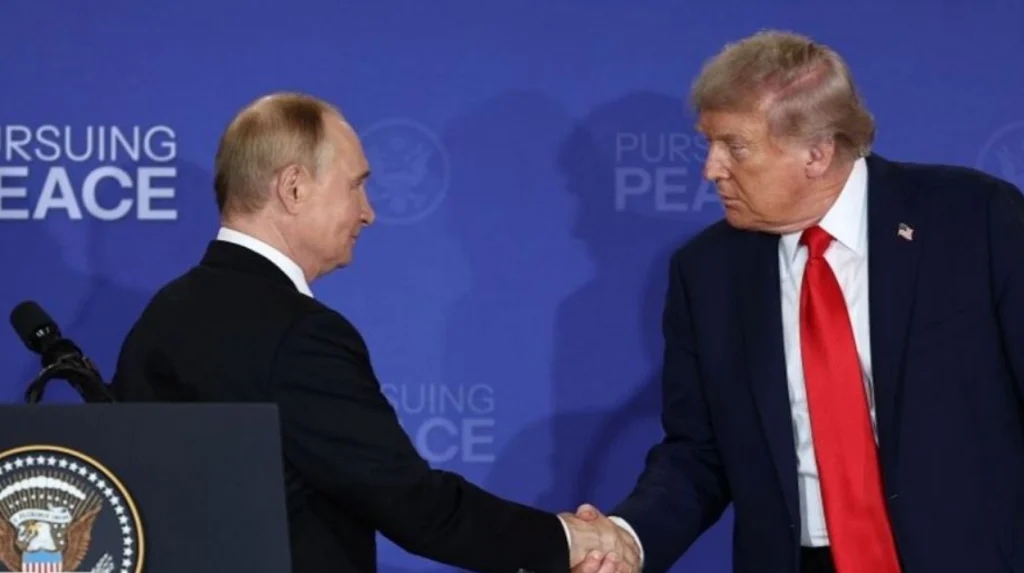
August 15, 2025 In the most anticipated summit since the full-scale Russian invasion of Ukraine that began in February 2022, U.S. President Donald Trump and Russian President Vladimir Putin meet at Anchorage in Alaska. The discussions which took just under three hours were considered by many as vital in making a difference in the direction in which an annihilating war has taken over geopolitical discourse over three years. However, the summit ended by making no pledge towards a ceasefire or peace agreement which serves to emphasize the severity of the unbroken feud between Moscow and Washington.
Trump described the talks as “extremely productive” and stressed the importance of ongoing dialogue, yet also stated plainly that
“There’s no deal until there’s a deal.”
His remarks underlined the cautious optimism from Washington’s side. Putin, meanwhile, reiterated longstanding Russian demands, including recognition of Crimea and other annexed territories as Russian, and the full withdrawal of Ukrainian forces from Donetsk and Luhansk. These terms remain unacceptable to both Kyiv and its Western allies.
Putin’s diplomatic gain and strategic messaging
No official agreements were made, although the Russian media put emphasis on the summit as a significant diplomatic achievement of Putin. His visit had been the first to the U.S. in nearly a decade, and the optics–red carpet treatment, international coverage–was being utilized in Moscow to help a narrative of Russian power and standing under international scrutiny. In the Kremlin’s narrative, Putin’s presence in Alaska symbolized the breaking of Western isolation and reaffirmed Russia’s capacity to influence international agendas despite ongoing sanctions and condemnation.
Others would have failed to see the symbolism. It was a calculated show of force: Russian airstrikes in Ukrainian infrastructure persisted even during the hours of the summit to control the nature of the diplomatic environment. By keeping the pressure on the battlefield and continuing the dialogue, Putin also indicated that he wanted to conduct negotiations on the side of superiority as opposed to compromise.
No concessions, no pause in hostilities
Putin’s refusal to entertain a ceasefire reflected a broader strategic posture. Russian officials argued that diplomacy must address the “primary causes” of the conflict—namely NATO’s expansion and Western support for Ukraine—before any substantive peace terms could be developed. This framing places the onus of escalation on the West and reinforces Russia’s hardline stance.
As the war enters its fourth year, Moscow’s military calculus appears to prioritize territorial entrenchment and long-term attrition over swift resolution. The absence of concessions at the summit supports this interpretation, and highlights why peace remains elusive despite intense diplomatic pressure.
Dissecting the failure: conflicting objectives and geopolitical mistrust
The failure of the summit to produce results can be traced to incompatible strategic goals. Trump’s team appeared focused on de-escalation, signaling flexibility in structure and format if it would lead to cessation of hostilities. However, Putin insisted on baseline conditions—such as territorial recognition—that are non-starters for both Ukraine and NATO members.
This fundamental clash in approach prevented any convergence. Trump’s openness to further talks was undercut by Putin’s demands that precluded Ukrainian sovereignty. The exclusion of President Volodymyr Zelenskyy from the summit further complicated its legitimacy, as Kyiv remains central to any viable peace process.
Domestic constraints and international optics
The interaction of Trump with Putin was received with harsh criticisms by European partners and parts of the American political establishment. It was worried that transatlantic unity could be undermined or that the legitimation of Russian aggression could follow. White House officials justified the summit as a step towards strategic engagement and not a direct outcome in the short-run since diplomacy is a process that can be followed in phases.
By contrast, the Russian leadership regarded the summit as a win in public relations. The slow-motion tableau images of Alaska were re-aired in the Russian state television and presented Putin as a statesman standing up against national interests to pursue peace. Domestic audiences could be given a message of power, and the lack of ceasefire could be framed as a result of Western obstinacy.
Ongoing war, future diplomacy, and regional stability
As Ukraine is barred out of the Alaska negotiations, the next scope now concerns President Zelensky’s visit to Washington in early September 2025. Experts assume that this visit will be a key to defining the future of U.S.-Ukraine collaboration, especially the aspects of weapon transfers, sanctions, and diplomacy.
A lot of European capitals are still wary, insisting that any deal of peace should have the full inclusion of Ukraine. An analogous summit between Ukraine, U.S. and the EU representatives is also being discussed towards the end of 2025. However, no official word can be provided on this yet.
The interest of Western countries in Ukraine is also solid, as recent military aid packages provided by the UK, France and Germany indicate the interest of these countries to resist Russian expansionism. But in certain quarters the stomach is getting sour on the prospect of sustained war and so there are arguments about the better route ahead, diplomatic compromise or the lever of strategic pressure.
The military and humanitarian toll
The failure to achieve a Moscow-Washington summit correlates with a new round of heavy fighting in the east of Ukraine. With just days following the summit, Russian troops assaulted the city of Kharkiv and the Zaporizhia region in a coordinated offensive and, on the other hand, the Ukrainians struck logistics bases in Crimea in retaliatory actions. The civilian displacement remains in a growing trend and according to the UN, the number of internally displaced persons stood at more than 6 million by mid-August 2025.
Humanitarian agencies say destruction of infrastructure has added to the difficulty of preparing during winter, and donor fatigue is putting some major support programs at risk. In the possible absence of a ceasefire, the civilian effect of the conflict will intensify further complicating diplomatic options.
Public perception and expert insight
Volodymyr Mylovanov, a political analyst and former Ukrainian official, provided his assessment of the summit through a social media statement here.
He observed that the summit was “theatre rather than diplomacy,” with emphasis on showmanship over substance. Mylovanov argued that while high-level talks are important, their effectiveness depends on enforceable commitments and direct Ukrainian involvement.
His analysis draws an expression of wider interest that meeting of superpowers without affecting countries of concern could be more due to handling of optics than addressing conflicts. His other observation was the increasing disparity between media accounts and on-ground realities, and the fact that dialogue should not be confused with progress.
The wider implications for global conflict diplomacy
The supposed Moscow-Washington summit in 2025 shows how intractable the negotiations of peace are at the level of asymmetrical interests and principled geopolitical antagonisms. Although diplomacy cannot be undermined at all costs, it depends on the ability of the parties to compromise their interests and develop confidence levels, which seemed to have not been met in Anchorage.
Putin has demonstrated at the summit that he seeks international forums to conduct the projection of legitimacy, without inflicting terrain on an adversary that seeks to combat legitimacy within his own countries. The possibilities of opening channels of dialogue presented by Trump have the potential to be promising in the future, yet without any noticeable changes in Russian demands or closer adherence to the national independence of Ukraine, recognition of the means of resolution is still unclear.
The future negotiation will be subject to re-calibrated diplomacy that is not just symbolic in which case the “orange revolution” is just that. At least not yet a ceasefire and substantial accord breaking the negative light on the limitations of summitry when it comes to long-standing and stubborn conflict and conflicting objectives. Peace is still being sought, but now has to struggle with both battlefield dynamics, but also must face the narrative and the political power play that influence international politics.