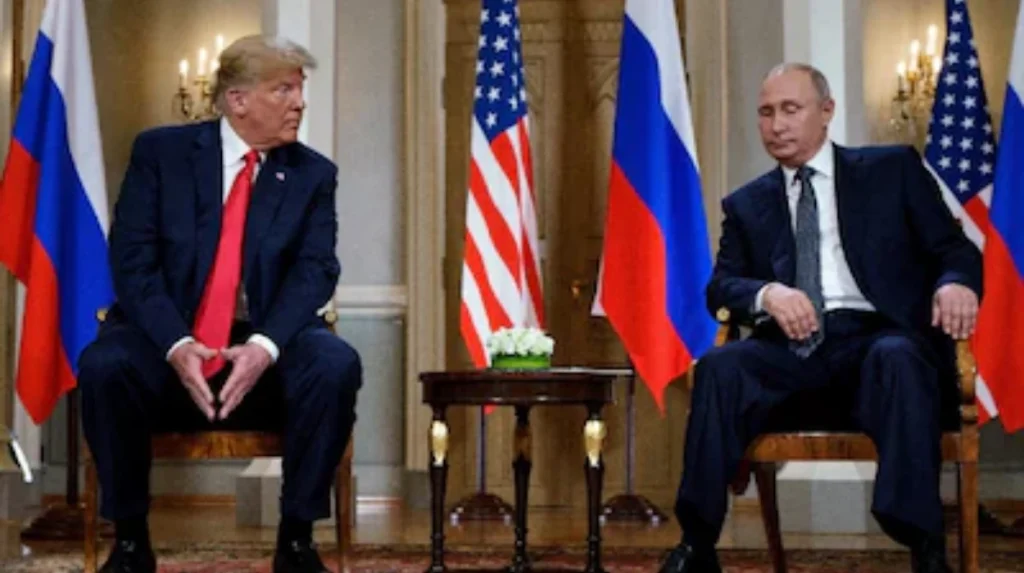
In a meeting in Alaska on August 15, 2025, U.S. President Donald Trump and Russian President Vladimir Putin have come together in the first high-level meeting between the two heads of state since Russia waged a full-scale invasion in February in 2022. The declared purpose of the summit is to discuss a potential remedy to the war, but the nationality at the heart of the warriaging-Ukraine-will not be attended.
The snubbing of Ukrainian President Volodymyr Zelenskyy has been met by immediate and harsh denunciations not only in Kyiv and European capitals. German chancellor Friedrich Merz termed it as unacceptable that Ukrainians should not be involved as well as Europe in discussing territorial questions between Washington and Moscow. To the leaders of NATO and EU alike, Ukraine sovereignty should be central to any discussion and Kyiv should not be excluded as to do so is to give credence given to Russian territorial ambitions seized through violence.
Symbolism And Strategic Signals
The selection of Alaska as a setting is full of connotation. Alaska was once a property of the Russian Empire up until the year 1867 when it was sold to the United States and is only located across the Bering Strait to Russia. Moscow has presented the meet as a symbolic step towards reconstruction of its international position.
For Washington, the bilateral setting reflects a calculated gamble. Trump has characterized the event as a “feel-out meeting” rather than a formal negotiation, suggesting the possibility of territorial trade-offs—remarks that Zelenskyy has firmly rejected. The absence of Ukraine signals an emphasis on direct U.S.-Russia engagement, but also raises questions about the credibility of any peace framework produced without Kyiv’s consent.
Russian And American Strategic Calculations
By engaging directly with Washington, the Kremlin gains a platform to bypass both Kyiv and European intermediaries. The summit could allow Russia to test U.S. positions on contested regions such as Crimea and the Donbas, potentially locking in territorial advantages achieved on the battlefield.
Moscow’s narrative portrays the summit as a diplomatic reset rather than a concession to the West, reinforcing its long-standing view that great powers should resolve major security disputes without smaller states at the table.
The U.S. Calculus Under Trump
The Trump administration’s decision to exclude Ukraine reflects a belief that streamlined negotiations may yield quicker results. Yet this approach risks sidelining the very party whose cooperation is essential for any lasting settlement. By entertaining proposals that could leave Russia in control of occupied areas, Washington may erode Ukraine’s leverage and weaken Western unity.
Trump’s real estate metaphors—calling contested regions “prime oceanfront property”—have amplified perceptions that territorial sovereignty is being reduced to transactional bargaining, unsettling both allies and critics.
Risks To Ukraine’s Sovereignty And Peace Prospects
Ukraine’s exclusion undermines both the symbolism and substance of its sovereignty. Zelenskyy has warned that the country “will not cede land” and denounced the summit as acting “against peace.” Without Ukraine at the table, any agreement risks being viewed as externally imposed and legally questionable under international law, which prohibits acquiring territory by force.
The danger is that such an arrangement could legitimize Russian control over roughly 20% of Ukrainian territory, setting a precedent that aggression yields rewards and weakening deterrence against future violations elsewhere.
Potential For Escalation Management
Some analysts see the summit as an opportunity to reduce tensions, even without Ukrainian participation. Negotiations might in principle open the door to restricted understandings on exchanging prisoners or local ceasefires. However, these steps are weak without the buy-in of Kyiv and thus may give Moscow strength to hope more concessions are ready in further negotiations.
International Responses And Diplomatic Repercussions
Leaders across Europe have sounded alarm. France, Germany, and Poland repeatedly said that a credible peace process is one that cannot shut out the country which is under the attack. Speaking at the summit of the North Atlantic Treaty Organization, Secretary General Mark Rutte underlined that it is crucial to not isolate anyone, as the latter may contribute to further divisions in the alliance.
The European Union has organised a common stand expressing that Ukraine should be included in any decision making process. Diplomats warn a rift in the Western ranks will undermine not only the effectiveness of sanctions but also the continued flow of military aid to Kyiv.
Global Perspectives
Elsewhere outside Europe, response has been milder. A strategic partner to Moscow, China has welcomed the opportunity of a renewed dialogue but has not demanded the entry of Ukraine. The stance of Beijing highlights the fact that greater emphasis is laid by major powers on strategic stability than by the inclusion of smaller states.
In the case of Washington, the summit will mark a step towards personal diplomacy in favor of a bilateral dialogue with Moscow, rather than multilateral ones. Such recalibration may have long term implications on the fealty to the collective security arrangements by the U.S.
Analytical Perspectives On The Exclusion
This person has spoken on the topic and succinctly summarized the tension between realpolitik diplomacy and the principles of sovereignty, noting how the summit’s structure could shape both immediate outcomes and the long-term legitimacy of any peace deal:
Navigating The Path Forward
The Alaska summit can be best seen as a showdown between practical diplomacy and comprehensive legitimacy. Although direct U.S.-Russia negotiations could accelerate the process, disregarding Ukraine will go against the likelihood of a long-term solution. The long-lasting peace necessitates agreements that are not made to the parties in war but made with them.
The possible benefits of the establishment of the lines of communication should be compared with the strategic downsides of losing approachability to the Kyiv and undermining allied unity. Should the summit culminate in frameworks that are seen to be biased to Russia, the summit may deepen divisions instead of reducing the same.
Lessons For Future Engagement
Any diplomatic process that seeks to succeed in settling the Ukraine war must be one that balances the conflict between power politics and self-determination. The inclusive, yet excluding, design of the Alaska summit symbolically emphasizes the burden of the past on the current negotiation processes, yet it may obscure possibilities to achieve the truly inclusive peace initiative.
In the run up to the meeting, the world will avidly watch to see whether it is a stepping stone to meaningful dialogue or a precedent upon which lesser states are put to the side in favor of great power deals. The solution could not only define the course of the conflict in Ukraine, but also the principles of the international crisis management processes in 2025 and later.