It has been a year of global realignments, but, in it, the Arctic has reasserted itself in 2025 as a field of tentative, but meaningful cooperation between US and Russia. Although the roots of deep-seated hostilities between Ukraine and NATO on one hand and Moscow and Washington on the other hand have been firmly planted on the backdrop of military games of 2015 and 2016, interest in common grounds in the Arctic changing geostrategic and environmental platform appears to be on both sides of the politics. Warming temperature patterns, resources potential, and business opportunities in the region have brought the Arctic region to the same playing field where competitive deterrence is now shared with alternative selective engagement.
Cold War legacies and post-Soviet cooperation frameworks
When it comes to the historical events, the Arctic as a Cold War frontier consisted of submarine patrols and missile bases. But the thaw which followed Mikhail Gorbachev’s speech in Murmansk in 1987 made possible the formation of the Arctic Council in 1996. This international institution (excluding the military problems) provided a diplomatic meeting place of Arctic states and Indigenous peoples. The recent years, however, have seen a growing level of strategic competition, providing the council with a reason to test its relevance as Russia modernizes its military presence in the Arctic and the U.S. reconsider its position on the polar policy.
The recalibrated U.S. approach under 2025 strategy
The 2024 Arctic Strategy of the Biden administration placed great importance on ensuring a credible deterrence posture, but it was open to scientific and environmental cooperation. That approach is currently the basis of selective engagements with Russia, concerning the monitoring of the environment, disaster response, and safe shipping. The U.S. seems intent on dealing with tensions using utilitarian compartmentalization and making a difference between the otherwise geopolitical disharmony in the Arctic.
Targeted cooperation in critical domains
Despite political divides, functional collaboration between the U.S. and Russia has continued across several practical sectors of Arctic activity.
Environmental risk monitoring and data sharing
Collaborative monitoring of melting permafrost, diminishing sea ice, and the environmental consequences of deteriorating military and industrial facilities is among one of the bilateral activities which continues to be strong. In early 2025, scientists in both countries started cooperating once again, this time via the university partnerships and Arctic research consortia. It is an issue of curbing the spill-over effects of Soviet-era radioactive wastes dump sites, as well as an organization of climate models to measure the risk of sea levels in the global environment.
Maritime navigation and emergency protocols
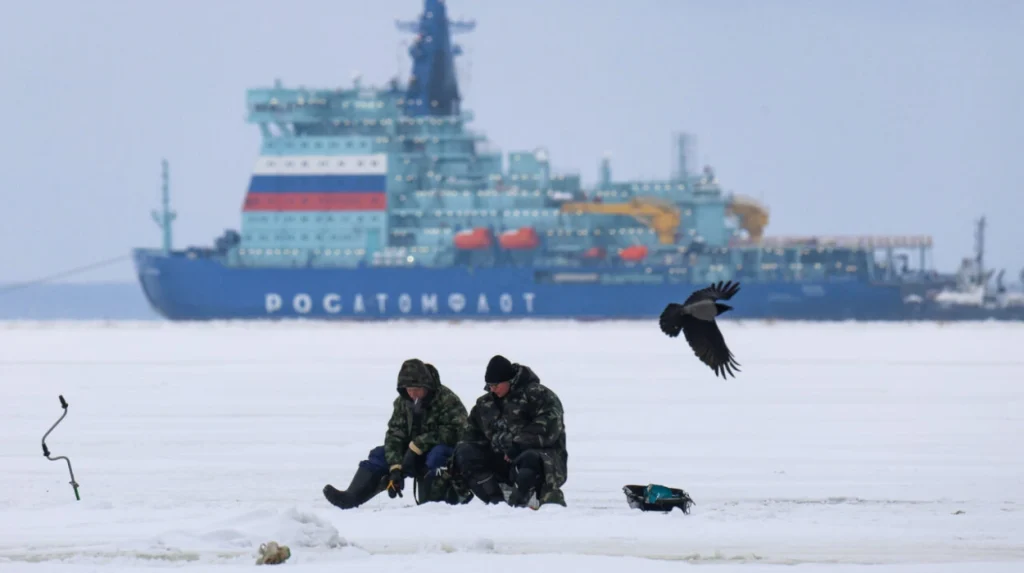
With the retreat of polar ice, the Northern Sea Route and the Northwest Passage regions are getting a lot of traffic. The U.S. and Russian coast guard services communicate with each other on a periodic basis on navigational safety and search and rescue exercises. Such exercises especially those in the Bering Strait area are humanitarian and commercially oriented, in that such expeditions are quick to respond to shipwrecks and other environmental threats.
Resource development and regulatory convergence
The management of energy and fisheries have become sensitive areas of discussion. The two countries are also seeking ways of harmonizing shipping laws in the Arctic and harmonizing policies to establish resource extraction in the region. The ambition which is detailed in the discussions held at Reykjavik in May of the year 2025 is to prevent the destructive competition as well as to secure the environment along with stabilization of the Arctic investment conditions. There are now even proposals to involve trilateral cooperation with Canada and Norway but no signing of binding agreements has been done yet.
Persistent friction and strategic limitations
Though such cooperation efforts are promising, there are significant barriers, thus limiting stronger integration between the U.S. and Russia in the Arctic.
Russia’s military expansion and signaling posture
Russia has been steadily increasing its military presence in the Arctic by establishing new air bases and radar outposts and a nuclear-armed submarine patrolling. Aerial surveillance orbited around the archipelago Franz Josef land with the deployment of Arctic-specialized missile systems widely reported as confounded by satellite photography. This growth causes anxiety to Washington and to its partners in NATO, who wonder what is behind them even though they come hand in hand with diplomatic outreaches.
American force limitations and the China factor
The U.S. Arctic fleet remains underdeveloped compared to Russia’s. While construction of two new heavy icebreakers resumed in 2024, full deployment is expected no earlier than 2027. The gap leaves American forces reliant on allied facilities and cooperation. Simultaneously, China’s “Polar Silk Road” ambitions introduce an additional layer of strategic uncertainty. As China invests in Arctic research stations and under-ice drone technologies, Washington grows wary of a Russia-China axis that could challenge U.S. influence in the polar north.
Governance frameworks and regional stability
Beyond bilateral considerations, the U.S.-Russia Arctic relationship intersects with global governance debates and climate response agendas.
Institutional mechanisms for de-escalation
The Arctic Council remains a foundational, albeit strained, forum. Its scientific workgroups and Indigenous advisory bodies play a key role in preserving stability. Moreover, UNCLOS provisions continue to guide territorial claims and resource demarcations. Both Moscow and Washington have used these structures to manage friction, although they often diverge on interpretation. Arctic legal frameworks now face a stress test: can they prevent escalation in a region increasingly vital for global energy and security?
Indigenous representation and environmental protection
The Arctic has governance smack at the core of the Indigenous peoples such as the Inuit, Sapmi, etc, whose territory is directly affected by military and commercial invasions. Alaska and Chukotka (Russia) Community leaders have demanded protection across a border to conserve mi migrations, food security and heritage sites. In 2025, forums of Arctic Indigenous peoples became visible in their attendance when global activists began to connect climate justice with self-determination among Indigenous people in the polar world.
This individual has addressed the issue and summed the situation the following way: Arctic strategist Emma highlighted that: Her discussion echoes with the emerging agreement that the Arctic governance system should be designed in such a way that it combines human rights, environmental sustainability, and the strategic balance in order to survive.
Navigating dual tracks of engagement and deterrence
Strategic competition has not come to an end as cooperation in some of the functional areas only goes deeper. America is treading on a thin line-making them seem rigid over military preparedness, at the same time they were trading information and tackling common initiatives regarding the environment. On its part, Russia can keep exploiting Arctic leadership to prop up its international significance, as a local hegemon and an investor in climate dialogue.
The result of this two-track approach can define either the Arctic becomes the simile of practical coexistence or fails to an additional competing area. As climate change picks up pace and with commercial interest racking up, the stability of the region is now anything but peripheral from the world of energy systems to migration flows to geopolitical fault lines.
The emerging events in the Arctic in 2025 will become an important indicator of the adaptability of great powers. The durability of collaboration mechanisms under the pressure of inconsistent ambitions and changing coalitions might become a matter which not only affects the development of polar politics but the entire model of global governance of the future decades.