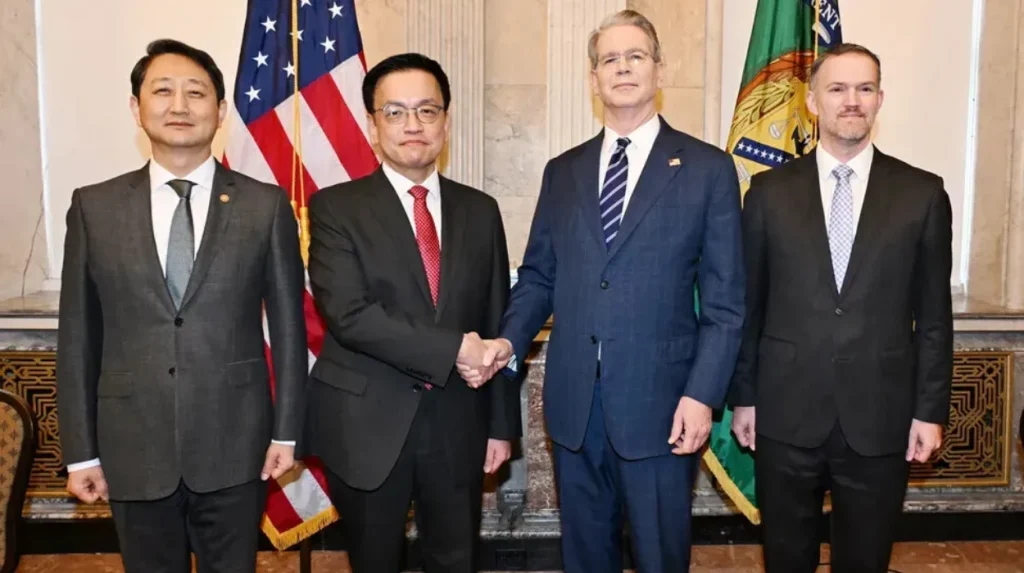
The July 2025 Korea-U.S. tariff agreement constituted a major turn in the economic interactions, dropping auto tariffs to a large extent and locking in multibillion dollar Korean investments in America in strategic U.S. industries. But what is most notable about it is that it does not mention security cooperation. In a part of the world where trade and defense have traditionally been inseparable cornerstones of the alliance policy, their stilling in this agreement is bringing into question traditional interpretation of the diplomacy of those in alliance.
Seoul also embraced the reduction of auto tariffs to 15 percent and agreed to investments above and beyond 350 billion dollars in shipbuilding, semiconductors, clean energy and biotech. However, in spite of positioning the agreement as a new platform of economic relationships, the negotiators did not want to link trade concessions with security promises or higher levels of strategy synchronization.
Why Security Exclusion Is Significant
Bilateral Alliance Dynamics Unraveled
In the past, Korea US treaties such as 2007, Free Trade Agreement have entrenched trade and defense arrangements further assuring Seoul in support of Washington in deterring North Korean and countering strategic threats. The overt decoupling later in July 2045, with no references either to the tariffs, or to any communiques, of China or North Korea, or alliance preparedness, portend a restoring of the balance of bilateral powers.
The government of South Korea reiterated that security was still under different constructs like the extended deterrence and joint military training. However, analysts observe that the shortcut to an integrated dialogue creates a risk: strategic ambiguities are likely to arise in case of crises in the future when coherent coordination of the alliance is required.
Regional Calculations in Flux
Shortage of security-related references causes doubts on the perception held by China, Japan, and North Korea on the strength of the U.S.‑ROK alliance. It is possible that in global politics as Japan remains committed to trilateral dialogues with the U.S., stretching back to the Cold War, the approach adopted by Seoul has potential strategic vulnerabilities. It also indicates that Seoul is moving toward a self-determined approach to economic policymaking as an assumption of continued use of current defense constructs–but without direct expressions of commonality addressing novel security challenges that are imminent to the late 2025 point.
The decoupling is likely to give such adversaries confidence in pushing the limits of alliance discipline, and it increases the weight of independent diplomatic negotiation to cement subsequent alignment on trade, defense and geopolitical messaging.
Economic Milestones, Strategic Limitations
Gains and Lingering Trade Exclusions
For Korean exporters, the deal represents significant recovery: automobile and auto parts tariffs are lowered, energy purchases increase, and U.S. investment flows in critical industries are guaranteed. These moves boost confidence in bilateral commerce and investor certainty.
However, key sectors remain untouched. Steel, aluminum, rice, and other staple exports are not covered. This imbalance underscores the purely economic lens of the deal, which lacks strategic scaffolding—unlike previous agreements that secured both market access and deeper policy alignment.
Corporate and Defense Community Reactions
Korean corporate entities praised the trade stability but also noted strategic uncertainty. As regional security pressures grow, senior executives warned that reliance on separate security dialogues may not sustain investor confidence amid geopolitical shocks. American business groups echoed concerns that an unclear security framework could create risk in multinational supply chains.
The defense community, accustomed to policy integration, now faces the task of reinforcing alliance coordination through separate channels—bilateral summits, military exercises, and intelligence sharing—that remain vital yet informal in the new arrangement.
Diplomatic Echoes and Wider Implications
Commentary from Regional Observers
Experts like Matthew Skrzypc1 have pointed out that
“the clear vendors and beneficiaries of this deal are economic actors,”
adding that neglecting security considerations may leave allies strategically fragmented.
This perspective reflects a broader concern: that the alliance now relies on patchwork diplomacy rather than robust, unified strategy.
Seoul’s leadership framed the separation as deliberate policy design, seeking to avoid trade negotiations being hostage to security disputes. But critics warn this signals transactional pragmatism over principled coordination in alliance logic.
Implications for Indo‑Pacific Strategy
This evolving Korea‑U.S. posture directly impacts broader regional cooperation. A united economic and strategic front has traditionally underpinned Indo-Pacific architecture. Now, with Seoul opting for compartmentalization, coalition-building may rely more on fragmented alignments—Japan‑U.S.‑Australia in defense spaces, Korea‑U.S. in economic ones, and ASEAN in diplomatic balancing.
China’s regional ascendance may be encouraged by perceived alliance disunity, prompting recalibration among U.S. partners and complicating Washington’s efforts to manage shifting Indo-Pacific dynamics through a single, cohesive framework.
The Crossroads Ahead: Trade Triumph, Strategic Test
July 2025’s tariff breakthrough delivers real economic relief and investment opportunities. Yet the visible absence of any security component places the alliance at a delicate juncture. Will Seoul and Washington maintain auxiliary coordination that mirrors the clarity of their trade accord? Or will the alliance’s economic and security dimensions drift apart?
The next Korea-United States summit that is planned toward the end of this year will probably provide clarification. The returning of integrated strategic commitments or institutionalizing compartmentalization in policy domains will be observed closely by analysts to observe whether leaders will reaffirm them or not.
In the case of an upcoming Korea to plot its way through an international competition, the issue to be faced is between self-governing and unity with the alliances. In the meantime, to the U.S., maintaining influence in Asia might turn out to be relevant to maintaining strategic dialogue that continues to hold credibility even without express reference to the mechanics of trade.
The future development of this relationship in the backdrop of 2025 and beyond is not only going to define bilateral relations, but also the working principles of alliance diplomacy that may have to be conducted in a world where economic and security needs have come to be more closely knit but possibly no longer mutually as negotiable.