With the Trump administration putting an additional emphasis on the immigration crackdown of international students, this issue poses a threatening challenge to U.S. higher education, research innovation, and diplomacy in 2025. With the number of visa cancellations on the increase, the university adoptions are under a lot of threat and as social media vetting continues to grow, the policies are threatening the academic and economic landscape that international students support. This discussion weighs the complex consequences of these kinds of limiting actions on universities and students and the American strategic picture as a whole.
Heightened Visa Restrictions and Enforcement Measures
Expansion of Social Media Vetting and Visa Interview Suspension
This was reinforced by Secretary of State Marco Rubio, who in May 2025 put a hold on the setting of new visa interviews of foreign students and at the same time indicated an imminent expansion of the requirement that all foreign students seeking visas be subject to monitoring social media accounts. This action comes against the backdrop of an increase in the process of cancelling visas and intensified tracking measures against what are perceived national security threats associated with international students. The policy is aimed at finding those people who have a relationship with the adversarial regimes or are engaged in activities that are considered as against the U.S. interests.
The postponement of visa interviews adds to the backlog facing aspiring students, which may end up discouraging a good number of aspiring students to apply to the U.S. institutions. Visas of over 4,700 international students have been cancelled since the start of March and in some cases without sufficient warning, which has caused a tremendous impact on academic continuity and planning. A large portion of those targeted are foreign nationals who are of Indian and Chinese origin as these two countries contribute to more than a half of the international student population. The Optional Practical Training program, particularly attractive to Indian STEM students, is severely impacted by visa terminations and hostility from enforcement agencies.
Targeting of Elite Universities and Enforcement Actions
Leading universities, such as Harvard and Columbia, have felt direct pressure. The Department of Homeland Security (DHS) sought to revoke Harvard’s authorization to enroll international students, citing concerns over campus climate and ideological trends. This unprecedented step led to legal challenges, with courts temporarily blocking enforcement and issuing injunctions against the university bans. Meanwhile, other Ivy League and large public universities continue to grapple with visa cancellations among their diverse student bodies.
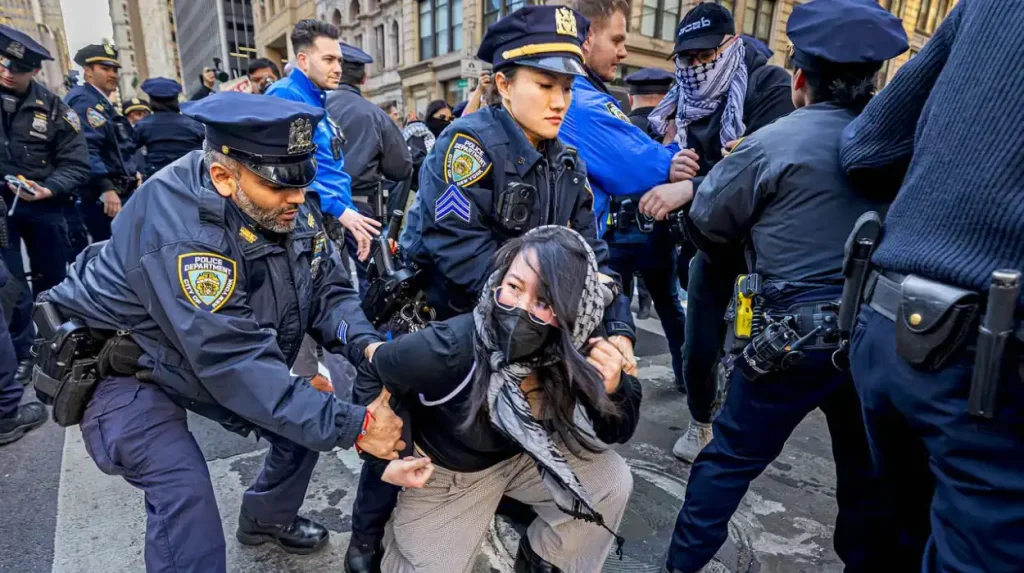
Enforcement actions have extended beyond visa protocol. Hundreds of students involved in pro-Palestinian demonstrations or with social media expressions of solidarity with Gaza have been especially vulnerable to visa revocation and deportation threats. Some students have faced removal or detention over minor infractions, including traffic violations, amplifying fears over the nebulous scope of immigration enforcement.
Institutional and Economic Ramifications
Threats to Academic Missions and Research Innovation
Colleges are threatening to abandon their academic missions and their ability to pay with these aggressive policies. The international students will also help the colleges to earn plenty of tuition fees: the tuition revenues will be somewhere between $43 billion and 44 billion dollars during 2023-2024 academic year alone. International students also play an important role in certain essential research projects, especially those connected to STEM courses. The drive to send back the large class of foreign students risks derailing laboratory projects, innovation pipelines and intellectual diversity, all of which take a toll on US competitiveness globally.
Faculty leaders have expressed the same worry that breaking up the pipeline of foreign talent will reduce the innovation ecosystem that supplies Silicon Valley and other high-tech centres. The process of immigration policy and its connection with economic thriving were clearly stated by California Representative Ro Khanna, who emphasized the role of big technology entrepreneurs such as Elon Musk immigrating to the U.S. as foreign students. Khanna has been highly critical of the crackdown, saying that American universities and industries should be defensive about global talent making it into America.
Legal Challenges and University Responses
Colleges have resorted to legal and administrative measures to help affected individuals. Most of the institutions encourage international students to stay in the U.S and consult with lawyers to appeal the revocation of their visas or continue to enjoy lawful stay. There are other students who have secured court orders to prevent deportation and allow them to proceed with their studies. It is common to find universities like George Mason and the University of California system coordinating legal help and accommodation that provides minimal disruption to education.
But the atmosphere of condensed condition of fear is reality. Students are deleting social media accounts, refraining from political engagement or speaking, and putting international trips on hold because they do not know whether they will be allowed back in. Faculty and staff of universities are reporting increased anxiety among foreign and domestic members of the campus communities about freedom of speech and personal security.
Broader Societal and Political Context
The Intersection of Immigration, Security, and Ideology
The crackdown is presented by the Trump administration as an appropriate process created to protect against any ideological threat, specifically against bringing in values, ideas, or even movements that are seen as a threat against the national interests. The concern about threats to disruptive activism on U.S. campuses that is said to be sponsored by foreign governments appears as a particularly strong concern on the part of officials regarding the possibility of harmful protests, including the possibility of protests on a massive scale as could be expected in 2024 due to pro-Palestinian activism. But these rationales are challenged by civil rights activists, university students, and scholars who fear exaggeration and loss of the right of due process.
The critics of such policies point to an unnecessarily discriminative approach that specifically affects students whose countries are believed to represent a geopolitical challenge or have tension-packed diplomatic relations, and darken the historical U.S. openness and academia. This security-related approach is accentuated by the diplomatic cable to consulates on strengthening social media vetting and increasing the scope of vetting.
Economic and Innovation Consequences
It is economically problematic, as it can result in a less increase in the economic activity of some crucial spheres that depend on working with highly qualified workers. The way the U.S. system, the university system is apparently research oriented, and, of course, American students are going down in terms of interest in STEM, it is part of the fabric. U.S. universities cannot be this research intensive without foreign students to participate in various fields like artificial intelligence, biotechnology, and aerospace.
Business heavyweights and economists express concern that the policies will lead to a brain drain situation in which top talent will go to other nations. The funding of many programs becomes threatened because universities rely heavily on international tuition fees, most especially in the face of a post-pandemic world where funding by the government is drying up.
Global presence The economic contribution of international students is not just at the international level, but also the local communities involved and the university towns through consumption, housing and services and a multiplier effect outside the academic institutions.
Navigating Complex Challenges
The multi-pronged Trump administration attack on international students illustrates the precarious overlap between immigration policy, national security, and higher education twenty years hence in 2025. Though its intent is to control and prioritise security grounds ideologically, the practical implications continue to laterally spill over into the spheres of academic, economic, and foreign relations.
The practice produces alarming questions regarding the struggle between security needs and the mandate of international cooperation and ideas sharing which is the pillar of contemporary higher education. The response of both afflicted students and universities signifies stand-up and fight in defense of rights during turbulent times, but the overall uncertainty has a potential downside of jeopardizing the status of the U.S. as home to the most scholars around the globe.
According to political analysts, the actions of the administration may reshape the face of education in the U.S. in the years to come and will at least lose some of its territory to competitor nations that have not been as hostile to foreign learners and scholars. As these policies see the light of the day, there is a sense of continuous critique with regard to their sustainability and wisdom, as indicated in the voices of critics such as DC_Draino.
What it all boils down to is that preserving the national interest versus promoting the open, divergent systems that are essential in innovation is the main conundrum in the realm of U.S. leadership today. The manner in which this balance is achieved will define the path American higher education and its presence on the international scene takes in the proceeding years of 2025 and the future.