Emergency break in U.S. exports of weapons to Ukraine occurred in July 2025, and indicated major issues in the decision-making processes of the foreign policy of the country. This event that mostly started without the involving of the White House, the Congress or other major departments showed the complicated and fragmented system of leadership in the national security in the U.S. With Ukrainians facing server and server Russian air raids, the issue of who, actually, is in charge of U.S. foreign policy becomes especially relevant.
The Sequence of the Pause: Confusion at the Top
Unilateral Decision-Making by the Pentagon
The move to suspend arms deliveries to Ukraine was decided by the Pentagon which is headed by the Secretary of defense- Pete Hegseth without consulting the white house or even communicating it to the congress. The suspension was particularly because Ukraine was getting more and more Russian missile and drone assaults at an important period in time. Pentagon officials claim that the stoppage of shipment was initiated to safeguard American reserves but this has rapidly been refuted even by the Department of Defense itself.
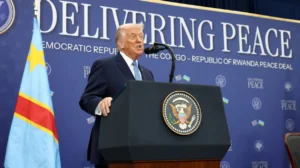
In an even greater sign of dysfunction, when President Donald Trump received the question on the decision, he answered,
“I don’t know. Why don’t you tell me?”
Such commentary also highlighted the poor organization of the Pentagon and the White House, and how decisions such monumental ones are reached without any apparent control.
The Rapid Reversal and Mixed Public Messaging
Days after an internal debate and a lot of pressure between the Congress and U.S. allies, president Trump instructed them to resume shipments of aid. His public comments on the matter fluctuated however, as Trump, on the one hand, stated that he was not aware of the pause before, and on the other hand, felt anger with the Pentagon, which had taken the action unilaterally.
On its part, Pentagon officials argued that Secretary Hegseth had given a framework that the President needed in assessing military aid, but this was refuted by various sources. The misunderstanding that led to the first pause and later reversal showed serious malfunction in the top echelons of American foreign policy formulation.
Competing Centers of Power: The Pentagon’s Expanding Role
The Pentagon’s Influence in Foreign Policy Decisions
This unilateral action by the Pentagon to cancel the shipments of arms is more than an indication of a change in the national security complex of America. Although the Department of Defense has long been consulted on security issues, this event came to the foreground to show how it is capable of taking action without presidential guidance. The actions of Secretary Hegseth pose severe concerns over the extent to which the civilian control over the military and the role of the bureaucratic actors are today guiding, or even usurping the decisions of the President. Pentagon infighting with certain officials trying to reason that the suspension of aid was not necessary indicates that even at the Department of Defense there is no agreement on the course of action.
Congressional leaders have already demanded an investigation on the incident and how such a serious decision was made with no involvement of the President or approval of the congress. The trend towards increased control is out of the fear that the Pentagon has been gaining power and increasingly becoming free to operate without the consent of the White House.
The President’s Reactive Role
When compared to the proactive decisions by the Pentagon, the decision by President Trump to respond to the pause showed a reactive leadership position as opposed to proactive leadership. Trump was placed in a situation where he is reacting to events that have happened instead of steering the decision and therefore has given mixed signals in both domestic and foreign relations. Trump statements to the press added confusion as he moved back and forth between disconnection to the decision and the praise to the change. This absence of coordinated message made the American people and foreign allies confused on the White House advisory role under the U.S. foreign policy.
The lack of consistency in the message by the President regarding the issue of aid pause in Ukraine also compromised the reliability of the U.S. positions, especially considering the fact that during a meeting in The Hague at a summit of NATO allies, Trump discussed and committed to deeper involvement in assisting Ukraine. The confusing policies and words by the administration made the U.S. seem unreliable as a security ally which became a source of unpredictability.
Congressional and Allied Reactions: Demanding Accountability
Bipartisan Calls for Oversight
This delay in assistance to Ukraine caused a shockwave on Capitol Hill, with both sides crying out to have more control over policy matters in U.S. foreign policy. Both party law-makers queried how an important decision like this could be reached without the participation of the President or even warning the Congress. The decision to withhold aid was also criticized by Representative Adam Smith who, as the subject of a powerful time slot, is very outspoken having been a member of the House Armed Services Committee as he described the reasoning being used by the Pentagon as being disingenuous and that the actual purpose was to limit any aid whatsoever to Ukraine.
The absence of deliberation and disclosure resulted in a fresh uproar to have safeguards in defensive laws so that such actions cannot be undertaken on an individual basis by the Pentagon in future. These trends portend an increasing worry on the dilution of checks and balances in the U.S foreign policy.
International Concerns and Strategic Implications
The stopping of arm supply had extended implications such as remedial actions outside the U.S borders. The European allies who were already worried about the evolving patterns of the U.S. foreign policy echoed their concerns about the lack of coordination and transparency. The suspension of the military assistance came at the same time when Ukraine was so far seeing its deadliest drone and missile attacks in months, and the backlog on receiving air defense equipment had an immediate operational consequence. Ukrainian President Volodymyr Zelenskyy, who talked to Trump, stressed the necessity of the enhancement of air defenses and the US stability in his statements.
That circumstance served only to increase suspicion regarding the credibility of the U.S. as a security partner in international affairs. European leaders were wondering whether they can rely on Washington in the long run, at least in the issue that is as important as the defense of Ukraine at the time when the U.S. foreign policy seemed to become more and more fragmented and unpredictable.
Systemic Dysfunction: What the Pause Reveals
The Breakdown of Decision-Making Processes
The freeze on the aid to Ukraine reflects more fundamental problems in the process of U.S. foreign policy-making. The absence of strict chains of command, veto points and the openness of the bureaucratic actors to take unilateral decision making all factor into a system where important decisions can be reversed and made without the review or coordination. The fact that the Pentagon can decide to stop the aid without the permission of the President and the fact that Trump himself has no idea where the decision to do that came from given the fact that he owns so much of the Executive does not offer an encouraging first step towards order.
This misunderstanding does not only undermine the U.S. policy but also intimidates its foes as Russia, as well as other allies of the U.S. In an era of rapidly shifting global dynamics, such dysfunction poses a significant risk to U.S. interests and global stability.
The Future of the U.S. Foreign Policy: Lessons and Unanswered Questions
The Ukraine aid pause has exposed significant weaknesses in U.S. foreign policy. It raises fundamental questions about the true authority behind policy decisions and whether the President, Pentagon, and Congress can ever forge a unified approach to foreign policy. The episode highlights the dangers of fragmented decision-making in an increasingly complex global environment. With adversaries exploiting divisions and allies losing confidence, the U.S. must confront its systemic dysfunctions if it hopes to maintain its leadership role on the world stage. The path forward will require clearer authority, better coordination, and a more transparent decision-making process—one that aligns with the country’s values and global interests.