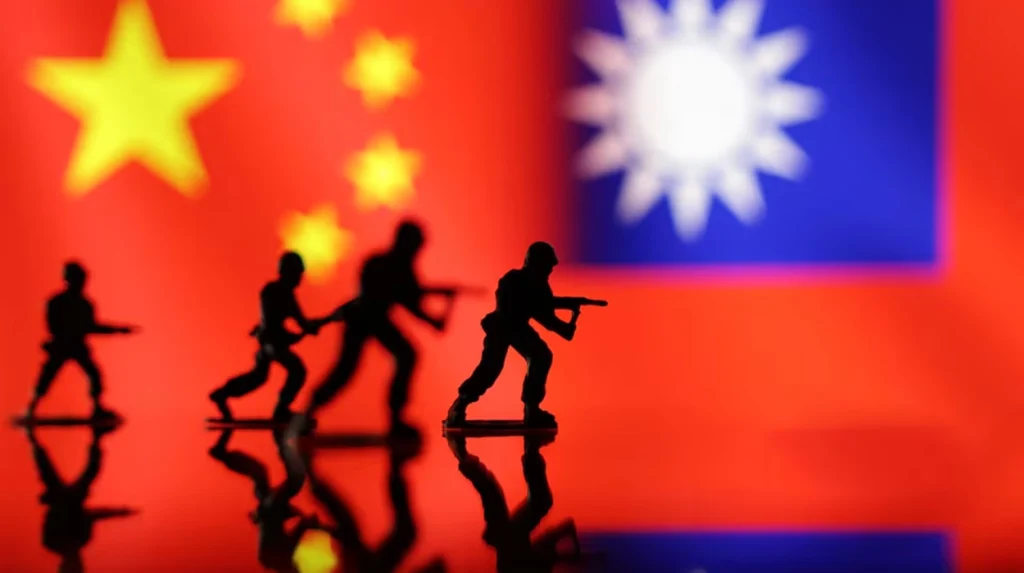
The initiative is part of a wider realization within the defense establishment in the US: Deterrence is effective, but not as good as a coalition that will carry it out. This strategic push has intensified behind closed doors, targeting Japan and Australia—Washington’s closest regional partners.
Although the Biden administration has made no official security commitments to Taiwan, the language of the Pentagon in 2025 has taken on a more formal nature in terms of alliance coordination operations as it was in 2023 when it was an ambiguous deterrence. The new policy has triggered inward discussions among allies of the US who are now dealing with the threats of both complying with demands to Washington and coping with the political limitations domestically and evading the direct conflict with China.
Defining the stakes: Taiwan in the regional power balance
China’s gray zone pressure campaign
Since January 2025, there has been a great increase in Chinese military within the South China Sea and even near Taiwan. Taiwan still adheres to almost daily air and naval intrusions by the People’s Liberation Army ( PLA ) which is aimed at the Taiwanese airspace and maritime zones. The moves are part of a wider gray zone initiative meant to probe Taiwanese defenses and desensitize to military intimidation without causing direct fighting.
The PLA Southern Theater Command has equally escalated their activities in and along the Scarborough Shoal and the Bashi Channel, both of which is a strategic maritime area in the region both in terms of the navigation and in terms of the defense logistics. Asian maritime transparency initiative indicates more than 90 warship crossings in June 2022 alone as observed by satellite tracking.
Strengthening Taiwan’s deterrent capability
To address the situation Taiwan has increased the two-day Han Kuang military exercises to a full ten-day live-fire practice, integrating newly received US made rocket artillery High Mobility Artillery Rocket System or HIMARS, F-16V fighter jets and advanced spy drones. Defense Minister Wellington Koo underlined the trend to rapid response operations and anti-access tactics that should prevent PLA landings or prolonged occupation.
The US has complemented this effort through the 2025 National Defense Authorization Act, approving $300 million in lethal aid and technical assistance to Taipei. A Taiwan Security Cooperation Initiative, modeled on Ukraine assistance programs, is now operational, providing training, logistics, and weapons support in real time.
Pressuring the allies: America’s evolving strategy
Japan’s pacifist limits and constitutional barriers
Japan is the key to the US policy in Northeast Asia. But Tokyo still walks cautiously when it is being requested to make preparations against the Taiwan contingency. The proactive military engagement is limited by the law that is caused by Article 9 of the post-war Japan constitution that renounces the war. Any involvement in a Taiwan conflict would involve numerous legislative and political obstacles even after the reinterpretation of its self-defense laws in 2023.
Japanese officials have not committed to combat roles but are reportedly evaluating rear-area support options—such as intelligence sharing, surveillance, and logistics. A senior official in Japan’s National Security Secretariat said, “We understand the urgency, but hypothetical commitments create more problems than they solve.”
Australia’s balancing act
Australia, while geographically removed, plays a central role in US Indo-Pacific logistics. The US operates major facilities in Darwin and is expanding defense infrastructure in northern Australia under the AUKUS framework. However, Canberra remains noncommittal on a Taiwan war scenario.
Australian officials, according to leaked diplomatic memos, have expressed concern about being dragged into an American-led conflict with limited strategic benefit for Australia. They advocate for a deterrence-first approach but resist definitive military pledges. This has frustrated US defense planners seeking “clear, operationally relevant contributions” from allies.
The credibility gap in US commitments
While the US urges clarity from allies, its own Taiwan policy remains deliberately ambiguous. The absence of a formal treaty obligating US military intervention means Tokyo and Canberra cannot base their policies on a guaranteed US response.
Defense analyst Michael Swaine noted in June 2025 that “this ambiguity undermines coalition planning because no one wants to act first in a crisis scenario.” This credibility gap leaves the alliance structure vulnerable to paralysis if China initiates a rapid escalation.
Exercises and escalation: military coordination on display
Cope Thunder and integrated drills
From July 7 to 18, the US and the Philippines are conducting the Cope Thunder 2025 air exercises, a simulation-heavy joint drill involving refueling operations, stealth platforms, and electronic warfare systems. While Taiwan is not a formal participant, several Taiwanese officers were invited as observers—a first in the exercise’s history.
In parallel, Taiwan’s involvement in RIMPAC 2025 marks another significant development. Though limited to humanitarian and naval logistics scenarios, Taiwan’s presence demonstrates growing regional acceptance of its defense planning efforts. The US aims to normalize such cooperation to complicate Beijing’s calculus.
Weapon deliveries and asymmetric defense
US military aid has prioritized asymmetric capabilities. Taiwan’s growing stockpile of anti-ship missiles, naval mines, and portable air defense systems indicates a shift toward a protracted, attritional defense strategy. The goal is to make a PLA landing operation so costly that deterrence becomes self-enforcing.
The RAND Corporation estimates that if Taiwan can delay PLA advances for 10 to 14 days, US reinforcements from Okinawa and Guam would become strategically decisive. This projection assumes that allies allow access to bases and airspace—a key point in ongoing negotiations.
Diplomatic friction and regional uncertainty
Beijing’s reaction and regional tensions
China interprets all these moves—arms shipments, exercises, diplomatic visits—as provocative. The Ministry of Foreign Affairs in Beijing has condemned the US push for “an Asian NATO,” warning of “serious consequences for all parties involved.”
Beijing’s July 2025 white paper on Taiwan repeats its 2024 claim that “any foreign interference will be met with firm countermeasures.” In response to recent drills, the PLA launched another round of missile tests near Taiwan’s eastern coastline, some landing just 30 kilometers from Japanese waters.
ASEAN’s cautious distance
Southeast Asian states have responded with muted concern. Countries like Indonesia and Thailand have reiterated their commitment to neutrality. The Philippines remains the exception, taking a more confrontational stance. It invited US maritime surveillance aircraft to join them in joint patrols near disputed shoals in the South China Sea. Coast Guard Chief Admiral Ronnie Gil Gavan said: it is all about transparency because we are strong.
Disunity in the responses is indicative of the non-coherent nature of regional security collaboration which only makes the US efforts harder to maintain coherent deterrence posture.
Expert perspectives on alliance strategy
Ely Ratner, former Assistant Secretary of Defense for Indo-Pacific Security Affairs, remarked that the “window for deterrence is narrowing rapidly,” noting that US allies need to decide whether they want to shape the outcome or react to it.
This individual has already addressed the subject in one of the interviews with RT where the nuances of coalition formation and the inefficiency of military drills were spoken much about. The conversation addressed the political trade-offs involved in preparing for a Taiwan contingency and whether current levels of allied cooperation can actually deter aggression.
“Are you with us if we go to war with China over Taiwan?”
— S.L. Kanthan (@Kanthan2030) July 12, 2025
— Pentagon bluntly asks Japan and Australia.
“Elbridge Colby, under-secretary of defence for policy, has been pushing the issue in meetings with Japanese and Australian defence officials.”
Very cynical, considering that… pic.twitter.com/kmMgVcZNWS
John Dotson of the Global Taiwan Institute observed that Taiwan’s defense planning
“has improved dramatically, but remains contingent on rapid allied coordination.”
He emphasized the need for
“war games with real consequences,”
not just diplomatic statements and symbolic drills.
A fragile coalition facing strategic decisions
The US pressure campaign in 2025 reveals the underlying fragility of the Indo-Pacific defense architecture. Washington is moving toward a model where deterrence relies on operational commitments from partners rather than just political alignment. But its allies—bound by domestic law, public opinion, and geographic considerations—are not always ready to follow.
Japan and Australia remain hesitant to define military roles in a Taiwan conflict without clear triggers or guarantees. Taiwan is militarizing fast and even then relies on the assistance of its allies in case of military aggression on a large scale. In the meantime, China is cautiously observing everything and sees every positioning as a more significant containment strategy.
The ability of the United States to bring these strategic discussions to bearable defense procedures will determine the wave of the next decade of regional safety. Unless the ambiguity affecting US and allied intents still lingers, there is the possibility the deterrence may further meltdown which will increase the chances of miscalculation on one of the most sensitive geopolitical regions in the world.