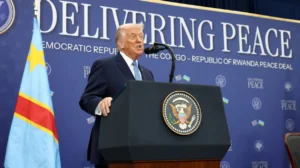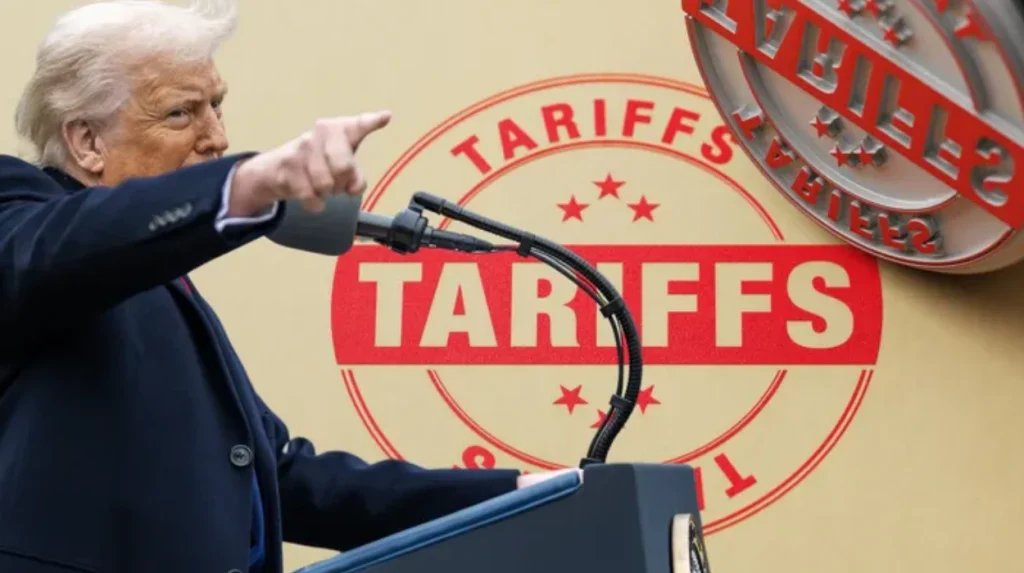
On July 7, 2025, President Donald Trump imposed a blanket 30% tariff on all South African imports into the United States, citing “unfair barriers” to American goods and an “unsustainable trade imbalance.” Framed as part of his administration’s updated reciprocal trade doctrine, South Africa became the only African country targeted in this latest round of economic offensives.
Trump declared that the US was:
“No longer willing to subsidize foreign competitors who block American products.”
This assertion, repeated by officials at the Office of the US Trade Representative, was immediately contested by South African President Cyril Ramaphosa, who called the tariffs “unilateral, unjustified, and economically self-defeating.”
Key sectors now under pressure
Automotive exports: A central concern
The automotive industry in South Africa is right in the centre of the impending economic upheaval. In 2024, over 60 % of South African export to the US was made in vehicles and their components and reached over 2 billion dollars. This market advantage is endangered by American tariffs of up to 30 percent, which undermine the possibility to sell at optimal prices, and also by the risk of loss of between 75,000 and 115,000 direct jobs in the process.
The South African Automotive Business Council warned that the tariffs could “collapse market access overnight” and lead to the shuttering of key production facilities. Already, Volkswagen and BMW—major automakers with assembly plants in South Africa—have announced reviews of their US export strategies.
Wine, metals, and broader trade flows
The tariffs come into play besides vehicles, wines, citrus, metals, and made goods which used to qualify under preferential treatment in the US through African Growth and Opportunity Act (AGGOA). Although the critical minerals will be temporarily exempted, the country stands to lose considerably on its trade balance especially by the time the AGOA is not renewed in 2026.
The Department of Trade, Industry and Competition (DTIC) has provided a Framework Deal that has left-handed reciprocal access to American agriculture and pharmaceuticals. However, the US insists that South Africa revise its regulatory regime and reduce “unwritten barriers” to US firms—terms that Pretoria views as excessive and unilateral.
The broader political calculus
Strategic friction and ideological signals
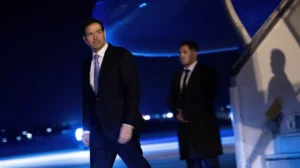
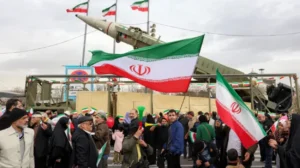
South Africa’s participation in BRICS, its defense ties with Russia, and ongoing diplomatic engagement with Iran have all drawn increasing scrutiny from Washington. US Secretary of State Marco Rubio linked the tariffs to “strategic misalignment,” noting that “continued cooperation with hostile regimes cannot go unanswered.”
The Trump administration has also suspended non-essential aid programs to South Africa and frozen some forms of military cooperation. The cumulative effect of these moves is a hardening of US posture toward a country once seen as a key African partner.
Ramaphosa’s diplomatic balancing act
President Ramaphosa has tried to keep trade talks alive. His administration maintains that South Africa remains committed to fair trade, but also to a multipolar global order. In a July 9 press briefing, he said,
“We will not allow economic coercion to dictate our foreign policy.”
Nonetheless, South African officials have avoided public condemnation of the US, hoping to keep room for negotiation open before the August 1 implementation date.
Privately, some in Ramaphosa’s cabinet have voiced concern that rejecting US demands could jeopardize not just exports, but long-term investment flows and AGOA renewal prospects.
Societal consequences beyond the ledger
Jobs, inflation, and inequality
Economists at the University of Pretoria estimate that the tariffs could cause a 1.5% contraction in GDP over the next 12 months, driven by reduced export earnings and rising inflation. Consumers are expected to bear the brunt of cost increases in transport and basic goods as the rand weakens in response to policy uncertainty.
Job losses in the automotive and manufacturing sectors would hit South Africa’s middle class and urban labor force hardest—intensifying inequality in a nation already reeling from youth unemployment above 50%.
Migration and the Afrikaner visa program
Amid these economic pressures, another issue has stirred controversy: the Trump administration’s renewed offer of special asylum pathways for White South Africans. First announced in late 2024, the program was framed as a response to “anti-Western hostility” and alleged threats to Afrikaner communities. Over 70,000 individuals have since expressed interest in emigrating, adding a political and racial dimension to the US–South Africa relationship.
South Africa’s Human Rights Commission has criticized the move as “divisive and destabilizing,” accusing the Trump administration of selectively amplifying internal tensions for geopolitical leverage.
The BRICS connection and global power shifts
A pivot toward China and Russia?
China has moved swiftly to present itself as a more stable economic partner. Beijing announced in June the removal of 99% of tariffs on goods from African countries (excluding Eswatini), a move designed to contrast with Washington’s coercive trade posture.
Russia has also signaled willingness to expand its role in South African agriculture and infrastructure development, offering investment incentives to offset any losses from US sanctions. Both nations are seeking to deepen their influence in Africa’s most industrialized economy—leveraging this trade dispute as an entry point.
AGOA’s future in question
The African Growth and Opportunity Act, originally enacted in 2000, has underpinned US–Africa trade for two decades. With AGOA up for renewal in 2026, South Africa’s eligibility may now be at risk. Washington is already reviewing Addis Ababa and Niamey on governance issues and Pretoria might soon start facing such a challenge in terms of strategic alignment.
The wider implications of AGOA expiry or exclusion would be epic in itself, continuation would imply speeding up of the African economic shift to Asia.
Expert view: Pressure and realignment
Alejandro Choggins, a trade and geopolitics expert, spoke to CNBC on the evolutional situation. He underlined that the crisis in South Africa is just one of the challenges facing the whole continent in the 21 st -century global economy. He said:
“Pretoria is being asked to choose sides. It’s being pushed into a corner where economic survival depends on appeasing Washington—or building a deeper reliance on Beijing.”
He warned that prolonged tariffs could permanently shift supply chains away from US markets and force South Africa to seek alternatives.
SA is sleepwalking into economic disaster and mass job losses. It currently exports, duty-free, over R250bn worth of goods into the USA. Absent an unlikely turnaround by Ramaphosa, in three weeks Trump's 30% tariff ends that. Joel Pollak is in Washington: https://t.co/KmntscSk0H pic.twitter.com/IuUWht5KWT
— Alec Hogg (@alechogg) July 8, 2025
Will Pretoria bend or break?
As the August 1 implementation deadline looms, the stakes continue to rise. The Framework Deal proposed by the DTIC remains under US review, but Trump administration officials have given no public indication that they intend to delay or dilute the 30% tariff plan.
In the meantime, South Africa is being pressured by the industrial unions, manufacturers and opposition parties to resist as well as negotiate and that poses a paradox with little clear-cut means to resolve. The suggestions of WTO involvement have been made by some, however this is only a legal procedure and would take quite some time, bringing respite in the short run.
The world is waiting with interest to see whether Ramaphosa scores an opening or whether a trade war is being established with the repercussions being spread beyond the continent.
A broader shift in the world economy
South Africa’s predicament reflects the increasingly transactional nature of international trade in 2025. Under Trump’s revived unilateralism, economic measures have become tools of strategic pressure, often at the expense of long-term alliances or regional stability.
The outcome of this dispute may not just determine the future of South Africa’s export economy—it could also reshape the way middle powers engage with the global order. Will economic coercion succeed in forcing realignment? Or will it trigger a backlash that accelerates the diversification of global trade away from the United States?
As trade ministers, automakers, and diplomats scramble to salvage talks before the deadline, the underlying question lingers: can a fragile but globally connected economy like South Africa’s absorb this shock without yielding its sovereignty? The answer may define a generation of economic diplomacy.