The federal trial that is ongoing in Boston led the act involving a controversial Trump-era initiative, which is simply referred to as the ideological deportation policy, to come into a head-to-head clash with the protections of the First Amendment. The case opposes the U.S. government to a grouping of civil right activists, legal experts and colleges and universities demanding what they say is an unconstitutional campaign against political criticism by foreign citizens.
At issue in the case is whether the executive branch has the wherewithal to employ the immigration law as a means of suppressing opinions that contravene the official U.S. foreign policy, specifically, criticism of Israel and the U.S, its attitude towards the military actions in Gaza. In their argument, the plaintiffs establish that ideological censorship should not allow deportation of international students and faculty members based on their political views. The department of justice has come out to argue that it is applying immigration laws, which are founded on national security.
Unpacking the ideological deportation policy
Surveillance and selective enforcement
Legal filings indicate that policy was enforced via a multi-agency interagency effort led by the Department of Homeland Security, the State Department, and an internal group headed by the name of the “Tiger Team.” The team is said to have compiled intelligence on more than 100 noncitizens who had attended or engaged in anti-Palestinian protests or even studies on Palestine. The noncitizens are mainly international students and visiting academics.
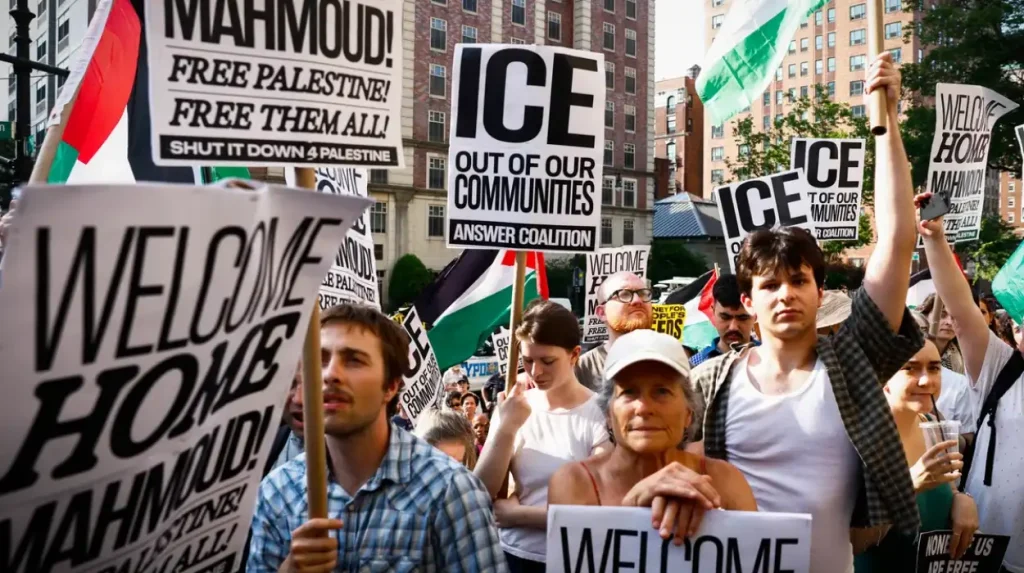
While government lawyers deny the existence of any such “ideological” motive, multiple visa revocations have occurred since late 2024. These are those of students such as the Mahmoud Khalil, a Columbia graduate who was arrested and almost deported after he had written an op column against the sale of arms by the U.S. to Israel.
Immigration officials have, in several instances, invoked some part of the Immigration and Nationality Act that permits the exclusion of those people whose presence is deemed to be detrimental to the U.S. foreign policy objectives. Civil rights organizations claim that such sweeping wording is now being used as a weapon to punish speech.
The scope of its academic impact
There have been immediate and wide-ranging implications. Instructors in various colleges have claimed that students have dropped out of coursework on Middle East politics, and deactivated social media accounts as well as cancelled their scheduled attendance at international academic conferences due to the fear of being banned by their countries on re-entering them.
University administrators have also expressed concern about the chilling effect. Harvard Law Professor Andrew Manuel Crespo described the environment as:
“Choked by intimidation,” warning that “students and faculty alike are modifying their behavior not because they broke the law, but because their opinions are politically inconvenient.”
Free speech, foreign students, and the legal battlefield
Constitutional arguments against deportation for dissent
At the center of the case is whether the federal government’s actions violate the First Amendment by targeting speech based on viewpoint. The Knight First Amendment Institute at Columbia, co-counsel in the case, has asserted that the policy amounts to unlawful censorship.
Attorney Ramya Krishnan stated during opening arguments, “This case is about whether the government can punish foreign students for criticizing its allies.” She argued that protected speech remains protected even when expressed by noncitizens, particularly those who are lawfully residing in the U.S.
The plaintiffs also argue that by punishing expressive conduct, the government is interfering with the broader academic ecosystem. “We’re not just defending the rights of noncitizens,” said AAUP President Todd Wolfson. “We’re defending the intellectual integrity of the American university system.”
Government’s rebuttal and security framing
Representing the Department of Justice, attorney Victoria Santora rejected the notion that the administration’s actions were ideologically motivated. She told the court, “There is no immigration enforcement strategy based on protected speech.”
Instead, Santora has focused on the objections of the administration with what it calls an increased rate of antisemitism in campuses. She did not mention specific people, but said the United States has a legitimate and urgent interest in making sure that its visa system is not used to bring to this country people who promote violence or help establish hostile environments on campuses.
Critics of the policy, however, note that the government’s actions have thus far failed to distinguish between advocacy for Palestinian rights and genuine incitement, often conflating criticism of Israel with extremism.
The role of the judiciary and implications of precedent
Judge Young’s questions on constitutional boundaries
U.S. District Judge William Young has shown that he regards the case as a constitutional turning point. In the hearings, he grilled the government to find out whether it thinks it can legally remove a noncitizen when it is simply because his or her speech was unpopular but no more. He also enquired whether plaintiffs want to strike the statute or its selective and punitive application.
As Krishnan explained, the plaintiffs do not appear in court to overturn the foreign policy grounds of deportation in any way, but only want to challenge their application as a disguise to quash political speech, which may be decisive in the appeal judgment of the court.
The outcome of the trial may create some basis of the extent to which the executive authority may extend its mandate in controlling the involvement of noncitizens in political rhetoric particularly in the academic environment.
Past rulings and current uncertainty
Already a number of district courts have issued temporary injunctions against the deportation of individual students on the basis of a violation of the due process and a lack of evidence on criminal behavior. Nonetheless, those rulings are yet to establish binding precedent in a national level.
This Boston trial is the first to comprehensively examine whether the entire enforcement strategy violates constitutional guarantees. A decision in favor of the plaintiffs could curtail the administration’s latitude in using immigration enforcement to suppress dissent and set limits on the foreign policy exception carved into speech protections.
A divided public and politicized media coverage
Shifting lines between activism and national security
Public opinion remains sharply polarized. Conservative media has largely framed the policy as a defensive measure to combat radicalization and antisemitism. Meanwhile, academic institutions, liberal organizations, and major newspapers have raised alarm over the use of immigration enforcement to suppress political beliefs.
The trial has reignited debate over how the United States defines national security in a campus context. Is political protest against a foreign ally a threat—or a vital form of democratic expression?
Glenn Greenwald warned in May 2025 that the U.S. government’s increasingly fluid definition of extremism could make peaceful political protest indistinguishable from terrorism in the eyes of immigration officers. This legal ambiguity, critics argue, leaves too much room for abuse.
Media personality weighs in
RedPillSayian, a political commentator with a sizable following, addressed the case during a recent interview with MSNBC. He emphasized that targeting students for political speech—even when controversial—undermines America’s own democratic self-image. He said:
“If we say we support free speech but only for citizens, or only for speech we agree with, we’ve already lost the debate.”
Nick Fuentes on Trump deporting 300+ students for criticizing Israel 😳
— Charging… (@RedPillSayian) March 28, 2025
“They are prioritizing the deportation of people who criticize Israel over the illegal Immigrants” pic.twitter.com/EUDmlQUieg
Broader implications for academic freedom and U.S. immigration norms
International reactions and reputational damage
The policy has drawn criticism from foreign governments and international academic institutions, with some universities reconsidering U.S.-based exchange programs. A spokesperson for the University of Toronto called the policy “a breach of trust,” stating that international students need assurance their speech will not become grounds for detention.
The result is dramatic in the possible long term. Unless foreign academics no longer consider the U.S. campuses to be secure zones of research and discussion, American universities are not likely to obtain international students and may lose international academic prominence.
Possible policy reversals or reinforcements
In case the court decides in the favor of plaintiffs, it might compel the administration into changing or abandoning the ideological deportation system. Otherwise, it may encourage a wider movement to conceive of the immigration law as a tool of ideological enforcement, as the midterms of 2026 get closer and the political discourse about national security reach fever pitch.
Law-makers on both sides have already put legislation on the table. One bipartisan movement in Congress is a proposal to demand a judicial proceeding permitting the expelling of visas for overseas policy reasons, whereas an opposite measure would enhance presidential dominance in the issue.
What the outcome could signal for the future
As the case develops, its effects are felt way beyond the limits of the immigration law. It poses a simple question: Do the constitutional rights given to every person residing and studying in the U.S. actually extend to all these people and is America able to weigh national security interests against a long-established belief in free expression?
The response is not just going to impact international students and scholars but will also determine the extent to which political speech can extend itself under a presidency that is keen on declaring dissent as a security issue. As future administrations inherit the tools of immigration control, the boundary between public safety and political silencing may depend on the precedents being written now in Boston.