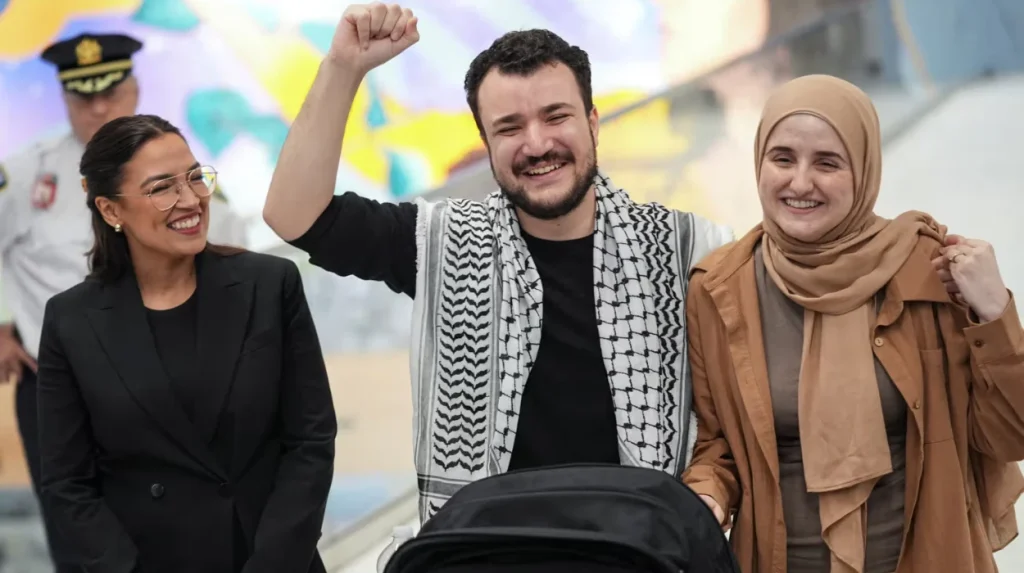
The Trump administration’s first pro-Palestinian college demonstrator, Mahmoud Khalil, was freed on bail Friday, ending his months-long detention. Mr. Khalil, a graduate of Columbia University and a lawful permanent resident of the United States, had been detained for 104 days. Other students the government had targeted received favourable decisions and were freed on bail. He missed his Columbia graduation and was not allowed to be there when his wife gave birth to their baby in April.
However, his attorneys gradually undermined the government’s argument. They persuaded Michael E. Farbiarz, a judge in the Federal District Court in Newark, to grant Mr. Khalil bail on Friday, arguing that there was cause to suspect that the Trump administration was taking revenge on him for his involvement in protests.
The notion that there had been “an attempt to use the immigration charge here to punish Mr. Khalil” had “at least something,” according to Judge Farbiarz, who concluded a two-hour session. Shortly before 7:00 p.m. local time on Friday, Mr. Khalil left the Jena, Louisiana, jail facility.
“Just hug my wife and son,”
he replied when asked what he would do first when he got home.
Did the Trump administration target Khalil for activism?
U.S. Immigration and Customs Enforcement (ICE) agents arrested Mahmoud Khalil on March 8, 2025, just outside his Columbia University apartment. They stated that he was arrested at the request of the State Department, which had told ICE to revoke Khalil’s student visa—and that this order was issued because the State Department believed Khalil might create “potentially serious adverse foreign policy consequences” under a section of the Immigration and Nationality Act that is rarely used.
The ICE agents changed their story a little when they realised Khalil was a lawful permanent resident and told him they would revoke his green card status instead.
Following Khalil’s detention, the government changed its theory again, now contending that Khalil did not furnish responsive information in his green card application or had made misrepresentations on his green card application.
He was never charged with a crime – the basis for his detention was administrative and immigration grounds – first, the foreign policy rationale and finally, fraud or omission with respect to his residency application. Khalil and his lawyers deny these allegations and argue that Khalil is a political detainee, simply being detained for his stature in pro-Palestinian activity at Columbia University.
How did the Trump administration react to Khalil’s release?
The Trump administration continued to oppose the release of Mahmoud Khalil, including mounting legal efforts. The federal judge ordered Mahmoud Khalil’s release, but the administration held the position that he should be looked at for detention or deportation, further calling his activism anti-semitic and a serious threat to national security.
In his memo, Secretary of State Marco Rubio accused Khalil of participating in “antisemitic protests” and creating a “hostile environment for Jewish students,” citing a seldom used provision of the Immigration and Nationality Act to support his initial detention as a means of avoiding legal action.
The Trump administration declared it will proceed with deportation attempts against Khalil after the court ruled that his detention was probably unlawful and questioned the government’s use of immigration as a tool to penalize political expression. An immigration court in Louisiana has already determined that Khalil poses a national security danger and may be deported; Khalil’s legal team is presently contesting this decision.