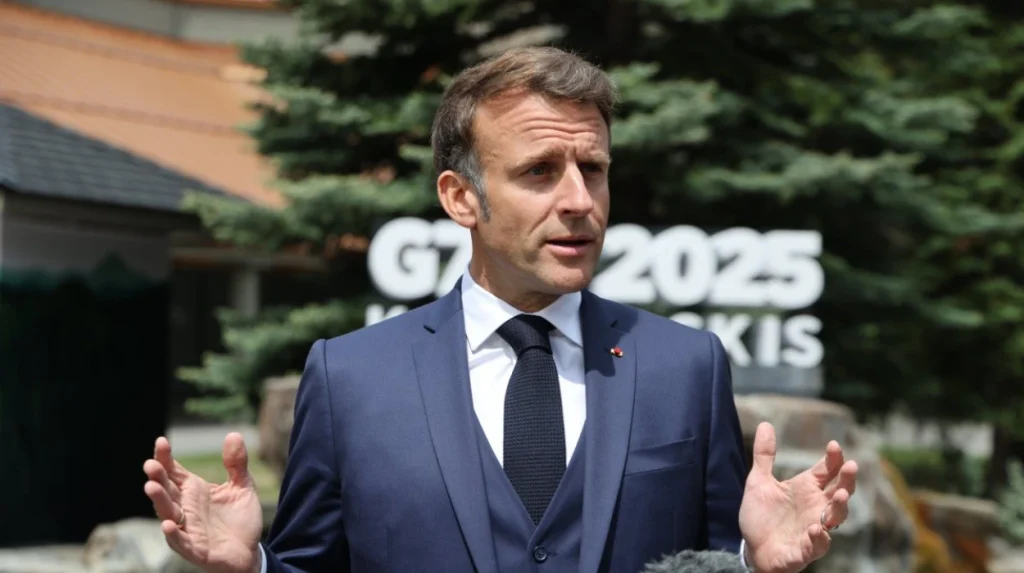
The Middle East is at an important moment in 2025. Emmanuel Macron, the president of France, provided comparisons with the unstable environment after American interventions in Iraq and Libya, fearing that the ensuing conditions, in case of a forcible regime change in Iran, would amount to a complete mayhem. Direct military engagement with Iran is an emerging reality in the light of the more confrontational language and tone used against Iran by the U.S President, Donald Trump and an additional move involving more military actions against Iran.
This analysis investigates the counter-ideology of both Trump and Macron, the pitfalls of forcing the current war-averse Iranian government out of power, and the broader implications for regional stability as well as international security.
'Regime change in Iran will be a mistake': French President Emmanuel Macron.
— TIMES NOW (@TimesNow) June 18, 2025
Trump will do anything to destroy the Iranian regime. Which means not directly and not overtly being involved, but using Israel as a proxy, giving all sorts of help…-JK Tripathy, Former Ambassador,… pic.twitter.com/P6ttCHpPPa
Macron’s Warning: The Specter of Chaos
Lessons from Past Interventions
President Emmanuel Macron has not been careful enough not to advocate a forced change of regime in Iran, hence the dangers of repeating the same errors made by the intervention in Iraq and Libya. He pointed out the consequences of the ouster of established and deeply rooted regimes without well-established politics; this has caused long-term violence, political vacuum and the emergence of extremist political parties which have reduced other parts of the world to anarchy.
The fears that Macron worries about have history:
- The 2003 Invasion of Iraq by the United States brought down the state institutions, thus, resulting in sectarian strife that ultimately created ISIS.
- The 2011 NATO intervention in Libya toppled Muammar Gaddafi who left a country in shambles and at the mercy of a civil war.
Regional stability is at stake.
Macron says the downfall of Iran may trigger a new wave of instability in the Middle East as well. Influence by Iran goes to a level of proxy organizations in Lebanon, Syria, Iraq and Yemen and sudden disappearance of such influence may give rise to violent struggles of power in the region.
Trump’s Escalation: The Gamble on Iran
Rhetoric and Military Posturing
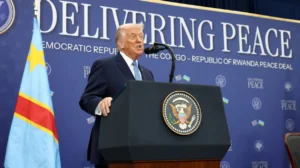
President Donald Trump has changed the nature of the rhetoric by ginning-up an escalating series of threatening remarks and proclamations to respond via military force. Trump’s remarks have become increasingly specific:
- He indicated that the U.S. had “complete and total control of the skies over Iran,” implying a degree of air superiority.
- He wrote to Ayatollah Ali Khamenei (the Supreme Leader of Iran) that he is an “easy target” but did not indicate that he would assassinate him, saying, “We are not going to take him out (kill!), at least not for now”
- Trump also declared that the U.S. would respond with overwhelming power if Iran attacks U.S. persons or assets, saying, “If they do anything to our people, we’ll come down so hard. Then the gloves are off so beautifully.”
Military Deployments and Sanctions
The U.S. military presence in the Middle East has been extraordinarily reinforced by deploying warships and fighter aircraft and by reinforcing special forces contingents (primarily the Navy’s SEAL teams). Additionally, the U.S. has imposed sanctions at the maximum level against Iran, following a maximum pressure plan, in what the U.S. hopes will devastate the economic and political structures of Iran and persuade it to change its nuclear programs.
Iran’s Dilemma: War or Talks?
Domestic and Regional Pressures
Iran finds itself under immense pressure in 2025. The regime faces:
- Dissatisfaction among the populace as a result of economic difficulties and currency collapse.
- Isolation after the loss of significant regional allies, e.g. the Assad regime in Syria and a diminishing Hezbollah in Lebanon.
- Balancing defiance and survival amid increased pressure by the U.S. and Israel.
Leadership’s Calculus
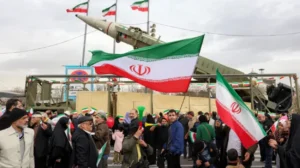
Iran’s leaders and the Islamic Revolutionary Guard Corps (IRGC) have been repeating threats of “heavy, decisive, and catastrophic” revenge against anyone who attacks them. Nevertheless, political analysts argue that while Iran’s rhetoric is strong, the regime is pretty weak and has internal weaknesses that make them incapable of sustaining a continued state of conflict with other nation states.
Regional and Global Implications
Proxy Conflicts and Power Vacuums
The Middle East may not be the only region affected by Iran’s possible collapse or destabilization:
- Proxy groups in Yemen (Houthis), Syria, Iraq, and Lebanon could escalate violence or splinter without Tehran’s support.
- Additionally, if power vacuums were created in the absence of Iran, there is risk that regional competitors (like Saudi Arabia or Turkey) choose to move in – sometimes launching conflicts would lead to sectarian and geopolitical tensions.
- There is also risk for use of terrorism through these conflicts – particularly if extremist groups capitalize on the chaos.
Effect on Global Energy and Security
The Middle East forms an important link in the global network of energy reliability. Should unrest develop in Iran it is unlikely that oil exports would remain insulated and would certainly produce price fluctuations for world economies accompanied by economic shocks. A potential wider conflict could also involve the major powers, creating a (perhaps inevitable) risk of an even larger war.
Stakeholders Perspectives
Emmanuel Macron
Macron’s position is characterized by a focus on caution and diplomacy. He is calling for:
- Avoiding a military conflict that would cause things to get worse.
- Continuing to negotiate and engage with the international community to provide a multilateral approach to Iran’s nuclear ambitions.
- Recognizing the threats that a regime change could lead to without a viable stability plan.
Donald Trump
Trump’s approach is aggressive and confrontational:
- Emphasizing military strength and readiness to act unilaterally if necessary.
- Demanding Iran’s “unconditional surrender” on nuclear issues.
- Using sanctions and threats as leverage to force Iran’s hand.
Iranian Leadership
Iran’s Supreme Leader and IRGC commanders maintain a posture of defiance:
- Warning of severe retaliation against any aggression.
- Balancing internal pressures with external threats.
- Seeking to leverage regional alliances and asymmetric warfare capabilities.
Analysts and Experts
Experts have emphasized that:
- Both military action and a hasty nuclear deal come with a great deal of risk.
- The uncertainty in Iraq, Israel, Syria, and Lebanon and the potential for the crisis in Iran to escalate, requires measured diplomacy to avoid the ramifications of an unintended outcome.
- Iran’s internal political dynamics and relationships with regional actors mean that no simple solution can be found to a complicated situation.
Recent Conflicts in 2025: Contextualizing the Crisis
Gaza and Lebanon Conflicts
In 2025, the cycles of conflict in Gaza and Lebanon have shown us the consequences of proxy wars and regional discord. The latest Israeli airstrikes and militant rocket response have caused a devastating loss of civilian lives and damage to infrastructure, reminding us that peace is always fragile.
Yemen’s Ongoing War
The conflict in Yemen continues to be a proxy battleground, with U.S.-led strikes targeting Houthi forces backed by Iran. The humanitarian crisis there remains one of the world’s worst, with millions displaced and in need of aid.
Ukraine War
In 2025, the war in Ukraine is still the world’s deadliest conflict in terms of casualties and devastation, with numerous deaths, and the ongoing threat of escalation and regional attention from multiple powers involved.
Navigating Between War and Chaos
TThe conflict between the admonitory rhetoric of the French president and the combative attitude of the American counterpart provides the most prominent illustration of the nature of the dilemma of the international community in 2025. A possible change in regime in Iran comes with the elegant threat of creating chaos in the region, but there is a threat of the Iranian nuclear ambitions and its proxy actions which causes a clamour of action being taken.
To evade a disastrous war, deterrence should be counterbalanced by diplomacy, and any pressure applied to Tehran must be followed by pathways to negotiate and build a stable status quo in good faith. The decisions taken over the months to follow will definitely determine the destiny of the Middle East and the entire global security in the years to come as the eyes of the world resume.
Are These Heading Us Towards World War III?
The growing tension between Israel and Iran has caused great concern of the higher chances of a new international war and even World War III. The tensions between Iran and Israel have been escalated by the latest Israeli attack of the Iranian nuclear facilities and Iranian counterattack through missile strikes, and the complexity of the situation is caused by the intervention of world states, including the United States, Britain, and their neighbors in the Middle East.
But analysts warn that the war would not escalate into a total war in the world unless the powers of China or Russia directly involved themselves in the war. The threat is however considerable in that attempts to contain the situation through diplomacy have vast challenges to overcome regarding hostile maneuvers and thick regional hostilities. The delicate nature of the balance between war and diplomacy in this volatile region implies that mere miscalculation can have far reaching implications in the global peace and security.