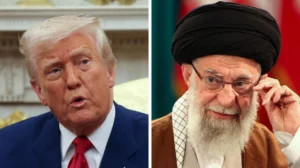
Donald Trump is frantically trying to avoid going to war with Iran. It makes sense to refrain from direct US offensive operations in the long-dreaded confrontation, which Israel characterizes as a question of defending its own existence due to compelling national security concerns and domestic political factors.
Strong forces, however, may entice America to enter the conflict more deeply than its current support for defending Israel against Iran’s deadly missile and drone assault. According to two sources cited by CNN, Trump rejected an Israeli plot to assassinate Iran’s Supreme Leader Ayatollah Ali Khamenei over the weekend. However, Trump has no control over part of this.
Washington will have to take strong action to maintain credibility and deterrence if Iran’s wounded government decides it has nothing to lose and attacks US objectives worldwide or US facilities and troops in the area. Another option is that by striking international ships in the Red Sea or Gulf and causing a worldwide oil crisis, Tehran may put pressure on Trump to restrain Israel.
Trump is also coming under increasing pressure from inside his own party to take action that only the United States could do: destroying Iran’s underground facility at Fordow, which is thought to be beyond Israel’s aerial capabilities. Such an attack would be justified by the argument that Iran is currently particularly vulnerable and that the US may never have a better opportunity to eliminate the threat of an Iranian nuclear weapon.
What might prompt Trump to enter the confrontation
It has been revealed that the president has serious doubts about involving the United States in the conflict. Making such a move would be risky. It may cause the battle to spread beyond its present combatants and become into a bloody, unresolved struggle with no end in sight.
If the early 21st century has taught us anything, it is that war plans and Middle East analysis formulated in Washington nearly invariably out to be utterly incorrect. It may be alluring to think that Iran’s ruthless religious rule may be overthrown. However, the overthrow of Saddam Hussein and the Syrian civil war demonstrates how easily Middle Eastern countries may fall apart when power vacuums occur.
Additionally, US involvement would deepen rifts among Trump’s political base and undermine a fundamental tenet of his America First movement: that, following almost ten years of suffering in Iraq and Afghanistan, the US should avoid getting involved in foreign conflicts. After all, it has only been a few weeks since the president unveiled a new plan for American engagement in the Middle East.
Such a concept is completely incompatible with a new American war. However, hawks in Washington would counter that Trump has a rare chance to eliminate the main obstacle to his agenda by stopping Iran’s nuclear development or perhaps helping to overthrow its theocratic regime.
In their autobiographies, presidents have frequently discussed their difficult and significant decisions to send soldiers to fight in other countries. However, sometimes it takes just as much guts to decide not to rush in, even when it seems appealing. In any case, problems like the one Trump is currently confronting usually have unfavorable consequences.
Even while the US has made it apparent that Israel is the only country that has decided to initiate significant assaults on Iran and that Washington’s forces are not involved in the offensive, political pressure is already building on the president to leave the sidelines. Trump’s situation is complicated by the fact that, although Israel’s assaults appear to have been effective in eliminating key military figures and nuclear experts, it is still unknown if Israel can completely destroy Iran’s nuclear program.