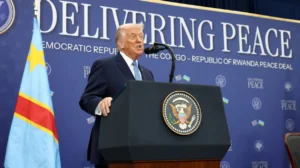
US President Donald Trump is presenting himself as a wartime commander in order to support his mass deportation campaigns by arguing that US forces should be used domestically rather than abroad. A long-feared moment of risk for US democracy is imminent, according to California Governor Gavin Newsom, a Democrat who leads the state’s opposition to a president who enjoys unbridled authority.
How is Trump portraying Los Angeles as a warzone?
Trump is using an invasion and insurgency narrative in a campaign that is just getting started and has significant constitutional ramifications. In the comparatively controlled disturbances, looting, and protests in Los Angeles, he is accentuating chaos. Additionally, he is hinting that he is prepared to send troops all throughout the nation to maintain national security.
On Tuesday, Trump made repeated, untrue claims that Los Angeles would have burned to the ground if he hadn’t sent the US Marines and National Guard there. As other states and cities, particularly those led by Democrats, prepare for broader sweeps of undocumented migrants and the potential demonstrations that may ensue, the president also cautioned that he was looking beyond Los Angeles.
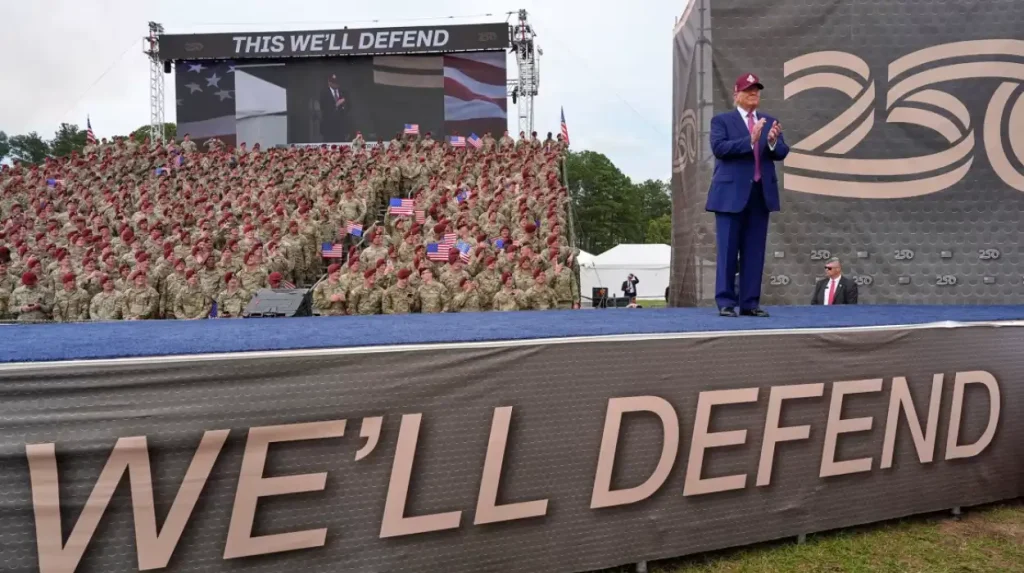
The president then depicted entire Los Angeles neighborhoods as being under the control of an invading force of international gangs and criminal networks in a highly political speech to troops at Fort Bragg, North Carolina, later Tuesday.
Is Trump using military power for political gain?
During calmer times, the president’s visit to Fort Bragg, which commemorated the 250th anniversary of the US Army, would not have garnered much attention. However, concerns over his authoritarian tendencies have been rekindled by his aggressive use of his commander in chief power.
How does Fort Bragg’s speech reflect authoritarian imagery?
Given that the military is meant to be a nonpartisan institution, Trump’s address, which at times could not be distinguished from a campaign rally, was startling. A commander in chief organizing troops for a mission on his behalf was the visual representation.
Such a backdrop has previously been Fort Bragg. When the public started to turn against the war in Iraq, President George W. Bush used it for a nationally televised speech twenty years ago in an attempt to regain support. This weekend’s massive military parade in Washington, which commemorates the Army’s 250th birthday, also seems ominous due to the way the present government is handling the situation in Los Angeles.
As he drove home from Fort Bragg, he turned up the music with an authoritarian attitude, making Los Angeles look like a city at war, which would make the deployment of active troops seem more appropriate.
What does Trump’s rhetoric mean for civil liberties?
His approach, which is becoming more aggressive every day, is similar to his assertions that he was elected president in 2020. At first, this looked ridiculous. On January 6, 2021, however, Trump’s demagoguery sparked a genuine rebellion against democracy and the federal government in the US Capitol. His allegation of a rigged election later won over millions of votes, leading to the biggest political comeback in history in 2024.
It is conceivable that the president might perpetuate misconceptions about the circumstances in California. Nevertheless, Trump frequently makes unfulfilled threats and exaggerated statements. Additionally, his government has not yet deployed military to engage demonstrators head-on in the streets of Los Angeles. Democrats objected on Tuesday when the Defense Department disclosed that the operation is costing $134 million, mostly because they are defending a number of government facilities.