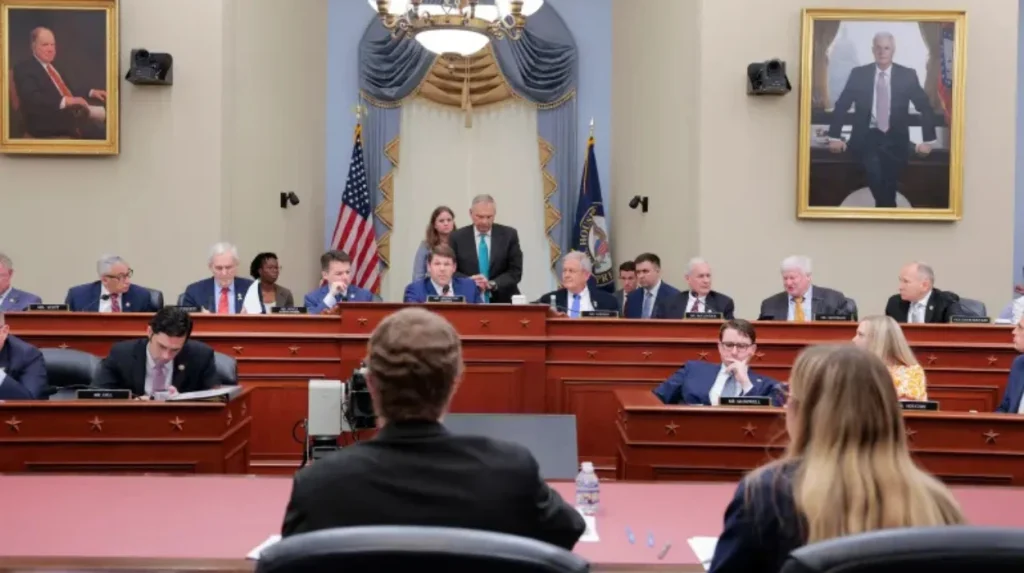
In a rare win for Trump and House Speaker Mike Johnson, a key legislative committee approved U.S. President Donald Trump’s comprehensive tax-cut measure on Sunday. The bill had been blocked for days by Republican infighting over budget cutbacks. Four hardline Republican conservatives on the House Budget Committee, who had stalled the plan on Friday, let it proceed during an unprecedented Sunday night session as they pushed for more significant expenditure cuts in private discussions with White House officials and Republican leaders.
What impact will the bill have on U.S. debt?
The law would increase the nation’s debt from $36.2 trillion to $5 trillion over the next ten years, according to nonpartisan economists. Moody’s downgraded its U.S. credit rating on Friday, citing the growing debt, which it claimed was expected to reach 134% of GDP by 2035.
The bill would increase defence spending, increase funding for Trump’s border and immigration crackdown, lower taxes on some tips and overtime pay, and prolong Trump’s 2017 tax cuts, which were his biggest first-term legislative accomplishment.
How did Republican hardliners influence the bill’s approval?
The hardliners want the full removal of the green tax credits that Democrats put in place, as well as further cutbacks to the Medicaid healthcare program for Americans with lower incomes.
The House Rules Committee will review modifications to the measure as it gets ready for a floor vote on passage once the budget panel approves it. Johnson is attempting to secure complete House support before the May 26 U.S. Memorial Day weekend.
Republican leaders were debating revisions to planned Medicaid work requirements, according to Representative Ralph Norman, another hardliner. However, he also advocated for a more significant cutback in federal medical assistance for those who are physically capable.
How are moderate Republicans reacting to the bill?
With a 220–213 majority in the House, Trump’s Republicans are split on how much spending should be reduced to pay for the tax cuts. Moderate House Republicans and a few Republican senators have opposed significant changes to Medicaid and nutritional assistance for the poor, arguing that they would harm the same voters who supported Trump in November and will be needed in 2026 when control of Congress is once again in question.
8.6 million individuals would lose access to Medicaid, the combined federal-state program for low-income Americans, as a result of the bill’s changes. Hardliners, however, maintain that the threat to the U.S. budget is far more serious.
What are economists saying about rising debt levels?
Meanwhile, economists caution that the downgrading by the final major credit agency was a glaring indication that the United States has too much debt and should force policymakers to either cut spending or raise revenue.
In 2017, Republicans in Congress similarly claimed that the tax cuts would boost economic growth and pay for themselves. Even when favourable economic impacts are taken into account, the Congressional Budget Office, which is impartial, calculates that the adjustments raised the government deficit by slightly less than $1.9 trillion over a ten-year period.
When Wall Street reopens on Monday, investors may be even more alarmed by Moody’s downgrading, which comes amid persistent economic uncertainty over Trump’s tariffs that have already agitated global markets. Since the Republican president returned to office in January, Trump and his administration have committed to balance the budget.
However, he has not been able to achieve his objectives of reducing government spending through Elon Musk’s Department of Government Efficiency. Additionally, as Trump alternates between raising tariffs and severing agreements, it is still unknown what kind of income would be generated by them. According to Johnson, the downgrading demonstrated the necessity of the tax package.