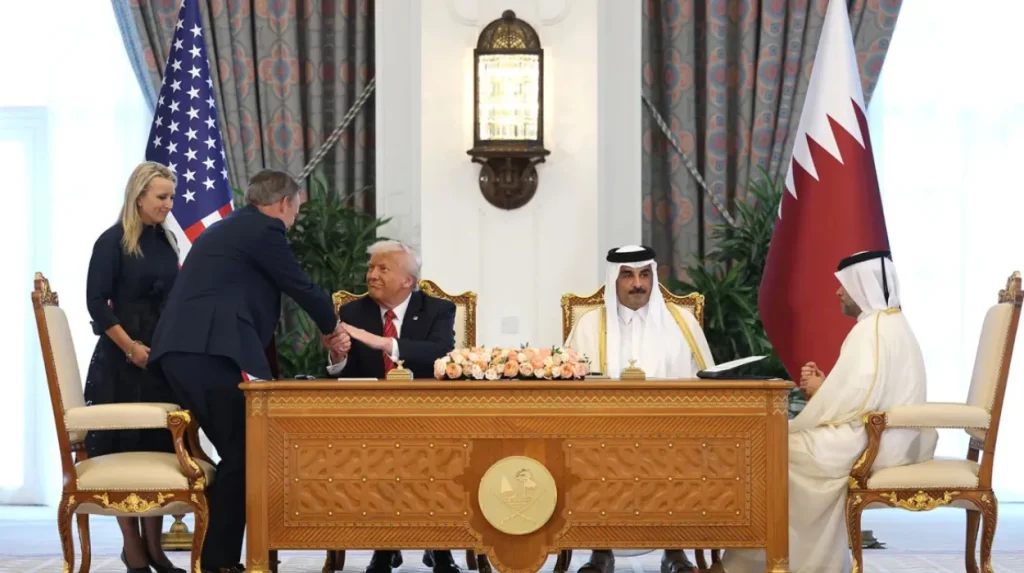
Donald Trump’s journey to the Middle East is about more than just camel parades, billion-dollar contracts, and a furore at home over Qatar’s pledge to give the president a new Air Force One. The region’s geopolitical jigsaw puzzle is being jumbled by a visit that the White House has carefully pitched as an opportunity for Trump to demonstrate his skill as a master negotiator.
Trump creates upheaval wherever he goes, which may lead to opportunities. He also takes chances, as seen by his decision to ease sanctions on Syria on this trip in order to offer a country devastated by conflict another opportunity. However, the action brings up an old concern regarding Trump’s whole trade and geopolitical strategy. Can he put forth enough effort to make real progress from the opportunities he creates?
Because of the White House’s infatuation with exalting Trump, his most important actions are frequently overshadowed by hype. Therefore, his meeting with Syrian leader Ahmed al-Sharaa in Riyadh on Wednesday received less notice at home than a contract for Qatar to purchase Boeing aircraft valued at tens of billions of dollars. The centrepiece of Trump’s trip may be the historic first meeting between US and Syrian leaders in 25 years.
Al-Sharaa was a rebel leader who swore loyalty to al Qaeda and had a $10 million US reward on his head before toppling the murdering dictator Bashar al-Assad. But in an effort to give his civil war-torn nation a chance to come together and save the lives of starving citizens, Trump sat with him and eased US sanctions on it.
Trump’s diplomatic ambitions on a regional scale are growing
Syria is only one example of Trump’s international upheaval. Clearly attempting to avert the looming threat of another Middle East conflict, he has used the trip to increase pressure on Iran to agree to limitations on its nuclear program while threatening military action if it does not.
His tour has also brought to light his growing dissatisfaction with Israeli Prime Minister Benjamin Netanyahu, who was once viewed as the 47th president’s ideological soulmate but is now a source of annoyance for Trump.
Behind the scenes, Trump’s team has been discussing ways to relieve the humanitarian catastrophe in Gaza, which has been brought on by Israel’s blockade and an assault that has killed tens of thousands of people, with officials from Saudi Arabia and Qatar. In reaction, Netanyahu said he had “no choice” but to continue fighting and attacked a hospital, targeting the Hamas commander who would be required for any peace negotiations.
There is no indication that the US-Israeli partnership is in danger. However, Trump’s evasion of the Israelis in a deal this week to rescue the last surviving American prisoner in Gaza, the US agreement to stop missile assaults by Houthi rebels in Yemen that excluded Israel, and the Syria sanctions decision have all caused rifts between him and Netanyahu.
In recent days, Trump’s attention was not just on the Middle East. Additionally, he had wanted to travel to Turkey for a shocking picture opportunity with Ukrainian President Volodymyr Zelensky and Russian President Vladimir Putin, which would have confirmed his so far fruitless endeavour to resolve their conflict. With neither opponent leader anticipated to attend Thursday’s negotiations, Trump was forced to postpone his plans for an unannounced side trip, significantly undermining his peace push.
Will Trump’s Syria gamble help or backfire politically?
One of Trump’s largest foreign policy bets to date in his second term is the decision to ease sanctions on Syria. The world still doesn’t know all the details of the complex diplomacy that must have preceded this choice. However, the action shows that Syria, which has been destroyed by years of civil conflict, is at a turning point, has a significant position on the regional map, and might degenerate into much more turmoil if it continues to worsen.
The president’s action reflects the readiness of several Middle Eastern and European officials to set aside their disgust for al-Sharaa’s previous actions for the sake of preventing a civil war from breaking out again.
Saudi Arabia and Qatar, who both wish to prevent the spread of turmoil in Syria, pushed for Trump to withdraw the sanctions. Additionally, Riyadh, Washington, and Doha want to keep outside powers from returning to Syria, which has suffered decades of foreign meddling from nations like Iran, Russia, Turkey, and Israel. Trump, however, is taking a chance.
Although outsiders view al-Sharaa as Syria’s greatest chance for peace, there is growing worry that his administration is failing to safeguard ethnic and religious minorities. Senior members of Congress in Washington, however, will want guarantees that he is expelling ISIS members before they consent to remove legally mandated penalties that the president is unable to waive alone.