The Oval Office has never witnessed a more acrimonious gathering. It wasn’t the hottest either.
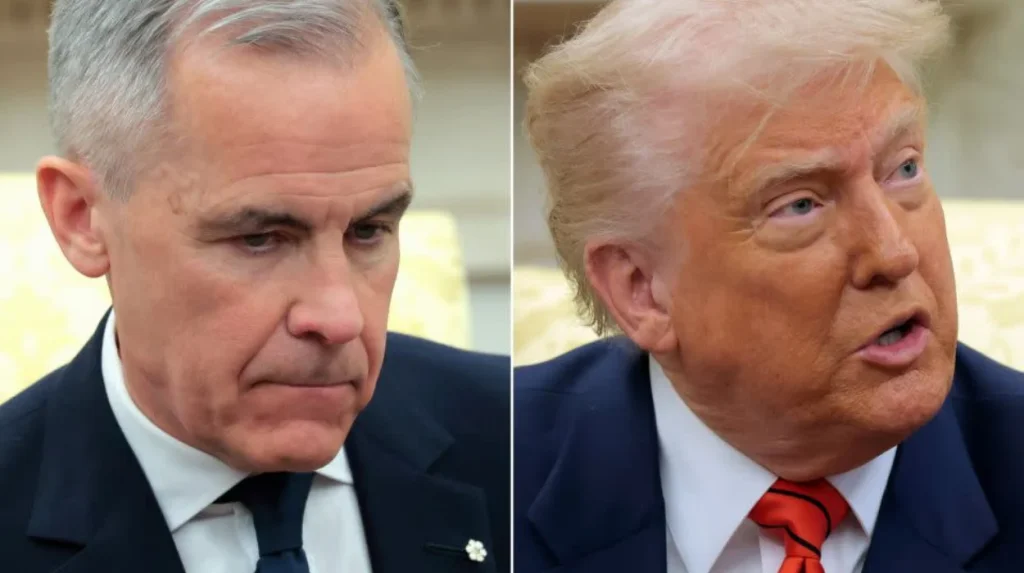
Rather, Tuesday’s much-anticipated encounter between President Donald Trump and his new Canadian counterpart, Mark Carney, was in the middle, neither overtly antagonistic nor overtly friendly, showing very little neighborliness—at least not the kind one wants to see in neighbors.
The noon discussions aptly demonstrated the new dynamic between the formerly cordial countries, whose 5,525-mile border—the longest in the world—once assured some collaboration but now, to Trump, signifies something quite different.
“Somebody drew that line many years ago with, like, a ruler, just a straight line right across the top of the country,” Trump said in the Oval Office as his meeting was getting underway. “When you look at that beautiful formation when it’s together – I’m a very artistic person, but when I looked at that, I said: ‘That’s the way it was meant to be.’”That is not how Carney believes it was meant to be.
“I’m glad that you couldn’t tell what was going through my mind,” Carney told reporters later that day about the moment Trump made that remark.
Carney did not, however, completely remain silent. The new prime minister’s opposition to the president’s goal of making Canada the 51st US state stood out in a meeting that was dominated by Trump’s remarks. Trump spoke 95% of the time about a wide range of subjects, from the Middle East to Barack Obama’s presidential library to the condition of high-speed rail in California.
“As you know from real estate, there are some places that are never for sale,” he said, drawing a begrudging “that’s true” from Trump before Carney carried on.
“We’re sitting in one right now. You know, Buckingham Palace that you visited as well,” he continued, as Trump nodded another “true.”
“And having met with the owners of Canada over the course of the campaign last several months, it’s not for sale,” he concluded. “It won’t be for sale ever.”
Carney effectively fulfilled his goal of coming to Washington by making it obvious that Canada would not be annexed by its southern neighbor with that declaration. Naturally, he has been saying that for weeks, but he spoke out the loudest during Canada’s federal election last month when his Liberals pulled off an unexpected comeback victory on a wave of anti-Trump anger.
Carney also used the sovereign to convey that Canada’s sovereignty was unquestionable by publicizing an impending visit from King Charles III, the country’s formal head of state, prior to his arrival at the White House.
Even while seated across from Carney in the Oval Office, Trump has not backed down in response to such communications, if he has heard them.
“Never say never,” Trump shrugged, while Carney repeatedly mouthed the word “never” beside him. “I’ve had a lot of things that were impossible to accomplish turn out to be possible, but only in a very cordial manner.”
Nevertheless, the president refrained from pressing the issue further, and the meeting proceeded as planned. For the time being, the Oval Office has defused a topic that has sparked a great deal of visceral rage in Canada. Carney informed Trump that it would not be “helpful” to reiterate his proposal to annex Canada after reporters had left the session.
He recalled the encounter at a post-meeting solo press conference, saying, “But he is the president, and he will say what he wants.” However, Trump hasn’t used the same invective against Carney as he used against Justin Trudeau, his predecessor. At a separate White House event later that day, Trump stated, “As far as calling him Governor Carney, no, I haven’t done that yet — and maybe I won’t.”
Trump had not previously committed to attending the G7 conference he is holding in Alberta, but Carney said they had decided to meet again next month. However, Washington-Ottawa relations are still at their lowest level ever. Carney was getting ready to leave for his meeting with Trump at Blair House, which is located across Pennsylvania Avenue from the White House when the president posted a tirade on Truth Social accusing Canada of being unduly reliant on the United States.
Trump suddenly stopped the discussion by saying that the US did not need Canadian steel or autos and that Carney could not do anything to persuade him to lower tariffs. However, it was all pretty moderate by the standards of the Trump White House, where earlier this year, another leader was reprimanded and removed from the Oval Office. Trump himself said that he has seen worse.