The concept of soft power has long underpinned the global influence of the United States, allowing it to shape outcomes through attraction rather than coercion. Cultural exports, diplomatic engagement, and institutional credibility have historically reinforced its leadership position. The ongoing Iran war, however, is placing that framework under visible strain, raising questions about whether military primacy is overtaking reputational capital.
The conflict with Iran is not only a geopolitical confrontation but also a test of narrative control. As military actions dominate headlines, the symbolic dimension of American power, its ability to persuade and inspire faces erosion. Observers increasingly argue that the gap between stated values and operational behavior is widening, complicating Washington’s claim to moral leadership.
How military escalation reshapes global perceptions?
The 2025–2026 escalation cycle has introduced new layers to how international audiences interpret American actions. The use of force, combined with assertive rhetoric, has amplified scrutiny across both allied and non-aligned regions.
Language and legitimacy
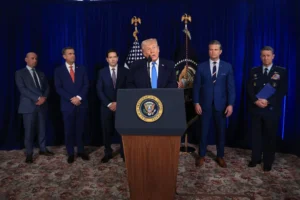
Statements from senior officials during the 2026 strikes have drawn attention for their tone as much as their content. Phrases emphasizing overwhelming force or deterrence through destruction have been interpreted by critics as inconsistent with the language of restraint traditionally associated with U.S. diplomacy.
This rhetorical shift matters because legitimacy in global politics often depends on perception rather than intent. When language appears punitive, it reinforces narratives that the United States prioritizes dominance over cooperation, particularly in regions already sensitive to external intervention.
Visual impact of warfare
Modern conflicts are mediated through real-time imagery, and the Iran war is no exception. Footage of strikes, infrastructure damage, and regional instability circulates widely, shaping public opinion beyond official narratives.
Such visuals create a lasting imprint. For many audiences, they overshadow diplomatic explanations and reinforce the association between American power and military action, reducing the visibility of softer instruments like humanitarian aid or cultural exchange.
Allied reactions and quiet recalibration
Even among allies, the Iran war has prompted cautious reassessment. European and Asian partners have expressed concern privately about escalation risks and the long-term implications for regional stability.
While formal alliances remain intact, the tone has shifted. Governments increasingly emphasize strategic autonomy, reflecting a subtle recalibration driven by uncertainty over Washington’s decision-making patterns during the conflict.
Institutional erosion and reduced outreach capacity
The weakening of soft power is not solely a consequence of military action; it is also tied to institutional changes that have reduced the United States’ ability to project influence through non-coercive means.
Decline of public diplomacy channels
Key institutions such as Voice of America and USAID have faced restructuring and funding pressures in recent years. By 2025, analysts were already noting a decline in their global reach.
In the context of the Iran war, this reduction becomes more consequential. Without robust communication platforms, the United States struggles to present its perspective directly to foreign publics, allowing competing narratives to gain traction.
Reduced cultural engagement
Educational exchanges, cultural programs, and academic partnerships have historically served as pillars of American soft power. These initiatives create long-term relationships that outlast political cycles.
However, the emphasis on security priorities since 2025 has limited investment in such programs. As a result, fewer opportunities exist to counterbalance the negative perceptions generated by the conflict, leaving a vacuum in people-to-people engagement.
The 2025 backdrop and shifting global sentiment
The Iran war did not emerge in isolation. It builds on trends that were already visible in 2025, when global confidence in U.S. leadership showed signs of decline.
Pre-existing skepticism
Surveys conducted in 2025 across multiple regions indicated that trust in American foreign policy had weakened compared to earlier periods. Concerns centered on unpredictability, unilateral decision-making, and reduced commitment to multilateral frameworks.
The Iran conflict has reinforced these perceptions. Rather than reversing skepticism, it has deepened doubts about whether the United States remains a stabilizing force in international politics.
Comparison with earlier conflicts
Analysts frequently draw parallels with the post-Iraq War era, when global approval of U.S. leadership declined sharply. While the contexts differ, the underlying dynamic is similar: military intervention reshaping reputational standing.
The comparison is not exact, but it highlights a recurring pattern. Each major conflict carries the risk of diminishing soft power gains accumulated over decades, particularly when outcomes remain uncertain.
Domestic divisions and their external signal
Internal debates within the United States also play a role in shaping its global image. The Iran war has intensified partisan divisions, which are closely observed by international audiences.
Public opinion fragmentation
Polling in early 2026 suggests that Americans are divided over the conflict, with significant portions expressing concern about escalation and long-term consequences. This division signals a lack of unified national consensus.
For foreign observers, such fragmentation raises questions about policy continuity. If domestic support appears unstable, allies and partners may hesitate to align fully with U.S. initiatives.
Democracy as both strength and vulnerability
The openness of American society allows for visible dissent, which historically has enhanced its credibility as a democratic model. Criticism of government policy demonstrates institutional resilience.
At the same time, persistent polarization can weaken the perception of coherence. When debates over the Iran war dominate domestic discourse, they can overshadow the values that underpin soft power, shifting attention to internal discord.
Strategic consequences for global influence
The erosion of soft power has tangible implications for how the United States operates on the world stage. Influence is not only about capability but also about acceptance.
Coalition-building challenges
Future efforts to build international coalitions may encounter greater resistance. Governments that question U.S. motives or reliability are less likely to commit resources or political capital to joint initiatives.
This dynamic complicates responses to global crises, where legitimacy and collective action are essential. Without strong soft power, leadership becomes harder to sustain.
Space for competing narratives
The decline in American soft power creates opportunities for other actors to expand their influence. Countries emphasizing non-interference and economic cooperation can position themselves as alternatives to a militarized approach.
This competition is not purely ideological. It reflects a shifting balance in how states evaluate partnerships, with reputational factors playing an increasingly important role.
Long-term implications beyond the Iran conflict
The Iran war may ultimately serve as a defining moment in the trajectory of American influence, depending on how its consequences unfold in the coming years.
Rebuilding credibility
Restoring soft power requires more than ending hostilities. It involves reinvesting in diplomatic institutions, cultural engagement, and consistent messaging that aligns actions with stated values.
Such efforts take time. The reputational effects of the Iran war, particularly in regions directly affected by its fallout, are likely to persist beyond the immediate conflict.
Memory and narrative formation
Global perceptions are shaped by collective memory. How the Iran war is remembered whether as a necessary intervention or a destabilizing episode will influence future attitudes toward the United States.
That memory is not fixed; it evolves through media coverage, political discourse, and lived experiences. The narrative that emerges will determine whether the conflict becomes a temporary setback or a lasting inflection point.
The deeper question is whether the United States can recalibrate its approach before the erosion of soft power becomes structural rather than situational. As the Iran war continues to redefine how American power is perceived, the balance between force and attraction remains unsettled, leaving open the possibility that influence in the modern era may depend less on what a country can do and more on how convincingly it can justify why it does it.