The national security team of US President Donald Trump is embroiled in a scandal following the accidental inclusion of a reporter in a messaging group where senior officials deliberated on attack strategies against the Iran-supported Houthi group in Yemen.
Trump and his team maintain that no “classified” information was exchanged in the Signal group chat involving The Atlantic’s editor in chief, Jeffrey Goldberg.
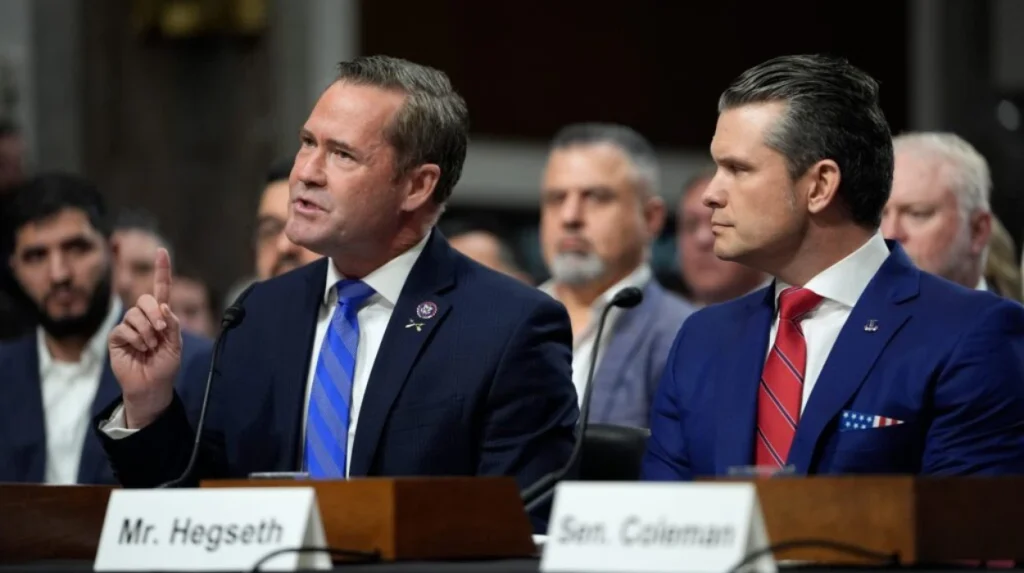
A conversation published by The Atlantic, first published on Wednesday, reveals the private discussions among Vice-President JD Vance, Secretary of Defense Pete Hegseth, CIA Director John Ratcliffe, and National Security Adviser Mike Waltz just hours prior to the attack’s launch.
The discussion features Director of National Intelligence Tulsi Gabbard (TG), her acting chief of staff Joe Kent, White House chief of staff Susie Wiles, deputy chief of staff Stephen Miller (S M), Secretary of State Marco Rubio (MAR), Ukraine and Middle East envoy Steve Witkoff, along with other senior officials.
What does this leak imply?
The Atlantic’s release of the nearly complete Signal chat among Trump administration officials, which details plans for assaults on the Houthis, could hinder the United States’ intelligence gathering efforts against the group and allow the militants to enhance their preparations for future military actions by the US.
Revealing the Signal chat could endanger US human sources, as the Houthis might suspect that the US’s capability to target specific Houthi military assets and individuals relies on intel from insiders. In conclusion, the Houthis might learn from the order of US military operations outlined in the Signal chat, finding ways to enhance the positioning of Houthi assets to reduce the impact of future US strikes.
There could also be a silver lining for the United States. The mention in the chat about the specific movements and locations of Houthi officials is likely to encourage the group to improve their internal communication, especially concerning the use of cell phones and the timing of their usage.
Although the negative impact on the United States could be substantial, the Houthi worries regarding their communications and intelligence could benefit the US. If the Houthis limit their cell phone usage and opt for verbal or written messages instead, their response to threats may become slower.
Moreover, internal spy hunts within the Houthi faction are likely to foster suspicion and mistrust among members, potentially undermining the group’s military effectiveness.
A reckless and politically-motivated bombing campaign
The leaked Signal conversation exposes a reckless and immoral approach to bombing. This is more of a political display than an actual war effort, focused more on signaling than on substantial action.
These attacks represent a significant escalation of the campaign that began during the Biden administration. The messaging indicates that the Trump administration is prioritising headlines over the broader implications of its actions against the Houthis. This conflict is being conducted remotely, with little regard for the destruction it causes. Civilian lives are treated as collateral damage, while the Houthis largely remain unharmed.
More concerningly, the leaked communications reveal officials celebrating these attacks with emojis, despite subsequent reports of significant civilian casualties.
The purpose of these attacks isn’t to weaken the Houthis; rather, they aim to convey a message to Iran and reinforce Trump’s critiques of the Biden administration’s attempts to deter the Houthis. At the same time, the highest-ranking Houthi leaders are enforcing security protocols to protect themselves from attacks, thereby minimising their exposure to strikes. In contrast, lower-level leaders and members face different circumstances that kill.
This bombing campaign does not represent a genuine attempt to weaken the Houthis, nor does it convey a coherent strategy for Yemen policy. Instead, Yemen is being used as a battlefield in an even broader war against Iran with little regard for the millions of Yemeni citizens who call the country home.