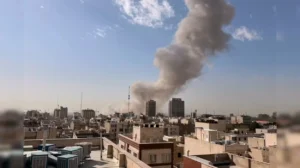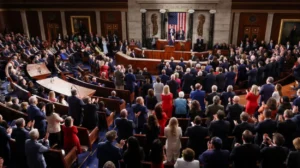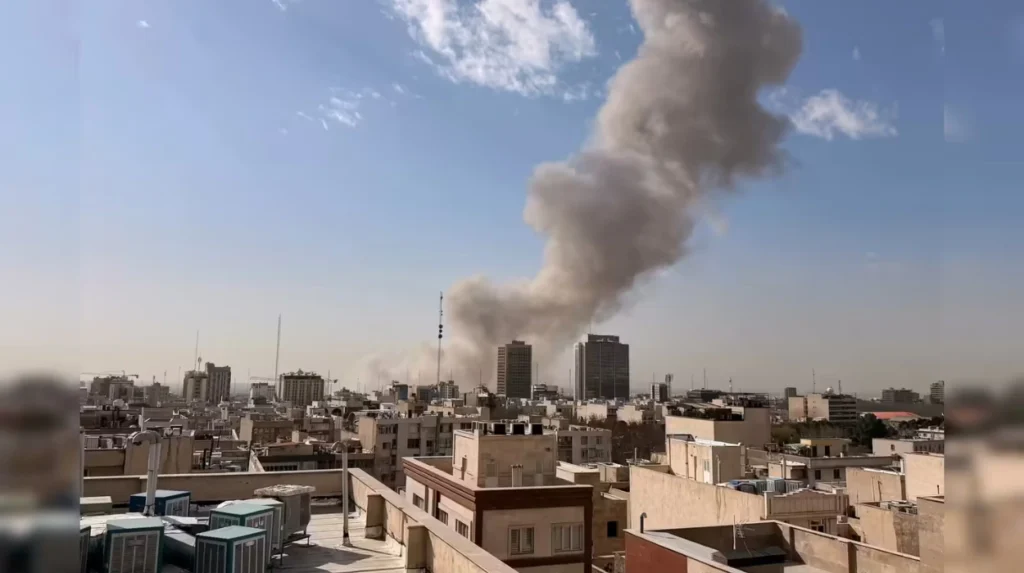
The emerging debate around Postponed Summits Depleted Arsenals reflects a growing reassessment inside Washington about the costs of prioritizing Iran operations at a moment when long-term competition with China dominates U.S. strategy. The Trump administration’s 2025 National Security Strategy emphasized shifting resources toward the Indo-Pacific, identifying China as the primary strategic competitor. Yet the escalation with Iran in early 2026 forced a rapid diversion of attention, assets, and diplomatic capital toward the Middle East.
The postponement of a planned summit between President Donald Trump and President Xi Jinping became an early signal of that shift. Originally expected to take place in March 2026, the meeting was delayed several weeks as U.S. military and diplomatic leadership concentrated on operations tied to maritime security and strikes connected to Iranian threats in the Gulf region. While summit delays are not uncommon in international diplomacy, the timing underscored how rapidly the operational environment reshaped U.S. strategic priorities.
Diplomatic Momentum Disrupted
Before the escalation, officials from both countries had been preparing discussions on trade tensions, critical minerals, and security stability in the Indo-Pacific. Diplomatic channels established during late-2025 negotiations were intended to stabilize a relationship marked by economic rivalry and military competition. When attention shifted toward Iran, the immediate effect was a pause in that momentum, creating uncertainty about how negotiations might proceed once leaders returned to the table.
Analysts observing US-China relations noted that Beijing often interprets scheduling changes as indicators of shifting leverage. While neither government publicly framed the delay as a strategic concession, the absence of early-year engagement removed an opportunity for Washington to reinforce its Indo-Pacific focus at a time when China has expanded diplomatic and economic outreach across Asia.
Signaling and Perception in Beijing
The delayed summit also carried symbolic implications. Beijing has carefully watched U.S. involvement in the Middle East, historically viewing extended commitments there as evidence of strategic overstretch. When Washington becomes heavily engaged in another region, Chinese planners often interpret the shift as creating additional maneuvering space in the Western Pacific, particularly in areas where strategic competition remains unresolved.
For U.S. policymakers, the episode highlighted how regional crises can ripple into broader geopolitical calculations, complicating attempts to maintain consistent signaling across multiple theaters.
Munitions Stockpiles Under Pressure
Alongside diplomatic consequences, the Postponed Summits Depleted Arsenals narrative has intensified scrutiny of the U.S. defense industrial base and its ability to sustain operations across multiple regions. Military campaigns targeting Iranian capabilities and intercepting retaliatory drone and missile launches have required significant quantities of precision-guided munitions and defensive interceptors. Many of these systems were previously prioritized for contingencies in the Indo-Pacific.
Defense analysts have observed that modern warfare places extraordinary demands on precision weapons inventories. Missile defense systems such as Patriot and THAAD interceptors, as well as air-launched precision weapons, require advanced manufacturing and complex supply chains. Sustained usage during active operations can quickly reveal limitations in production capacity, particularly when the same systems are intended to serve multiple strategic missions.
Lessons from Earlier Stockpile Debates
Concerns about munitions availability are not entirely new. During 2025, discussions in Washington focused on the strain placed on U.S. arsenals by global commitments, including support for allied operations and deterrence initiatives. Those debates prompted calls for accelerated production and expanded manufacturing partnerships. However, scaling up defense production often requires years rather than months, especially when rare materials and specialized components are involved.
The Iran operations have therefore become a practical test of whether the United States can sustain simultaneous deterrence commitments in both the Middle East and the Indo-Pacific without compromising readiness.
Industrial Base and Supply Chain Realities
Another element shaping the conversation involves the supply chain behind advanced weapons systems. Critical minerals and specialized manufacturing inputs remain concentrated in a handful of global markets, some of which intersect with China’s industrial dominance. Efforts initiated in 2025 to diversify supply chains and expand domestic processing capacity have begun but remain incomplete, leaving policymakers attentive to potential bottlenecks in future replenishment cycles.
These dynamics highlight how geopolitical competition extends beyond military deployments to include the industrial infrastructure that underpins long-term strategic capability.
China’s Strategic Observation of US Commitments
While Washington manages the operational realities of the Iran confrontation, Beijing has largely maintained a cautious diplomatic posture, calling for restraint while avoiding direct entanglement in the conflict. Chinese officials have emphasized stability in global energy markets and urged dialogue, positioning China as a stakeholder in regional calm while observing U.S. military commitments expand.
Indo-Pacific Implications
Security analysts monitoring the Western Pacific report that Chinese air and naval activity around contested zones has continued to evolve, including patrol patterns near Taiwan and within the South China Sea. These developments were already underway in 2025, but the diversion of U.S. strategic attention toward the Gulf has added a new dimension to the analysis. Allies in the Indo-Pacific are closely watching how Washington balances its commitments, particularly as regional deterrence relies on visible U.S. presence and rapid response capability.
Japan, the Philippines, and other partners have expanded defense cooperation and increased domestic investments in missile defense and maritime surveillance. These steps partly reflect long-term modernization plans but also demonstrate how allies respond when the strategic environment appears to shift.
Economic and Energy Dimensions
The Iran crisis has also influenced global energy markets in ways that intersect with broader geopolitical competition. Oil price volatility stemming from tensions near the Strait of Hormuz affects both exporters and importers, including China, which remains heavily reliant on imported energy. While higher prices can create economic pressure globally, China’s diversified supply relationships may help cushion sudden disruptions.
For the United States, however, domestic fuel price fluctuations often translate into political pressure, which can indirectly influence foreign policy decisions. The linkage between energy markets and public opinion has therefore become part of the broader context shaping strategic choices.
Domestic Policy Debate and Strategic Recalibration
Inside Washington, discussions about Postponed Summits Depleted Arsenals increasingly reflect a broader question about strategic sequencing. Some policymakers argue that addressing immediate threats from Iran is necessary to maintain deterrence credibility. Others contend that prolonged engagement risks diluting focus on long-term competition with China, which many strategists still view as the defining challenge of the coming decades.
Diverging Views Within Policy Circles
Former officials who helped shape earlier Indo-Pacific strategies have expressed differing interpretations of the current situation. Some maintain that responding decisively to Iranian actions reinforces global deterrence, while others warn that sustained diversion could undermine the strategic pivot outlined in 2025 policy documents. These debates illustrate how shifts in operational priorities can expose underlying tensions in national security planning.
Congressional hearings and think-tank analyses have revisited earlier assumptions about resource allocation, particularly the expectation that the Middle East would demand fewer direct U.S. military commitments as attention turned toward Asia.
Balancing Immediate and Long-Term Threats
For defense planners, the core challenge lies in maintaining readiness across multiple theaters without overextending the industrial base or diplomatic capacity. Modern conflicts rarely occur in isolation, and the Iran escalation demonstrates how quickly a regional crisis can disrupt carefully calibrated strategic priorities.
The delayed summit and concerns about weapons inventories serve as visible indicators of this balancing act. While neither development alone defines U.S. strategy, together they reveal how interconnected diplomatic scheduling, industrial production, and military operations have become in an era of global competition.
As policymakers continue to weigh the trajectory of the Iran confrontation against the broader contest with China, the interplay between immediate operational demands and long-term strategic positioning may determine whether the current moment becomes a temporary diversion or a turning point in how Washington allocates its focus, resources, and diplomatic attention across an increasingly complex global landscape.