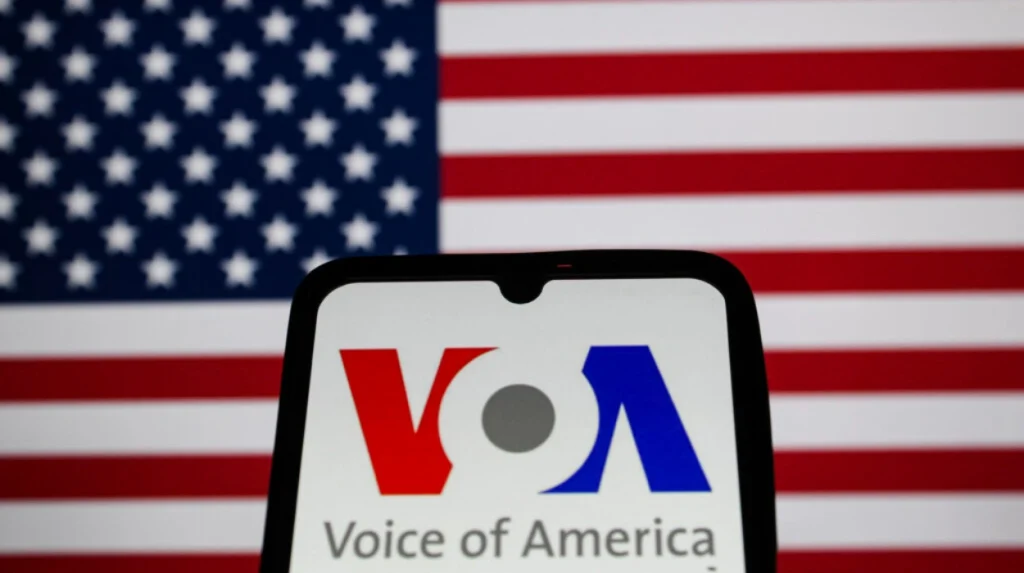
U.S. President Donald Trump has stepped in to shut down a series of notable US-funded international media platforms, including Voice of America and Radio Free Europe/Radio Liberty, as part of his efforts to slash government spending and reform US foreign policy. In a statement issued on March 15, the White House declared that this decision “will guarantee that taxpayers are not responsible for extreme actions.” propaganda.”
Those opposed to the move fear that it will intensify the positions of authoritarian regimes around the globe while causing millions of people in closed societies to be without independent access to information. Radio Free Europe/Radio Liberty CEO Steve Capus referred to the move as “a massive gift to America’s enemies.” He cautioned that the suspension would undermine the United States and would be welcomed by “the Iranian Ayatollahs, Chinese communist leaders, and autocrats in Moscow and Minsk.”
In authoritarian societies, many individuals find that outlets such as Voice of America and Radio Free Europe/Radio Liberty offer a reliable and unbiased alternative to a domestic information landscape that is frequently subject to heavy censorship.
As anticipated, the closure of Radio Free Europe/Radio Liberty and Voice of America received enthusiastic praise on prime-time Russian state television. For many years, authoritarian regimes, from Nazi Germany to Communist China, have complained about the impact of US-funded independent media outlets and have implemented various strategies to block them. Voice of America was founded in 1942 amid World War II, whereas Radio Free Europe/Radio Liberty was created in 1950 during the Cold War’s initial phase to offer uncensored news to those behind the Iron Curtain.
Over time, these outlets, as well as their numerous affiliates, have evolved into multi-media platforms, reaching hundreds of millions of people every week. This has never been completely altruistic; proponents argue that offering access to objective information overseas enhances the US’s standing internationally.
Before their abrupt recent shutdown, the Voice of America, Radio Free Europe/Radio Liberty, and various regional pro-democracy platforms, including Radio Free Asia, were managed by the US Agency for Global Media (USAGM). Despite accusations of political bias and doubts about their continued effectiveness in the United States, research shows that international audiences still value them as valuable sources of unfiltered information.
As a US government-funded network, the network adhered to journalistic standards similar to those of other state-funded media, such as the BBC. As a result of this independence from governmental editorial oversight, there have been a number of issues with American officials. Certain members of the Trump White House sought to defend the funding cuts by arguing that state-supported broadcasters had become too politicized and no longer aligned with the values the new administration aimed to convey.
The USAGM’s stable of media outlets has had an immediate impact on journalists who have been jailed or targeted by authoritarian regimes for their professional activities. There are currently ten journalists and staff members from USAGM-affiliated outlets being held in Belarus, Azerbaijan, Russia, and Myanmar.
There is no better time for Trump to shut down the United States international broadcasting network than now. As global conflict erupts between democratic and authoritarian camps in today’s multipolar world, information is a critical front in the struggle between the two camps. There is no doubt that China and Russia recognise this, as both countries dedicate vast budgets each year to supporting sophisticated international media activities under various guises. Previously, the US-dominated this soft power contest, but that is now no longer the case. Despite generations of autocratic regimes, the Trump administration has finally silenced Voice of America itself.