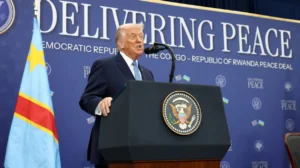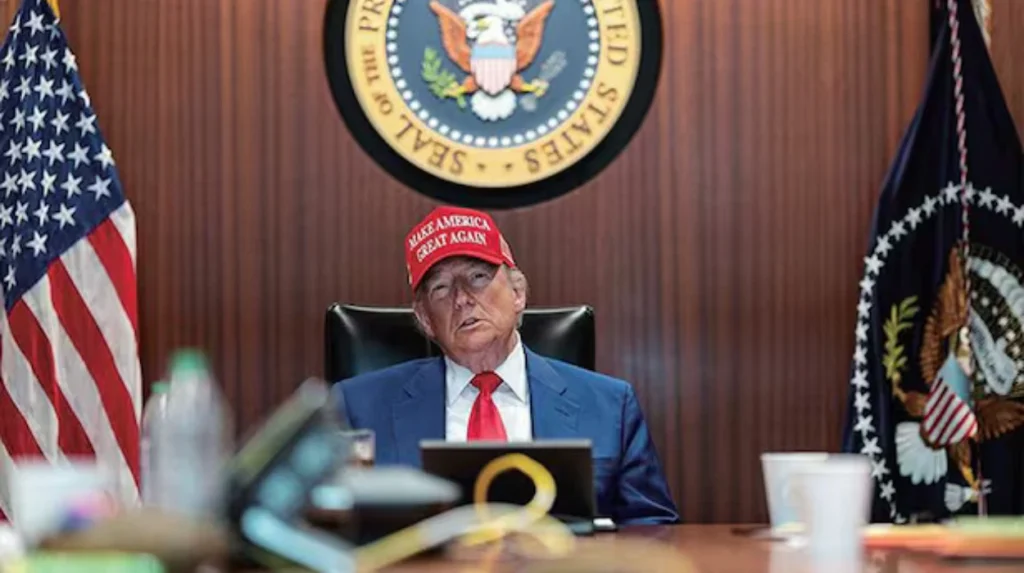
President Donald Trump announced what he called a 10 to 15 day time frame during which Iran can achieve a nuclear agreement with Washington or face unspecified but truly dreadful consequences. The ultimatum of 10 days replaced the idea of diplomatic involvement directly in the form of the race against time instead of the unlimited negotiation.
The warning was issued when Trump made comments at a foreign policy meeting held at the White House, where he associated diplomacy with deterrence. He said that Tehran would have to decide which one of the negotiated solutions and decisive consequences. The tightened schedule is in line with the resumed indirect negotiations in Geneva as well as an upcoming board meeting of the International Atomic Energy Agency.
The words are an indication of a push to put urgency in stagnant diplomacy. It also highlights a trend whereby due dates have been accompanied with overt military placement that supports the validity of threats and reduces the scope of politics.
Military buildup as negotiating leverage
The 10-day ultimatum coincides with the greatest concentration of the US forces in the Middle East since the 2-decade past. Operational readiness has been increased with the USS Gerald R. Ford carrier strike group deployed to the eastern Mediterranean as well as the addition of other naval assets to the Gulf. Pentagon officials have justified the buildup as being defensive and precautionary but its magnitude gives Washington numerous military contingencies.
Bases have been reportedly on the increase in alert level and intelligence, surveillance and reconnaissance flights have stepped up as well. These actions are aimed to be a warning of readiness without acute upsurge. According to analysts, force projection is not aimed at a diverse war plan but rather as a tool of diplomacy.
This pressure by posture, negotiating by intermediaries practice is a doctrine that Trump perfected during his first term and had to adjust after the 2025 attacks on Iranian nuclear plants.
Spectrum of strike options
Options that are being considered by policy planners are thought to include narrow attacks on enrichment plants as well as wide-scale attacks on missile and command centres. According to the administration officials, whatever will be done will be toned down to elicit negotiation and not a full scale war.
Nevertheless, even small-scale strikes are at risk of escalation. The asymmetric capabilities exist in the form of regional allies and ballistic missile forces. The US presence in the area is aimed at discouraging pre-emptive revenge as well as reassuring the regional allies that Washington is ready to respond to contingencies.
Operation Midnight Hammer’s strategic shadow
The situation at hand can be defined by the operation Operation Midnight Hammer in June 2025, when the US forces attacked Iranian nuclear-related sites due to the results of intelligence operations regarding the accelerated enrichment. President Trump would later state that the move had succeeded in burying the immediate break out route of Iran, although independent analysts stated that knowledge and far-flung capabilities had not been eliminated.
After such attacks, Iran did not retaliate on a large scale, but instead rebalanced its stance by increasing domestic restrictions in times of unrest towards the end of 2025. This self-limitation has affected the analysis by Washington that Tehran can focus on preserving its regime rather than escalation.
The 10-day ultimatum should be thus seen in the context of manifested US readiness to employ force. It is a threat which is rooted in recent precedent and not a theoretical threat.
Strategic constraint and calculation
Operation Midnight Hammer left Iran with little maneuvering space though without the leverage. Tehran still has the capacity to enrich and bargaining chips based on lifting of sanctions. The management is now faced with the decision of whether we should make small compromises in order to avoid another strike or we should fight back since this would enhance credibility in the negotiation.
Intelligence estimates released by the US in early 2026 allegedly state that Iran has a counteroffer which is supposed to save enrichment rights but with improved surveillance. It is not clear whether such an offer will meet the demand of Washington that Iran should never get a hold of nuclear weapons.
Diplomatic channel under compressed timelines
On 26 February under Omani mediation, indirect conversations were re-initiated in Geneva. US envoy Steve Witkoff described previous negotiations as positive, although no outline has been spelled out. The foreign ministry of Iran indicated its willingness to negotiate although it restated that enrichment on the issue of civilian purpose is a matter that is not negotiable.
This tightened time schedule adds to the diplomatic situation. The negotiators have to fill the gaps of substance in the negotiation and deal with domestic politics on both parties. This brevity of the ultimatum can be to avoid lengthy bargaining, but it also restricts room to compromise in small steps.
IAEA scrutiny and UN implications
The IAEA Board of Governors will convene on 2 March and there might be a possible censure resolution in which the issues concerning the compliance of Iran will be reverted to the UN Security Council. Director General Rafael Grossi has lately commented that there is not much time available to achieve a tangible understanding, and the gap in monitoring has been of institutional concern.
The fact that the 10-day ultimatum coincides with the IAEA calendar increases the pressure of diplomacy. Referral to the Security Council may provoke the new multilateral sanctions, which increases the US leverage, but makes Iran more resolute.
Regional and global reactions
European authorities have been alarmed by the fact that strict deadlines can diminish chances of a gradual compromise. The EU diplomats have pushed parallel de-escalation plans fearing another conflict in the Middle East due to consistent pressure by Ukraine.
Moscow on its part has urged restraint and has not broken the economic and defense relationship with Tehran. The trend was redefined in 2022-2024, when Russia acquired Iranian drones in its war in Ukraine, which revised the concept of the role of Iran in the region. Washington uses cooperation as an indicator of destabilization behavior and hence its argument on harsh enforcement.
Energy markets and strategic chokepoints
The ultimatum has been met with sensitivity in oil markets, as fears of a Strait of Hormuz disruption have been experienced in oil markets in the form of price volatility. Even minor aggression would impact on shipping routes, insurance premiums and international supply chains.
Gulf states are juggling between deterrence cooperation with Washington and silent diplomatic engagement with Tehran. Local forces remember how quickly the situation had spiraled beyond expectations in the previous deadlines and strikes in 2025, when Israeli actions resulted in direct conversations before de-escalation lines were restored.
Calculations in Tehran and Washington
The leaders of Iran are facing economic tightrope due to sanctions and domestic discontent that escalated towards the end of 2025. The submission of strict nuclear restrictions may be a financial burden, although this might lead to criticism of its hard-line constituencies. It may solidify nationalism but put the infrastructure at risk of new attacks in response to the rejection of the ultimatum.
The lack of transparency concerning the process of succession of Supreme Leader Ali Khamenei contributes to the mystery in the decision-making process. Stability calculations can play a role in determining how far Tehran is going to test the determination of Washington.
US political dynamics
The 10-day ultimatum has strategic and political purposes to President Trump. The message of determination to stop nuclear proliferation fits with the promises of the campaign, as well as the outreach to the constituencies that do not trust multilateral treaties. Simultaneously, the long-term warfare would be incompatible with the commitments against the open-ended wars.
Balancing credible coercion with war avoidance requires precise calibration. A limited strike could be framed as enforcement; a broader conflict would carry economic and electoral consequences.
The 10-day ultimatum compresses years of mistrust and negotiation fatigue into a narrow decision window. Each side seeks leverage without surrendering core interests, yet both understand that miscalculation could trigger consequences neither fully controls. As carrier groups hold positions and diplomats shuttle between capitals, the question is not only whether a deal emerges, but whether deadlines sharpen clarity or merely accelerate confrontation. The coming days will reveal whether urgency can unlock compromise or whether time pressure itself becomes the catalyst for a new and uncertain phase in the nuclear standoff.