The Arms Dilemma in Southeast Asia has escalated to a more acute level after the February 6, 2026 executive order of President Donald Trump to reorganize the U.S. arms exports under an America First model. The order codifies a precedence rubric according to which weapons access is tied to an economic reciprocity, cooperation in the critical minerals sector and proven self-defense expenditure. Instead of putting exports in established commitments of the alliances, the structure brings to the fore the value of the direct transaction.
In the fiscal year 2025, the U.S. recorded the largest exports of arms of over $238 billion, but Southeast Asia did not receive more than five percent of the total. With the order in place, sanctions to some regional allies have been delayed, including those that were earlier on board with Washington maritime security policies. The change is an indication that ideological conformity or past collaboration is no longer a pass to privileged treatment.
This re-reading captures a wider interpretation of the 2025 National Security Strategy, which focuses on reciprocity and domestic industry renewal. The exports of arms are not only placed as deterrence measures but also as a way of restoring American production capacity by bringing in foreign capital.
Rubric’s Regional Impact
The new criteria have drawn a configuration of the Southeast Asian continent in clear beneficiaries and limited partners. Geography, access to minerals and defence budgets have become determining variables in the Washington calculus.
Prioritized Beneficiaries Emerge
The Philippines is conspicuous under the rubric. It is close to Taiwan within a region of less than 100 miles of the southern tip and this makes it the center of U.S. contingency planning. Continued maritime conflicts with China in the South China Sea put Manila in a close position to the Washington deterrence position. Consequently, negotiations on the sale of F-16s have remained vibrant amid financial constraints on the budget of the Philippine defense.
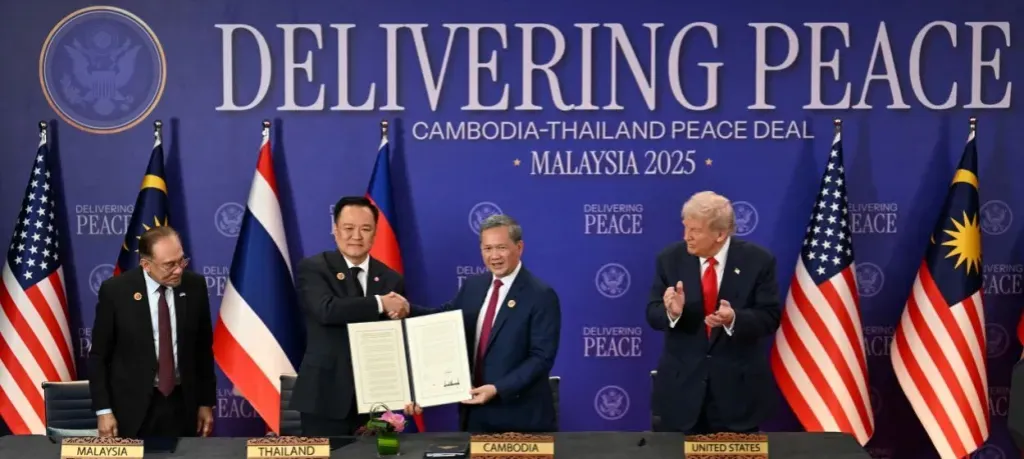
The situation in Cambodia is another but equally educational. Its U.S. weapons embargo was lifted later in 2025, after a ceasefire deal and a critical minerals agreement had been signed on a visit by Trump to the ASEAN summit in Malaysia. The correlation of mineral permissions and access to the security highlights the economic-security amalgamation that is inherent in the rubric. Nonetheless, financial limitations are still present. The U.S. fighter planes cost approximately 80 million dollars each, which is far much more than the Chinese equivalents, and this prohibits the extent to which diversification Phnom Penh can actually achieve.
Singapore has an advantage of its strategic port infrastructure and high financial capability even though its defense spending is less than the 3.5 percent of GDP informal threshold set by the administration. Its capacity to accommodate high-value systems makes it a strong and trustworthy associate within the new model.
Marginalized Strategic Partners
There are examples of Vietnam and Indonesia that depict the restrictive aspect of the rubric. They both have become closer to maritime coordination with Washington over the past few years. But neither meets the new requirement of geography directly connected to the situation in Taiwan nor can be compared to the investment levels desired in personal defense procuring.
In early 2026, Defense Secretary Peter DeSombre had made trips to Hanoi and Jakarta, which once again supported rhetoric of cooperation but did not result in any tangible arms accords. As countermeasures, both nations have intensified the diversification deals, experimenting with the South Korean and European vendors. These changes are indications of pragmatic hedging as opposed to ideological realignment.
Malaysia and Thailand have not achieved any major U.S. hardware approvals even though the two countries signed mineral agreements in October 2025. The lack of budgetary resources and the uneven correspondence with the requirements of the rubric seems to limit the results. In the meantime, Laos and Myanmar, with unexploited mineral resources, have become the subject of speculative debate on the possible strategic merit to Washington, and the new strategy is fluid and unpredictable.
The announcement of sales by the U.S. ambassador Brent Christensen on February 10, 2010, Bangladesh complicates the story even more. The agreement appeared even though Dhaka failed to comply with the essential geography or expenditure requirements indicating that there is flexibility in the system. These deviations threaten to affect predictability which is a pillar of defense planning.
Strategic Realignment Pressures
With the selective approvals emerging, the overall security structure is stretched. The governments of Southeast Asia had a long tradition of striking a balance between the major powers and keeping a diversified procurement portfolio. The new rubric makes that balancing act more serious.
Diversification And Fragmentation Risks
The states that cannot reach the transactional standards of Washington would tend to increase sourcing to Australia, India, Japan, South Korea, and their European suppliers. Others might keep having modest interactions with Russia or China where cost-effectiveness will be the defining factor. This can be seen as the procurement fragmentation that will water down interoperability in U.S.-led Indo-Pacific formations at the moment when unity is central in combating the assertiveness of Beijing in the ocean.
The White House has justified the order as necessary to use foreign purchase in order to restore the industrial capacity of the United States. The bottlenecks in the supply chain revealed in 2025 also strengthened the worries regarding the resilience of domestic production. The focus on high-spending or reciprocal partners of an economic kind is twofold by reducing the strain on production and enhancing the deterrent component of strategy.
However, analysts caution that the skewed implementation might create a perception of non-trustworthiness. The regional policymakers who are used to decades-long defense discussions are now faced with more metrics negotiation in shorter terms. The change modifies the psychological basis of the alliance management.
Economic Security Integration
Majority minerals have now become a bargaining chip. The agreement of October 2025 of Cambodia demonstrates how the rights to rare earths and other strategic inputs may open the doors to relief on the embargo and possible hardware transfer. The model resembles the previous summit diplomacy by Trump, which involves economic tradeoffs in the security interactions.
The fact that mineral access is now part of defence export decision making is also an indication of the larger project by Washington to counter China dominance in refining and supply chain. In using arms as leverage to securities of resource deals, the United States aims at redrawing industrial and security reliance concurrently.
The picture is however complicated by variability in application. The apparent exception of strict standards of rubrics in Bangladesh creates ambiguity. When criteria are viewed to be negotiable, partners will wonder whether compliance will provide predictable returns.
Broader Geopolitical Ramifications
The new export policy aligns with the focus of the 2025 National Security Strategy of deterrence via selective strengthening. Arms transfer is developed as being a strategic multiplier that is reserved to either compliant or high-value partners. This message was further reinforced by the Department of Defense in February 2026 when it put a priority on states with progress on shared operational objectives.
In the case of Southeast Asian governments, the consequences are short-term. The defense planning cycles are usually decades long, but the rubric puts conditionality on procurement decisions in shorter terms. The governments are now openly balancing mineral concessions, budgetary allocations and geopolitical positions against access to superior U.S. systems.
Concurrently, threat perceptions are still being influenced by the growing presence of China in the South China Sea. A third of world trade goes through these disputed waters making the stakes high. The security mosaic could be more fragmented but not weaker as a result of Washington being more selective in strengthening the front-line states like the Philippines and pushing other states into alternative suppliers.
The evolving pattern suggests that Southeast Asia’s Arms Dilemma is less about choosing sides and more about negotiating leverage within a shifting hierarchy of value. As 2026 unfolds, each mineral contract, each deferred approval, and each diversified purchase will signal how durable this transactional doctrine proves and whether strategic reciprocity can sustain long-term deterrence in a region where alignment has always been fluid rather than fixed.