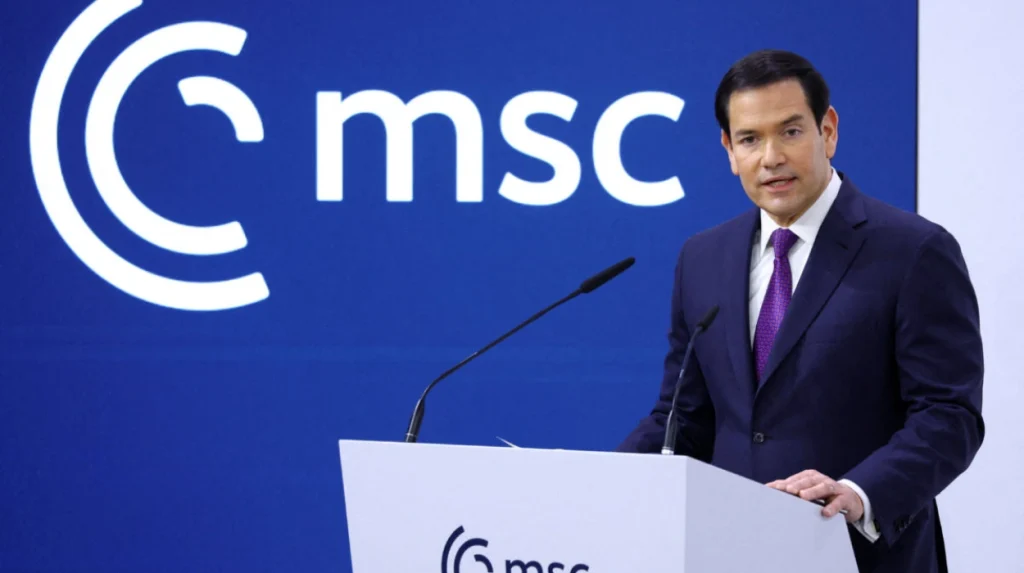
The speech by the U.S. Secretary of State, Mr. Marco Rubio, received a warm ovation at the Munich Security Conference, where he stated that the United States and Europe were historically and culturally intertwined. The ovation, however, masked the confrontational policy contained in the speech.
European leaders, still reeling from the aggressive speech delivered by American Vice President JD Vance at last year’s conference, seemed to breathe a sigh of relief at Rubio’s more conciliatory tone. But the message behind the words remains unmistakable: Europe needs to fundamentally shift its political, cultural, and strategic course—otherwise, it will be ignored by Washington.
From Vance’s Culture War Rhetoric to Official U.S. Strategy
Vance’s accusations of suppression of free speech, undermining of democracy, and civilizational decline in Europe last year were met with much disdain and dismissal by European leaders. However, these arguments have now entered the U.S. national security policy, which suggests that what was earlier perceived as political rhetoric now appears to have entered the realm of U.S. strategy in dealing with its allies.
Rubio did not have to resort to using the harsh words of Vance to put forward his views. Instead, he chose to deliver the same message in a more composed tone.
Demands for a Reformed Europe
He emphasized that the United States is still ready to “rebuild” the relationship with Europe, but on American terms. He encouraged Europeans to take more responsibility for their own defense and to undergo an ideological shift.
His speech espoused values such as a greater embrace of Christianity, tighter border controls, and a rejection of aggressive climate change policies. In other words, Rubio informed European nations that reform must go beyond their defense policies and include a shift in their cultural and political values. Rubio said that Europe and America “belong together,” but this message also conveyed a warning to Europeans that strategic abandonment could be on the horizon if they do not adapt to American values.
“Wrecking Ball Politics” and Europe’s Political Vulnerability
The conference organizers had issued a report prior to the meeting that warned that the world had entered an era of “wrecking ball politics,” and Europe finds itself marginalized in the process. Rubio’s comments were an outright challenge to the leaders of the European liberal centrists and brought him closer in line with their populist challengers at home.
Just the day before, German Chancellor Friedrich Merz had stated that Europe did not need to import the culture wars from America. French President Emmanuel Macron had defended the right of Europeans to regulate misinformation and protect democracy. Rubio’s speech dismissed both claims.
Ukraine’s War Overshadowed by Ideological Disputes
One of the most urgent and emotionally charged speeches came from Ukraine’s President Volodymyr Zelensky, who reminded the audience that the security crisis caused by the Russian invasion remains the defining issue in Europe. Zelensky spoke of the destruction of Ukraine’s infrastructure, stating that every power plant had been destroyed and that every kilometer of territory seized by Russia had come at a cost of 156 Ukrainian lives.
Zelensky spoke out against peace narratives that call on Ukraine to make concessions while sparing Russia, and he made light of the “Anchorage spirit,” which allegedly represents a series of clandestine meetings between the U.S. and Russian leaders. The speech, which included images of Ukrainian technology destroying Russian drones, provided a stark contrast to the more theoretical arguments that dominated the conference.
His presence underscored a deeper point: while Europe debates values and politics, Ukraine is fighting for survival.
A Transatlantic Relationship Deeply Strained
The positive reaction of Europeans to Rubio’s speech further proved how tense the relationship is. The tension surrounding Ukraine, as well as Trump’s controversial comments about Greenland, has created a sense of uncertainty for Europeans about their relationship with Washington. It is interesting to note that Rubio did not make any comments about Greenland, which was on the verge of a major crisis just weeks ago. The fact that it was not mentioned shows how easily a major conflict can be forgotten while underlying tensions persist.
Mixed Signals on Russia and Peace Negotiations
During the question-and-answer session, Rubio said that the Trump administration was unsure of Russia’s commitment to making peace, which was also echoed by the Europeans. This was different from Trump’s earlier claims that Russian President Putin was ready to make a deal, and that Ukraine was also willing to make concessions.
Such ambiguity is also an indication of the internal divisions within American policy circles, as well as the uncertainty surrounding Washington’s long-term strategy.
Europe’s Leadership and Defense Dilemmas
The conference also revealed the continued challenge in Europe to move from words to action. While there have been repeated promises to boost defense spending, there are budget constraints, political scandals, and elections to deal with in Europe.
The next conference could coincide with significant political changes in the United Kingdom, France, as well as midterm elections in the United States. The political uncertainty in the United States and Europe may continue to capture the headlines, including the Ukraine conflict.